
When did forex trading start? Most pages give you a year — 1971, when the dollar left gold, or 1973, when the big currencies began to float. I suppose each of those is an answer too. But for me the question has two halves, and the second half is the one a trader needs. When did forex trading start for people like you and me, with a terminal and a small account? That date is much closer — 1996 for the first web platforms, and 1 July 2005 for MetaTrader 4.
So this page gives both halves. One is the history of forex trading as a market — gold, Bretton Woods, the float. The other is the history of the trader’s tools — the screen, the platform, the robot. Below are the four dates I come back to most often, and then the story behind each of them.
| อะไร | เมื่อ | สิ่งที่เปลี่ยนแปลงไป |
|---|---|---|
| Coins and money changers | Lydia, 6th century BC | Swapping one money for another became a trade |
| Modern forex market | มีนาคม | Exchange rates became prices that move every second |
| Online forex trading | 1996 | Private traders got a screen and a live quote |
| การซื้อขายอัตโนมัติ | 1 2005 กรกฎาคม | MetaTrader 4 gave the trader a robot |
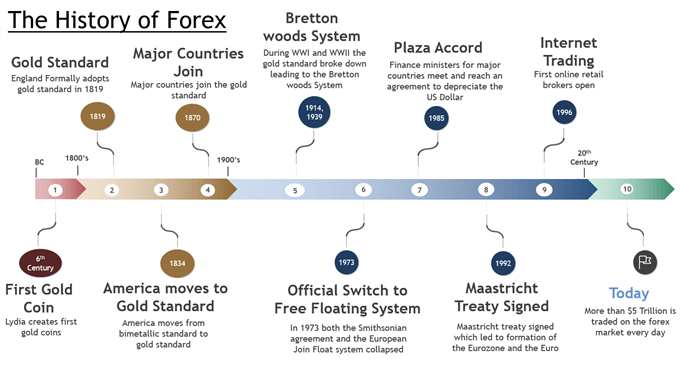
History of forex trading, briefly
What was a currency before 1973? For most of history it was a weight of metal. Coins with a fixed weight and purity appeared in Lydia, in what is now Turkey, in the sixth century BC. From that moment swapping one city’s coins for another’s was a job. The money changer is the oldest ancestor of the forex dealer. He had a bench, a scale and a margin — and that part has not changed.
Who started forex? Nobody did. There was no founder, no exchange and no opening bell. Merchants in Venice, Amsterdam and London kept exchanging coins and bills for centuries, and the trade grew with the trade routes. When people ask who started forex trading, the only fair answer is a long line of money changers whose names nobody wrote down.
The gold standard of the nineteenth century made things simple. Every major currency was a fixed weight of gold, so every exchange rate was fixed too. A rate could drift only inside the cost of shipping gold from one country to another. There was nothing to trade.
The next system was built on paper, not metal. In July 1944 delegates from 44 countries met at เบรตตันวูดส์ in New Hampshire. They tied the US dollar to gold at $35 an ounce, and every other currency to the dollar inside a 1% band. The same meeting created the IMF and the World Bank. The dollar became the unit everything else was measured in, and it still is — in April 2025 it was on one side of 89.2% of all forex trades.
Bretton Woods lasted 27 years. On 15 August 1971 President Nixon closed the gold window, and foreign governments could no longer swap their dollars for gold. The Smithsonian Agreement of December 1971 tried to save fixed rates with a devalued dollar at $38 an ounce and wider bands, and it failed within 15 months. From March 1973 the major currencies floated.
So when did the forex market start in its modern form? In March 1973. This is the date most people mean when they ask when forex started — and it is the one I would put in an exam answer.
For me the useful way to say it is this. Currency exchange is about 2,600 years old. The forex market — a place where the exchange rate itself is the price you trade — is 53 years old. So when did forex start — 2,600 years ago or 53? Both numbers are right. They answer different questions.
Fixed rates and floating rates
ก่อนเดือนมีนาคม พ.ศ. 1973
The rate is a number in a government table.
It changes by decree, a few times in a decade.
Banks buy currency for trade and travel, not for profit.
No night session. Nothing moves after the banks close.
Dealers work by phone and telex.
After March 1973
The rate is a price with a bid and an ask.
It moves every second, measured in pips.
The rate gap between two central banks drives a pair.
The market follows the sun from Sydney to New York.
Dealers get a screen in 1981. Traders get one in 1996.
What changed for a trader in March 1973? Everything that makes a chart worth opening. The first change was the price itself. Under a peg the rate was a number in a government table. Under a float it has a bid and an ask, it moves every second, and the distance it moves is measured in pips. One pip on EUR/USD is $10 on one standard lot and $0.10 on a 0.01 lot — the คู่มือ pip goes through that arithmetic.
The second change was the driver. Once rates could move, money began to flow towards the currency with the higher interest rate, and the gap between two central banks became the main engine of a pair. This is why a trader in 2026 reads Fed and ECB statements, and why the hawkish vs dovish guide exists on this site. A central bank does not trade the most. It sets the number every other participant prices from.
The third change was the clock. Under Bretton Woods nobody needed a 24-hour market, because the rate was not allowed to move at night. After 1973 the market followed the sun. The first forex market to open each week is Sydney, on Monday morning local time. Tokyo follows, then London, then New York, and the busiest hours are the ones when London and New York are both open.
The fourth change was the screen. Dealers moved from phone and telex to the Reuters dealing terminal in 1981 and to the EBS matching system in 1993. The market was electronic from then on, but closed — a bank talked to a bank, and nobody else could see the quote.
The dollar at the centre
Why is the dollar on both sides of so many trades? Because of 1944. Bretton Woods made the dollar the unit everything else was priced in, and the float of 1973 did not undo that — it only let the price move. The Bank for International Settlements counts the market every three years. In its แบบสำรวจเดือนเมษายน 2025 the dollar was on one side of 89.2% of all trades, up from 88.4% in 2022.
Share of trades each currency is on, April 2022 and April 2025. The shares add up to 200% because every trade has two currencies. Data from the BIS Triennial Survey published 30 September 2025.
Two lines on that chart deserve a trader’s attention. Sterling lost the most, from 12.9% to 10.2%. The renminbi kept rising to 8.5%, and turnover in USD/CNY grew 59% in three years. The euro, the second currency since its launch on 1 January 1999, has been losing share since 2019. I do not trade the renminbi and my robots do not either, but the direction of that line is the one piece of forex history that is still being written.
From the first web platform to the robot
When did online forex trading start? The usual answer is 1996 — the year the first web platforms for private traders appeared and a live exchange rate stopped being bank property. I have not found a document that fixes the first online trade to a day, so I give the year the way most histories do, as a year. Before 1996 the market was electronic but shut. After 1996 anyone with a modem could see a quote, and a few years later anyone with a credit card could trade on it.
The early retail years were wild — leverage of 400:1 was common, spreads were wide, and the broker was usually the other side of your trade. The rules came later. In 2010 the US regulator capped retail leverage at 50:1 on major pairs, and in 2018 the European regulator ESMA cut it to 30:1. If you ask when did online forex trading start and when it became a market with rules, those are two different decades — the late 1990s and the 2010s.
For me, though, the retail market has a different birthday. On 1 2005 กรกฎาคม MetaQuotes released MetaTrader 4, and with it the MQL4 language. That was the day a private trader got not only a chart but a robot. A robot here means a program that reads the bars, places the order and logs the result while you sleep. MetaTrader 5 followed on 1 June 2010. Most pages count 1996 as the start of online forex trading. I count 2005 — the trader I write for does not click, he runs code.
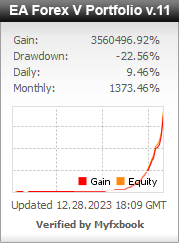
That is also why my own history is short. The backtests behind the พอร์ตโฟลิโอ Forex V start in 2014. I do not run them on 2005 quotes, because the spreads, leverage and execution of that market are not the market my robots trade in today. Even the real account I stream on YouTube has a shorter statement than I would like, because the broker keeps only part of the history on its server. A trader’s history is always shorter than the market’s.
Pegs that broke
The float of 1973 did not end fixed rates. Governments kept pegging, and every peg since has taught the same lesson at a different price. Two examples are enough.
On 16 September 1992 the Bank of England announced two rate rises in one day to keep sterling inside the European Exchange Rate Mechanism. It spent reserves on buying pounds, and by the evening it gave up both the rises and the peg. Sterling fell out of the mechanism and the day got the name Black Wednesday. The defence was the signal. When a central bank has to raise rates twice before dinner, the peg is already lost.
The second example is shorter and more violent. On 15 January 2015 the Swiss National Bank removed the floor of 1.20 under EUR/CHF without warning, and the pair fell by about 30% within minutes. Stops did not fill where they were placed. Several brokers did not survive the week. A robot with a fixed stop-loss in points has no answer to a gap like that. The only protection is position size, and not holding a pair that sits on a peg.
The Plaza Accord of 22 September 1985 is the same mechanism in reverse. Five governments agreed to push the dollar down, and it fell for two years. A chart position does not win against a policy consensus. If you trade a currency that is pegged, managed or floored, learn the date the peg was set and the reserves behind it before you learn the chart.
The market today
How big is the market now? Turnover averaged $9.6 trillion a day in April 2025, up 28% from 2022. That figure gets quoted everywhere, and it misleads in one way. Spot — the part a retail trader does — was 31% of it. FX swaps, which banks and companies use to fund and hedge, were 42%, about $4 trillion a day. Most of forex is not a bet on direction.
Where does it happen? Four places handled three quarters of all trading — the United Kingdom with about 38%, the United States with 19%, Singapore with 11.8% and Hong Kong with 7.0%. London has been the centre since long before there was a screen, and the London hours are still where the volume is.
Spot is a third of the market. The rest is plumbing.
As I write this, on 4 November 2026, the Bank of England decides tomorrow at 12:00 GMT, with Bank Rate at 3.75% going in. One more date, the same mechanism as in 1944 and 1973. A committee sets a number, and a price moves.
One thing to do today, because the history of forex trading is only useful once it touches your own chart. Open EUR/USD in your terminal, switch to the monthly chart and scroll left until the bars stop. That first bar is where your broker’s history begins. On every server I have worked with it sits in this century — decades after 1973 — and everything you will ever backtest lies to the right of it. The longer the history you have looked at, the calmer you are on the day a peg breaks.
แหล่งที่มา: BIS, OTC foreign exchange turnover in April 2025, 30 กันยายน 2025 Federal Reserve History, Nixon ends convertibility of US dollars to gold. US Office of the Historian, Nixon and the end of the Bretton Woods system. World Bank Archives, Bretton Woods Monetary Conference. MetaQuotes, company history.


 Signal2forex.com - สุดยอดหุ่นยนต์และสัญญาณ Forex


