
By 乌拉季米尔·列乌昌库Signal2Forex创始人 · 发表于2026年11月18日
Who is Jim Stanley? A strategist who writes about the dollar every week? I suppose that is an answer too. But for me James Stanley is first a teacher — the man who spent 13 years building trader education at DailyFX. Today he works as a senior strategist at StoneX.
In August 2019 he gave a podcast interview about trading the news. His idea fits in one sentence: price goes quiet before a big release, breaks out after it, and the better entry comes later, on the way back. I returned to that interview in November 2026 and checked the idea on one pair — AUD/USD.
Jim Stanley the strategist
James Stanley started with stocks in 1999, during the technology boom. Options came in 2000, bonds in 2006 and currencies in 2009. He worked at Merrill Lynch, Fidelity and TD Ameritrade before he joined DailyFX. This is a career across four kinds of markets, and you can hear it in how he talks.
At DailyFX he began as a trading instructor in 2010 and later led the education team. His degree is in business administration, from Baylor University in Texas. His public profile now lists him as Senior Strategist at StoneX and its retail brand. He calls his own style event-driven — trades that last from two days to two weeks.
Some readers reach this page by searching for Jim Stanley. If you mean the currency strategist, it is the same man. The name is common, so other people share it.
One more thing people type into Google is James Stanley net worth. I looked for it. There is no public number — and the sites that print one do not say where they took it. He is an employee and an analyst, so his income is a private matter. If you see a figure, you need to read it as a guess.
2019年采访
The show was called Trading Global Markets Decoded. DailyFX produced it, and by August 2019 the host was Martin Essex. The episode with James Stanley went out on 15 August 2019, and a written summary followed on 19 August. The feed stopped at 124 episodes. You can still find the show on 苹果播客.
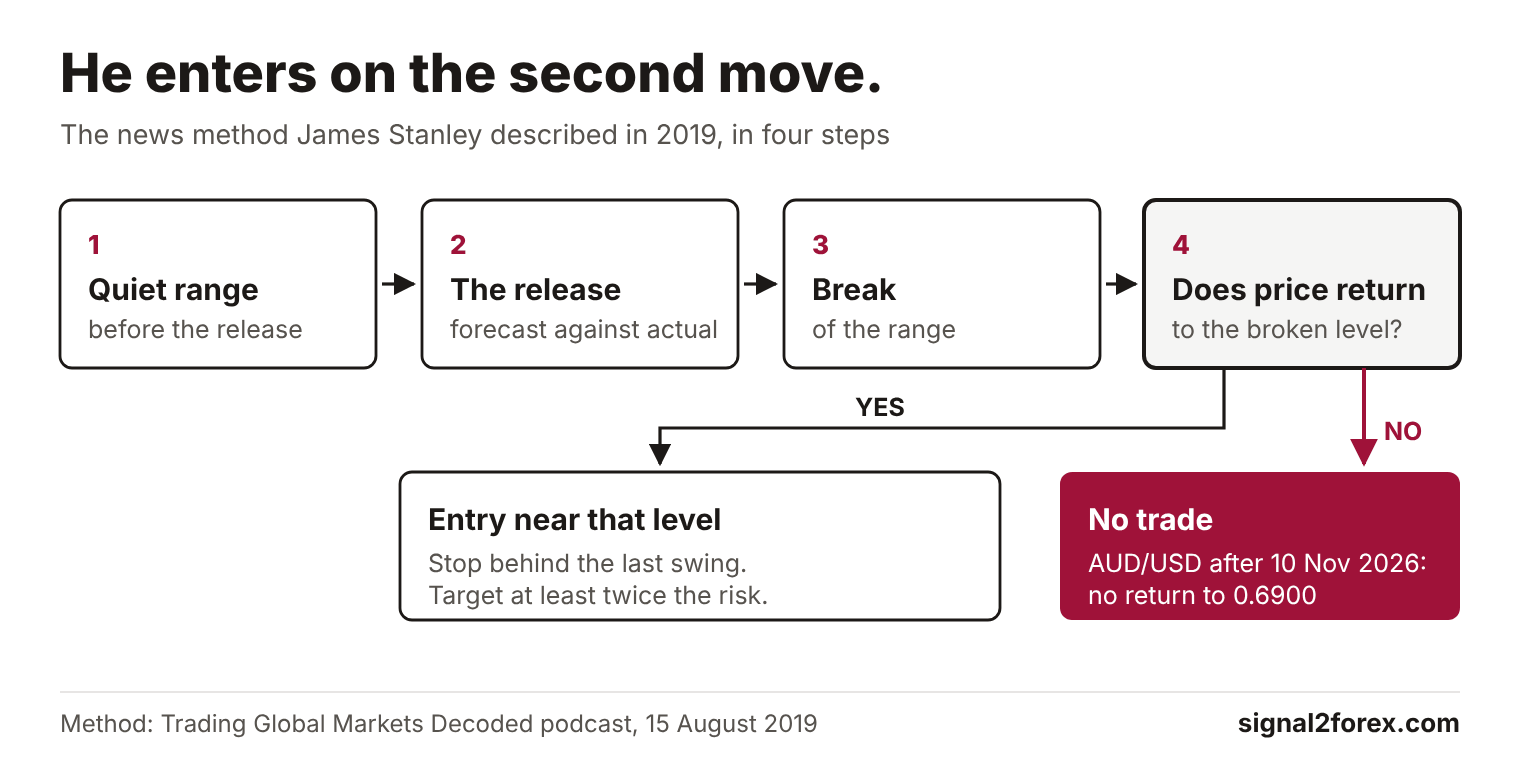
What does trading the news mean for him? His first point is about the days before a release. Ahead of a Fed or ECB decision price tends to stay in a narrow range, so a trend trade has little room.
His second point is about the hours after. A break of that range can start a move that lasts for days. Does he chase the first jump? No — he waits for price to come back toward the broken level and enters there, usually from a 4-hour or daily chart.
The setup itself is technical. He wants a reward at least twice the risk, so a 40-pip stop needs an 80-pip target. On AUD/USD that is $400 of risk and $800 of reward on one standard lot, or $4 and $8 on a 0.01 lot. On a $100 account that $4 is already 4% of the money.
The economy comes second — it decides whether he takes the setup at all. If the chart and the economy point in opposite directions, he stays out. For me this is the strongest line of the whole interview, because a missed trade costs nothing.
There is another idea in the interview — the crowd. When almost everyone holds the same position, he starts to look for the turn. His example was 2014 and 2015. Many forecasts then called for the euro to fall to one dollar after the ECB began to buy bonds. It did not get there.
He also spoke about time. In his words, “You can’t take a two-week course and instantly make a lot of money.” His own estimate was four or five years before a trader becomes steady. I write trading robots, and for me the same holds for a strategy: the code is the fast part, and trust in it comes from a long log.
A test on AUD/USD
Does the idea hold in 2026? I took the first half of November and a pair I had not written about before. Three scheduled events hit the Australian dollar in eight days, and a fourth is due as I write.
| 创建 | Expected → actual | AUD / USD |
|---|---|---|
| RBA rate, 3 Nov, 03:30 GMT | 4.85% → 4.85%, vote 6–3 | 降至0.6974 |
| US jobs, 6 Nov, 13:30 GMT | 65,000→165,000 | 0.6900 before, near 0.6930 by 10 Nov |
| US inflation, 10 Nov, 13:30 GMT | 0.3% → 0.4% | 0.6900 → 0.6845, −0.88% on the day |
| Australian jobs, 19 Nov, 00:30 GMT | +20,000 to +34,000 forecast | not known yet |
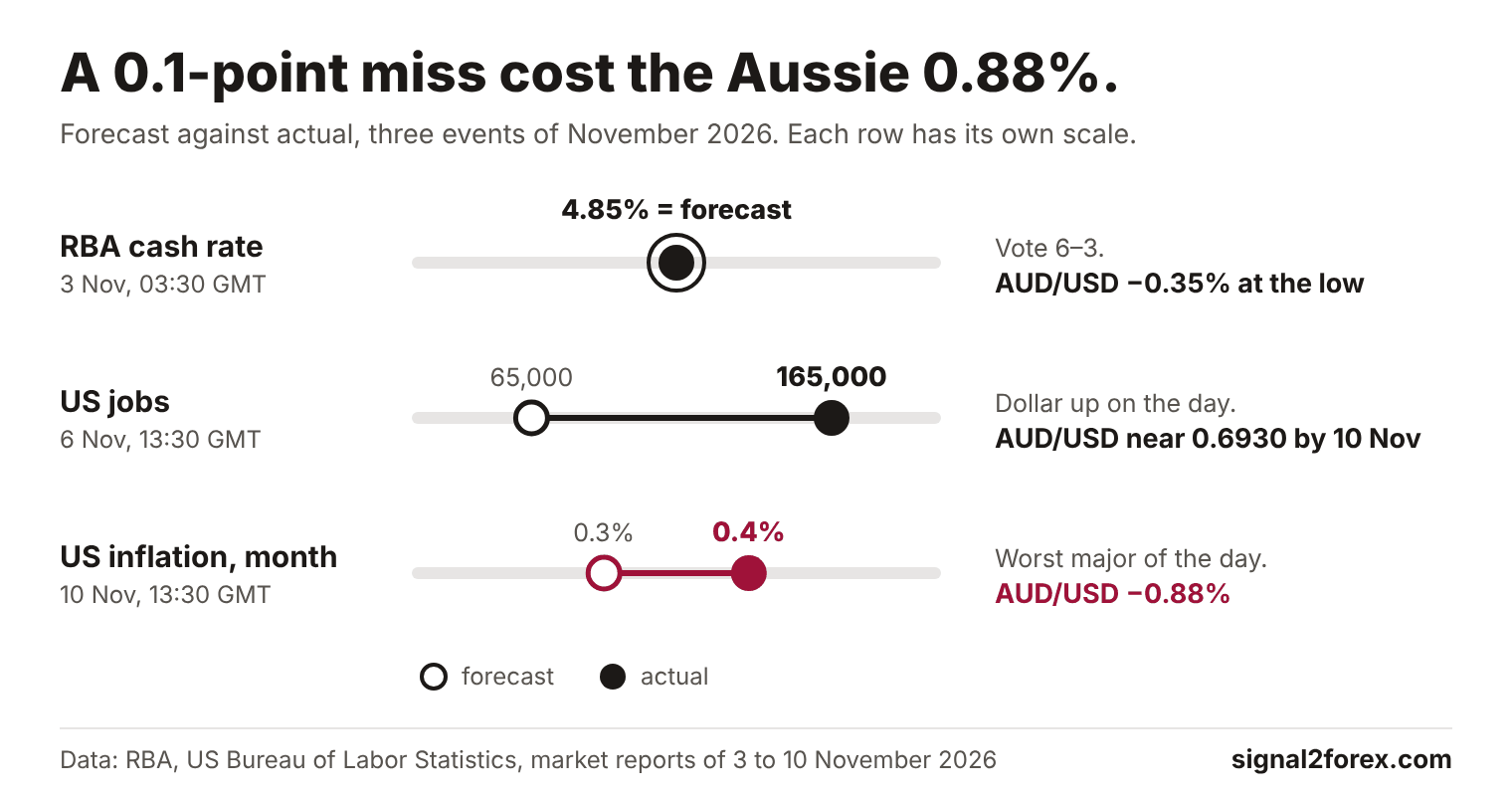
The first event is the strangest. On 3 November 2026 at 03:30 GMT the Reserve Bank of Australia raised its cash rate by 25 basis points, or 0.25%, to 4.85%. This is the highest rate since 2008. And the Australian dollar fell — by as much as 0.35%, to 0.6974.
Why? The rise was expected. The vote was not: six members voted to raise and three to hold, and the statement no longer promised more increases. It is the same lean I described in the article on 鹰派 vs 鸽派 政策。
A rate rise, and the currency went down.
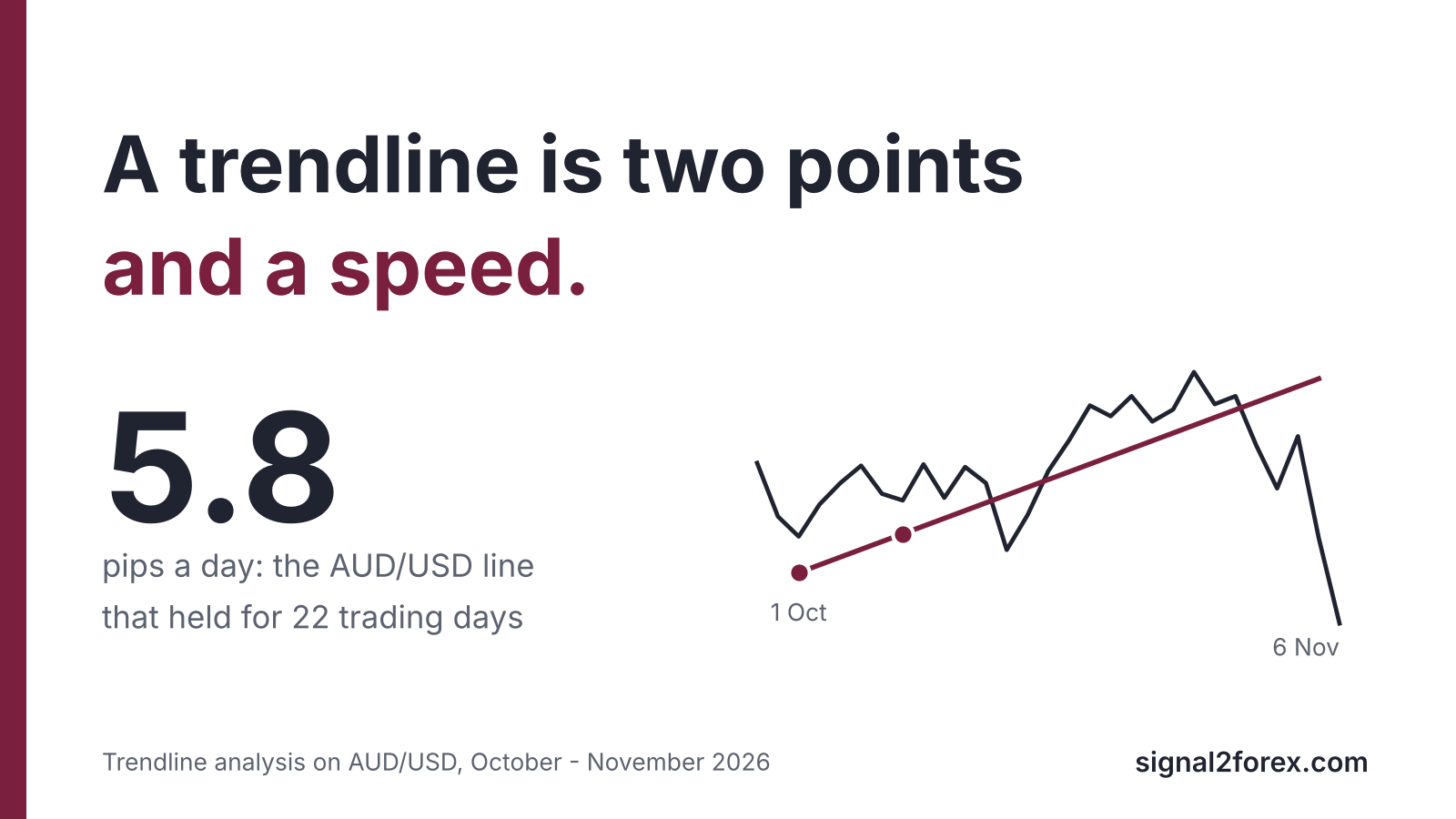
Then came a day with no release at all. On 5 November the RBA 4pm reference rate was 0.7014. A day later it was 0.6900 — a fall of 114 pips. US technology shares had dropped hard, the Nasdaq 100 lost more than 5%, and the Aussie went with them. Of the five steps in my chart this is the largest, and no calendar showed it.
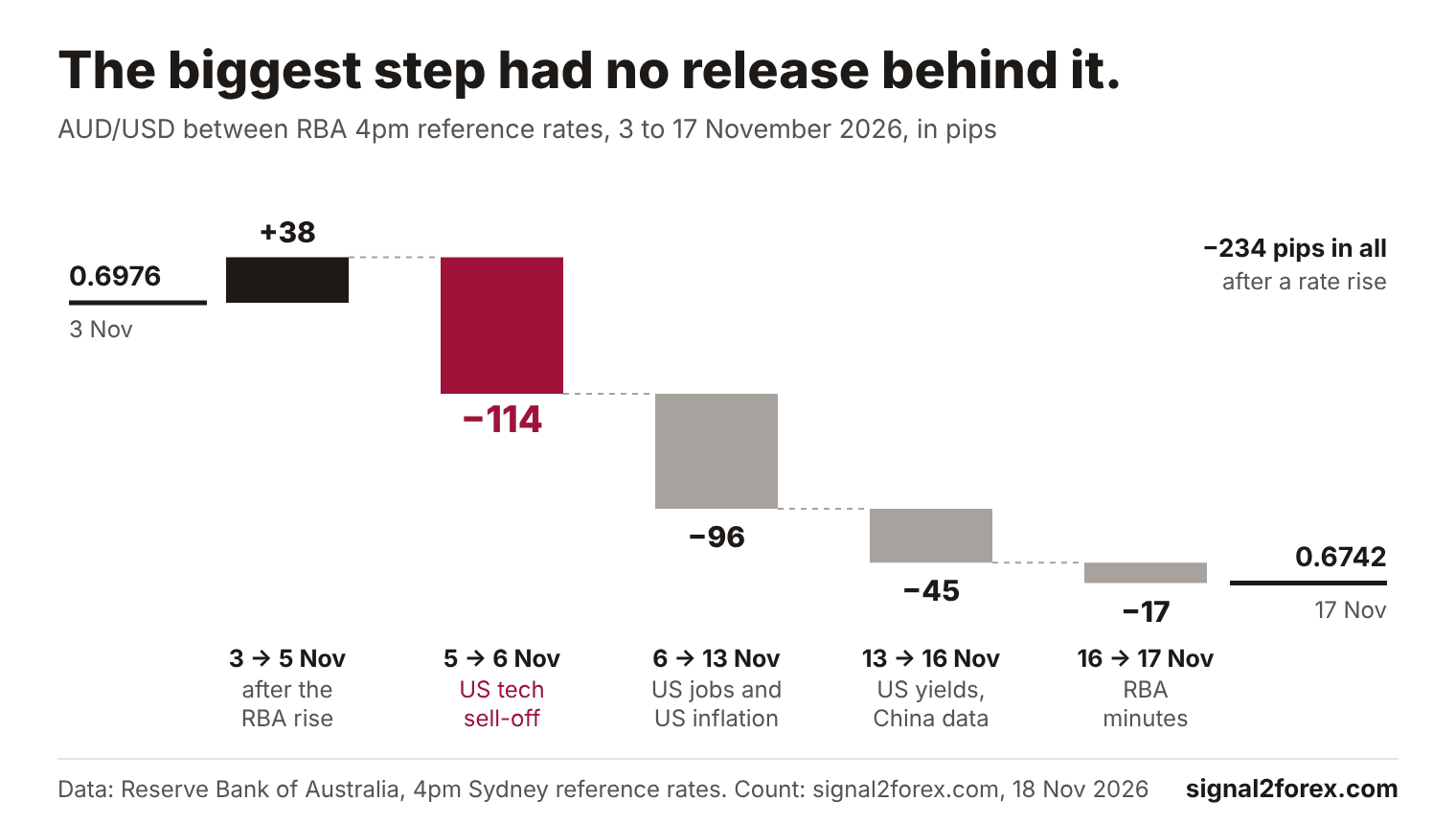
The US jobs report came on 6 November at 13:30 GMT: 165,000新的就业机会 against a forecast of about 65,000. The dollar rose on the day. Yet by 10 November AUD/USD had bounced to near 0.6930, above the reference rate set before the report. This is the quiet range James Stanley describes — two sessions of waiting for the next number.
That number was US inflation, on 10 November at 13:30 GMT. Prices rose 0.4% in October, and the forecast was 0.3%. One tenth of a percent — is that a lot? For the Aussie it was. AUD/USD went from about 0.6900 to near 0.6845 and lost 0.88% on the day, the most among the major currencies.
On one standard lot 55 pips is $550. On a 0.01 lot it is $5.50. I wrote separately about how CPI data moves currency prices.
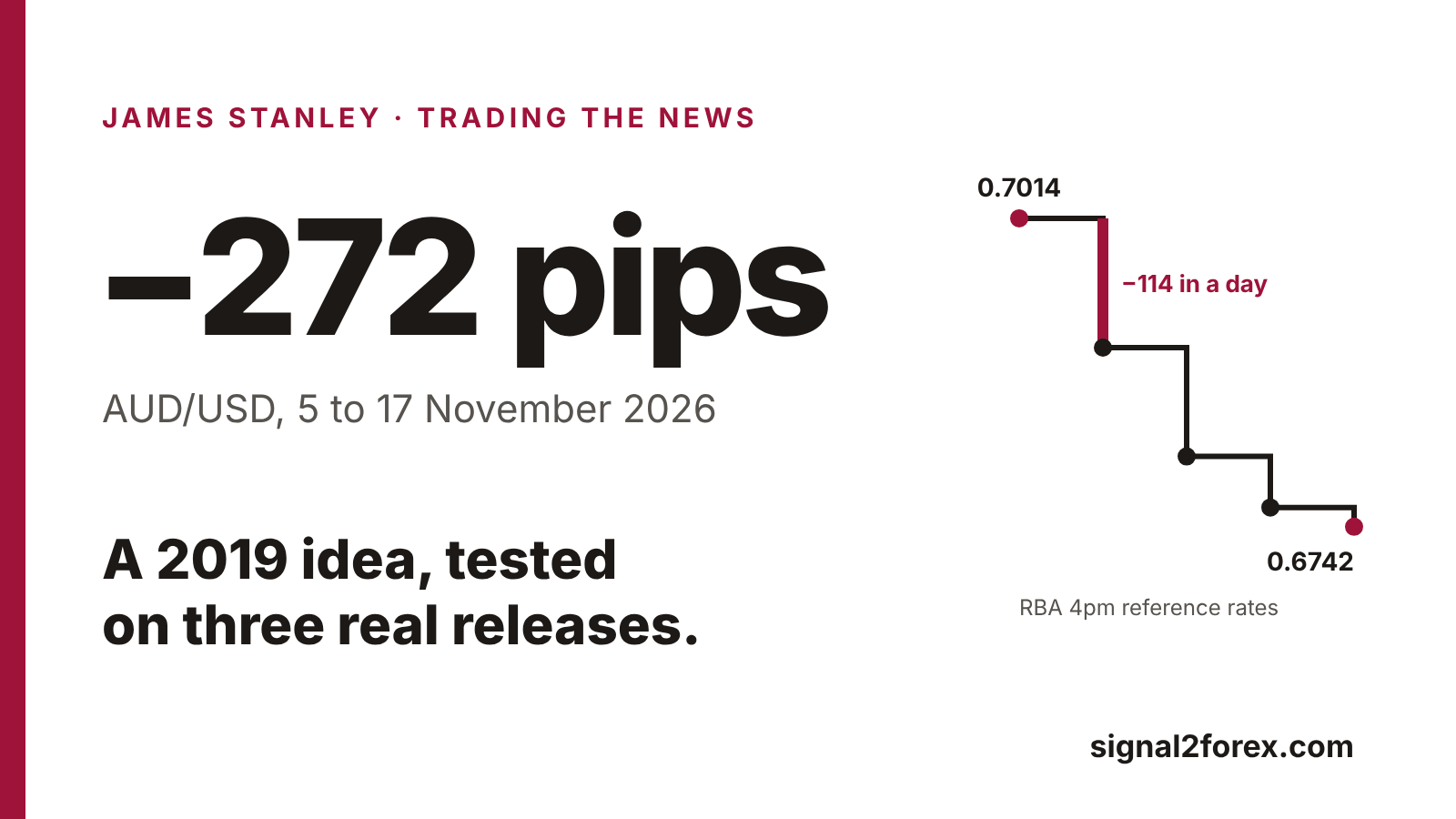
After that the range never came back. The pair lost another 0.27% on 11 November, although US shares rose that day. The RBA reference rates read 0.6804 on 13 November, 0.6759 on 16 November and 0.6742 on 17 November. From the rate of 5 November that is 272 pips — 3.9%. A trader short one standard lot made $2,720, and a trader short 0.01 lot made $27.20.
My one disagreement
So was he right? In two parts out of three, I think, yes. The quiet range before the release was there. The break after it was there too, and it lasted a week — well inside his window of two days to two weeks.
Part three is the entry on the way back, and here my reading differs. Most guides repeat that you need to wait for price to return to the broken level. Did it return in this run? It did not. I found no report and no RBA rate that shows AUD/USD back at 0.6900 after 10 November. A trader who waited for the better price is still waiting.
I do not know how often this happens. One pair and two weeks is a small sample — I counted nothing longer.
There is older research that points the same way. Andersen, Bollerslev, Diebold and Vega studied exchange rates around US data in a 2003 paper, Micro Effects of Macro Announcements. They found that the price jump comes within minutes of a surprise, while the market stays nervous for much longer. If the jump is that fast, the return is a second and separate bet.
This is no complaint about the method. Waiting costs you some trades and saves you from false breaks, and he says openly that he stays out when signals conflict. It matters to know which price you pay for that.
News and a robot
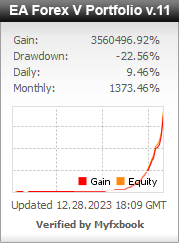
I do not trade releases by hand — my robots in the 外汇 V 投资组合 work on one-hour bars. What they have for moments like 13:30 GMT is a spread filter: if the spread is wider than the parameter allows, the order is not sent. Around a release this filter does what James Stanley does by choice — it waits.
You can watch the account on the 直播 on any release day. For me the useful part of his interview on trading the news is the order of things — the chart first, then the economy as a check, then patience. The logic of 突破与回调 is old, and a release only tests it harder.
The next test is close. On 19 November 2026 at 00:30 GMT Australia publishes its jobs report for October. Forecasts sit between 20,000 and 34,000 new jobs, with unemployment at 4.7%. I do not know the number. After five falling sessions the pair had its narrowest daily range of the run on 17 November, and to me it looks like the quiet range again.
James Stanley, a podcast from 2019, a rate rise that pushed a currency down, a share sell-off that no calendar showed, one tenth of a percent in US inflation — all this is one subject. The more of the range, the forecast and the vote you read before a release, the steadier you stay when the number comes.
Checked against: Reserve Bank of Australia, monetary policy decision of 3 November 2026 and daily exchange rates; US Bureau of Labor Statistics, Employment Situation for October 2026; Australian Bureau of Statistics release calendar; market reports of 3 to 17 November 2026 for intraday levels; Andersen, Bollerslev, Diebold and Vega, American Economic Review, 2003. Trading currencies carries a high risk of loss.
 Signal2forex.com - 最佳外汇机器人和信号


