
By Uladzimir Leuchankou, founder of Signal2Forex and developer of the Forex V Portfolio robots
What is a forex spread? Is it just the gap between two prices on the screen? I suppose that is an answer too. But for me the spread is the first bill of every trade — you pay it before the price moves at all.
The answer comes first. The spread in forex is the ask price minus the bid price. You buy at the ask, you sell at the bid, and the broker keeps the difference. To get the cost in money, you multiply the spread in pips by the pip value and by your lot size.
| Penyebaran | Cost on 1 standard lot | Cost on 0.01 lot |
|---|---|---|
| 0.2 pips | $2 | $0.02 |
| 1.0 pip | $10 | $0.10 |
| 1.2 pips | $12 | $0.12 |
| 2.0 pips | $20 | $0.20 |
For pairs quoted in US dollars — EUR/USD, GBP/USD, AUD/USD. One standard lot is 100,000 units, and one pip on it is $10.
Is this the 0.2 spread meaning that people look for? Yes. A spread of 0.2 pips costs $2 on a standard lot and two cents on 0.01 lot. On one trade it is almost nothing. But the bill is not paid once — it is paid on every order. Below I show how to calculate spread in forex step by step, and then what it costs on my own account.
How to calculate spread in forex
If a friend asks me how to calculate the spread in forex, I show one subtraction. Take GBP/USD on Friday 6 November 2026. After the US jobs report the pair traded near 1.3371. Say the terminal shows a bid of 1.33710 and an ask of 1.33722. Ask minus bid is 0.00012.
Now you need to turn this number into pips. For most pairs one pip is the fourth decimal place — 0.0001. So 0.00012 is 1.2 pips. The fifth decimal is a point, one tenth of a pip. MetaTrader counts the spread in points, so the same spread shows there as 12.
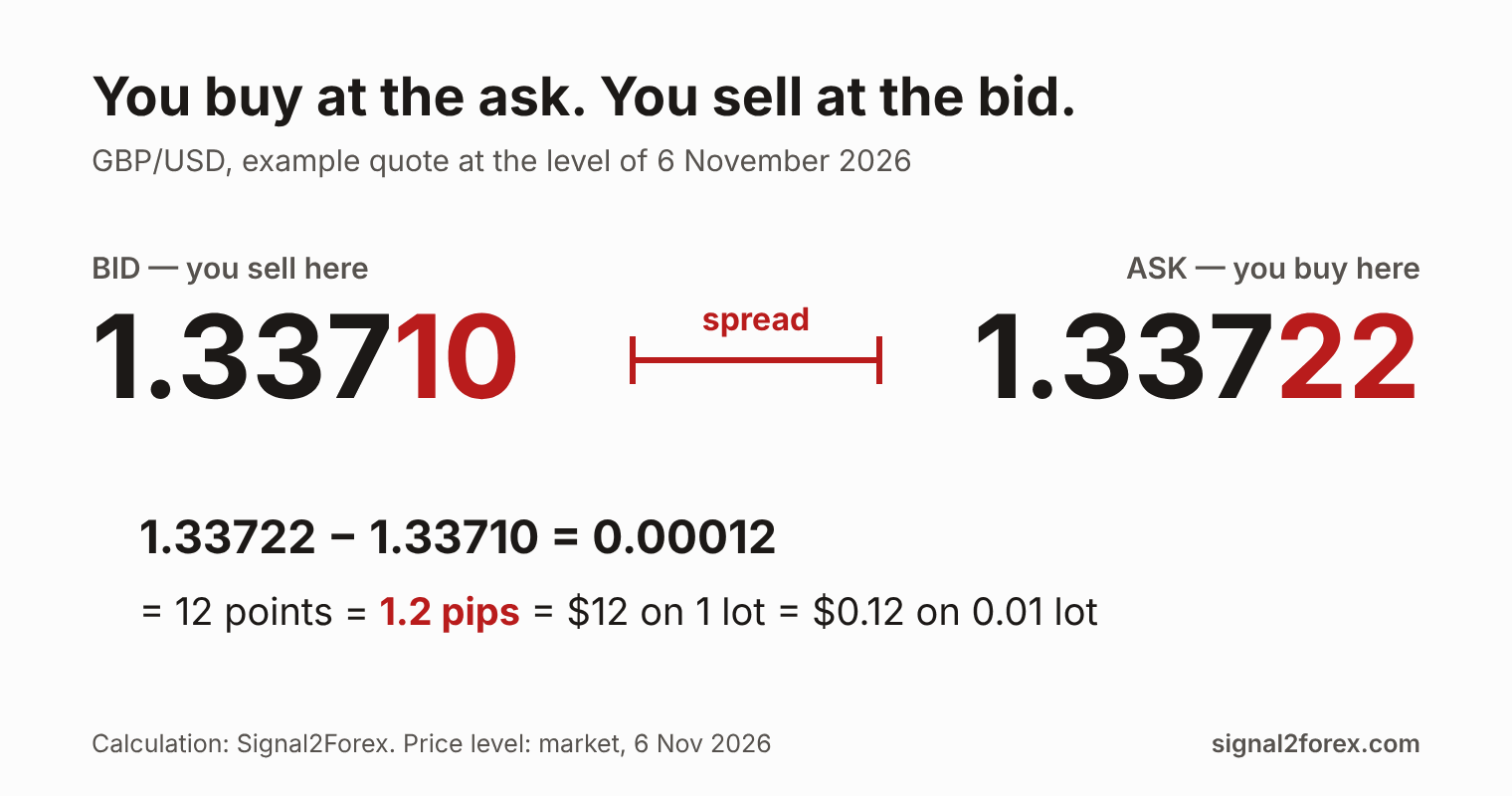
The money is the second step. Spread cost is the spread in pips, times the pip value, times the lots. For GBP/USD one pip on one standard lot is $10. So 1.2 pips cost $12 on one lot, $1.20 on 0.1 lot and $0.12 on 0.01 lot. If you are not sure what a pip is worth on your pair, I wrote it out in the article about pips.
People type this question in many ways — how to calculate spread forex, how to calculate fx spread, how to calculate forex spread, forex spread calculation. The answer does not change. Ask minus bid, then pips, then money. This is the forex spread explained in one sentence.
Yen pairs and crosses
There are two cases where the same steps give a different number. The first case — yen pairs. Here one pip is the second decimal place, 0.01. USD/JPY traded near 158.40 on 6 November 2026. A quote of 158.402 and 158.416 gives a spread of 0.014 — this is 1.4 pips.
The pip value is also different. For USD/JPY it is 0.01 times 100,000 divided by 158.40 — about $6.31 on one standard lot. So 1.4 pips cost about $8.84 on one lot and nine cents on 0.01 lot. In pips this spread is wider than on the pound. The bill is smaller.
The second case — crosses, the pairs without the US dollar. Take EUR/GBP. One pip on one standard lot is 10 pounds, and at a GBP/USD rate of 1.3371 this is $13.37. A spread of 1.5 pips costs about $20 on one lot and $0.20 on 0.01 lot — a third more than the same 1.5 pips on EUR/USD. If you compare pairs, you need to compare the cost in money and not just the pips.
The spread inside the terminal
How is spread calculated in forex platforms? The server sends two prices on every tick, and the terminal subtracts one from the other. I am an engineer, and I read the spread in code more often than on a chart. In MQL5 it is one line — SymbolInfoInteger(_Symbol, SYMBOL_SPREAD). The function returns the current spread in points. The MQL5 reference says that with a floating spread this value changes with every call.
You do not need code to see it. In MetaTrader, right-click the Market Watch window and turn on the Spread column. Then right-click the symbol and open Specification. If the spread line says floating, the number moves all day. If it shows a number, the spread is fixed.
Now back to my own account. My robots trade on the H1 timeframe on 14 currency pairs, and the account is disiarkan langsung di YouTube. On this account the robots open about 2 lots a month for every $800 of deposit. Many of the 14 pairs are crosses, so I count an average spread of 1.5 pips and about $10 a pip.
The sum is short. Two lots, times 1.5 pips, times $10 — about $30 a month. This is close to 4% of an $800 deposit, and on a $100 cent account the same share is about $3.75. I look at this number before any backtest result. A system has to earn the spread first, and only after that it earns for you.
Fixed, floating and raw
Most pages with forex spreads explained start from the account types, so I will be brief. A fixed spread is one number that the broker sets and holds. You pay for this calm with a wider spread, and around big news the broker can still refuse your price.
A floating spread follows the market. It is narrow in busy hours and wide in thin ones. Most retail accounts work this way.
A raw spread is the market spread without the broker’s markup, and the broker takes a commission for each lot. Here you need to count both parts. Say the raw spread is 0.2 pips and the commission is $7 per lot for opening and closing. The commission equals 0.7 pips, so the real cost is 0.9 pips — $9 on one lot and nine cents on 0.01 lot.
Many guides tell a beginner to take the fixed spread, or to pick the broker with the lowest number in the advert. I do not agree. For a robot on H1 the minimum spread matters little. What matters is the spread at the hour when the order goes out, together with the commission. A broker with 0.1 pips at noon and 4 pips at midnight is not a cheap broker for a system that trades at night.
Typical forex spreads
There is no single table of typical forex spreads, and I will not pretend there is. An average spread forex brokers publish is an average for their own account type and their own hours.
As a rough guide for standard accounts with a floating spread in busy hours — EUR/USD is often between 0.6 and 1.2 pips, GBP/USD and USD/JPY between 0.8 and 1.6, crosses such as EUR/GBP or AUD/CAD between 1.5 and 3, and exotic pairs such as USD/TRY cost tens of pips. These are ranges, not promises. The exact number for your account is in your own terminal.
Why are the main pairs so cheap? The size of the market explains it. The Bank for International Settlements counted $9.6 trillion of currency trading per day in April 2025, and $3 trillion of it was spot. Most of this money goes through a few pairs with the dollar. The more buyers and sellers a pair has, the less a dealer needs to charge for standing between them.
The spread as a signal
What does spread mean in forex trading apart from cost? For me it is also a signal. A narrow spread says that many dealers are ready to trade right now. A wide spread says that somebody stepped back. You can read it the same way you read volume.
One example from this week. On Friday 6 November 2026 at 13:30 GMT the US Bureau of Labor Statistics reported 165,000 new jobs for October. Forecasts were near 65,000. GBP/USD fell from a day high near 1.3463 to 1.3371 — 92 pips, or $920 on one standard lot and $9.20 on 0.01 lot. In such minutes a dealer does not know the next price, so the dealer widens the spread to stay safe.
How wide was the spread at your broker in that minute? I do not know — it depends on the broker and on the account. Your terminal knows. The next jobs report comes on 4 December 2026 at 13:30 GMT. Turn on the Spread column a few minutes before it and watch.
There are also quiet reasons for a wide spread. Around 22:00 GMT in winter — this is 17:00 in New York — banks move positions to the next day, and the spread grows for some minutes. The same happens early on Monday and on holidays. The narrow hours are the ones when London and New York work together, from about 13:00 to 17:00 GMT. I described this window in the London session guide.
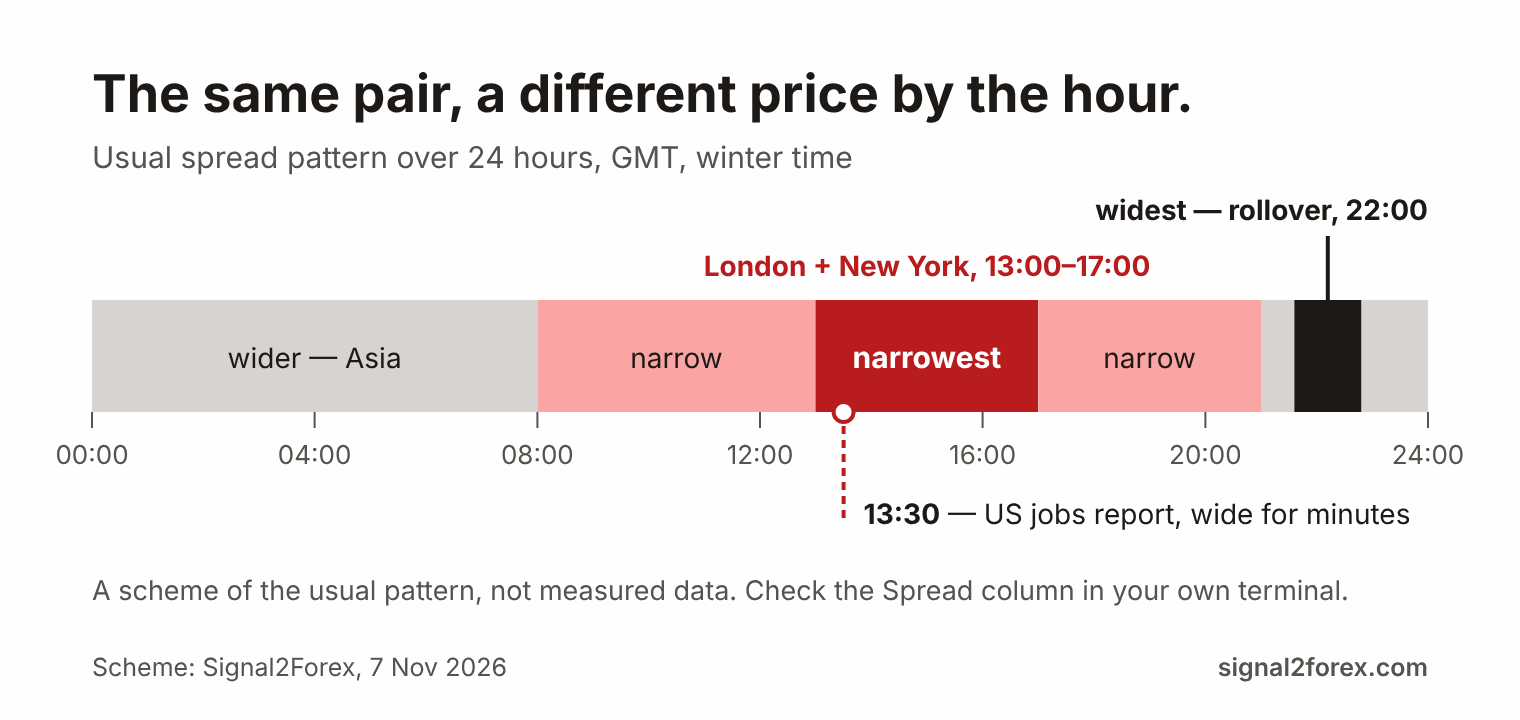
This is why each robot in Portofolio Forex V kami has a limit for the spread. If the spread is above the limit, the robot does not send the order and waits. A missed trade costs nothing. A trade opened into a wide spread starts with a loss that the system did not plan.
The spread and the target
One more thing — the spread is small or large only next to your target. Take the same 1.2 pips. Against a target of 5 pips it is 24% of the profit. Against 10 pips it is 12%, against 20 pips 6%, against 50 pips 2.4%, and against 100 pips a little over 1%.
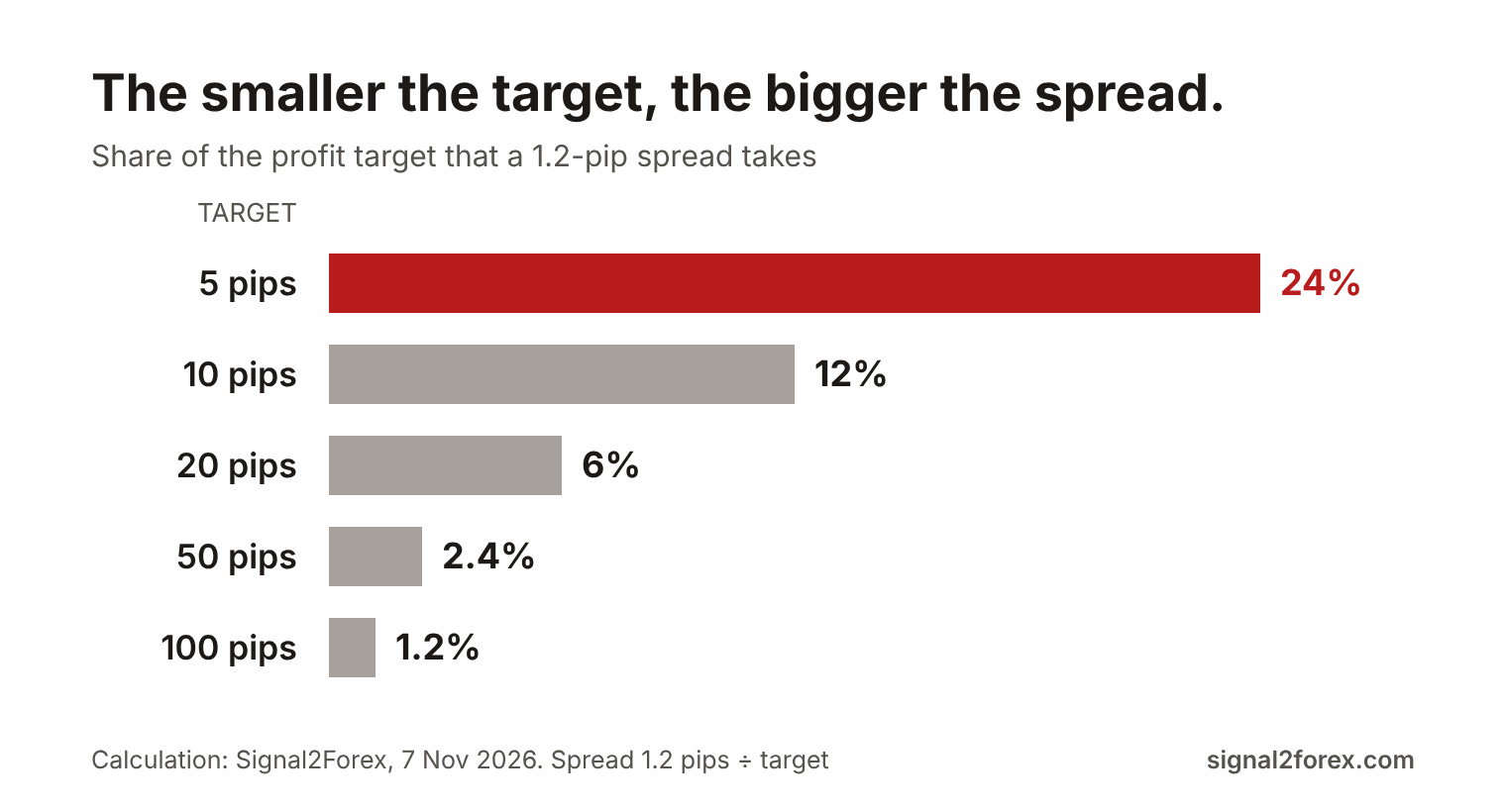
So the same broker is expensive for a scalper and cheap for a position trader. If you trade small targets, you need a narrow spread — or you need fewer trades. Leverage does not change the spread in pips. But it lets you open a bigger lot, and a bigger lot makes the same spread a bigger bill. I counted this in the article about leverage.
There is another detail that the spread explains. A MetaTrader chart is drawn by bid prices. A buy trade closes at the bid, and a sell trade closes at the ask. So a stop on a sell trade can work when the chart never touched it — the ask touched it. If you place a stop on a short trade, you need to add the spread to the distance.
A short summary
So what is the spread in forex for me now? It is more than the answer to how to calculate spread in forex. Ask minus bid, pips turned into money, the hour of the day, the account type, the size of the target — all this is one topic, the price of entry. I do not know a system that this price leaves alone. The more often you look at the spread before the order, the steadier your result becomes.
Sources: US Bureau of Labor Statistics, The Employment Situation — October 2026, published 6 November 2026; Bank for International Settlements, Triennial Central Bank Survey, OTC foreign exchange turnover in April 2025; MQL5 reference, spreads and order distance from the current price. Prices of 6 November 2026 are rounded market levels.
Uladzimir Leuchankou is the founder of Signal2Forex and a software engineer with a BSc in Finance. He writes the Forex V Portfolio robots and runs them on a live account that is streamed on YouTube. The lot count and the spread sums on this page come from that account and from his own calculations. He checked the numbers on 7 November 2026. Write to him at forexfactory1shop@gmail.com.


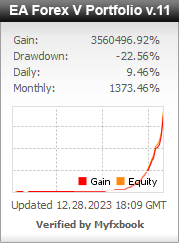
 Signal2forex.com - Robot dan sinyal Forex terbaik


