
By Uladzimir LeuchankouSignal2Forex'in kurucusu
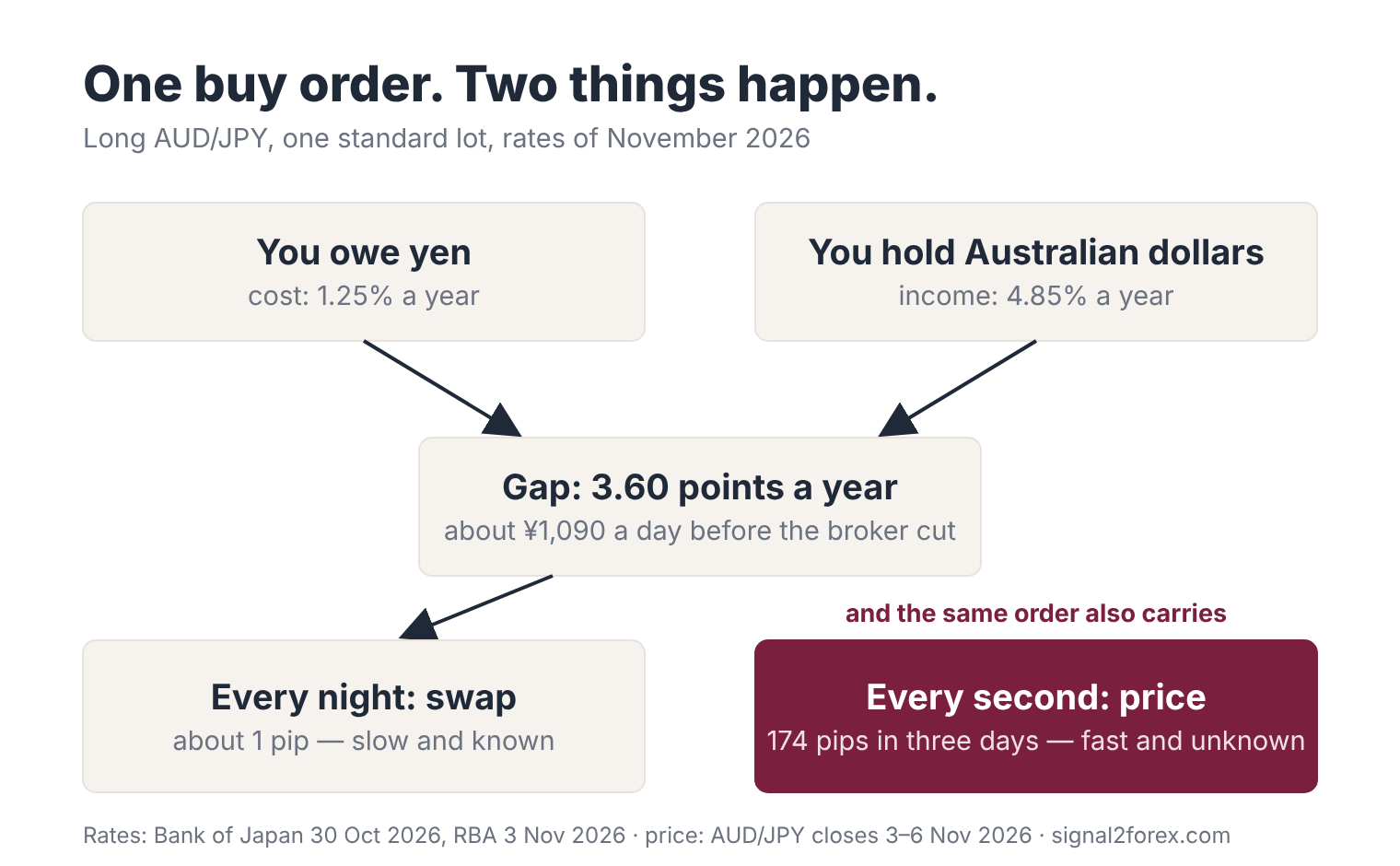
What is a currency carry trade? You borrow a currency with a low interest rate and buy a currency with a high one. The broker pays you the difference every night. I suppose that is an answer too. But for me a carry trade is first of all a bet on the exchange rate — and the interest is only a small daily payment for holding that bet.
I am writing this in November 2026, and the numbers are easy to check. Japan pays 1.25%. Australia pays 4.85%. The gap is 3.60 points a year, and on AUD/JPY one day of that gap is worth about one pip. Last week the pair lost 174 pips in three days.
| Ne | Numara | not |
|---|---|---|
| Japan, policy rate | 1.25% | held on 30 October 2026 |
| Australia, cash rate | 4.85% | raised on 3 November 2026 |
| Gap for a long AUD/JPY | 3.60 points a year | before the broker takes a part |
| One day of carry, 1 lot | about ¥1,090 — $6.91 | close to 1 pip |
| AUD/JPY, 3 to 6 November | 110.55 → 108.81 | 174 pips down |
Tanım · Günlük ödeme · Three days in November · Gap and price · Ağustos 2024 · Four checks
Currency carry trade definition
The currency carry trade definition is short. You borrow the funding currency — the one with the low rate. You buy the target currency — the one with the high rate. While the position stays open, you receive the gap between the two central bank rates, less what the broker keeps.
What is carry trade in foreign currencies when you look at a retail terminal? It is an ordinary buy order that you do not close in the evening. Nobody signs a loan. A long AUD/JPY position means you hold Australian dollars and owe yen, and the swap line in the terminal shows who pays whom.
Both rates come from the central banks. The Japonya Merkez Bankası kept its rate at 1.25% on 30 October 2026 — one member of nine voted for 1.5%. The Avustralya Merkez Bankası raised its cash rate to 4.85% on 3 November 2026, six votes against three.
How a rate decision moves a currency is a separate topic. I wrote about it on the page about interest rates and the forex market. Here only the gap matters.
The daily payment
How much is the gap in money? One standard lot of AUD/JPY is 100,000 Australian dollars. At the price of 110.55 that is ¥11,055,000. The rest is three lines.
With the dollar near ¥157.8 this is about $6.91 a day and $2,522 a year on one standard lot. On 0.01 lot it is 7 cents a day and about $25 a year. One bip of AUD/JPY on a standard lot is ¥1,000. So a day of carry is roughly one pip.
This is the number between banks. A retail broker pays less on the long side and charges more on the short side, and the difference is the income of the broker.
I write robots for MetaTrader, so for me a carry trade starts with two parameters in the symbol specification — swap long and swap short. Open Market Watch, right-click the pair and choose Specification. If swap long is negative on a pair with a positive gap, there is no carry trade at this broker at all.
The trade also works in the other direction, and this is the part people forget. If you sell AUD/JPY, you owe the high rate and hold the low one. You pay the gap every night, plus the broker’s part. A short position on this pair has to earn more than one pip a day only to stay at zero.
One more parameter sits in the same window — the day of the triple swap. For currency pairs it is usually Wednesday. A position held over Wednesday night gets three days of interest at once, because the settlement date moves across the weekend.
Three days in November
On Tuesday, 3 November 2026, the Reserve Bank of Australia announced its rise at 03:30 GMT. The gap became the widest of this autumn. AUD/JPY closed that day at 110.55, and a carry trader had every reason to be pleased.
Then came Thursday. On 5 November chip stocks fell, investors bought yen, and the Australian dollar was the weakest major currency of the day. AUD/JPY lost 1.5% in one session. On Friday, 6 November, it closed at 108.81.
Five days of interest — because Wednesday counted three times. On 0.01 lot the same trade lost about $11 and earned 35 cents. To get 174 pips back from interest alone, you need 160 days. Almost half a year of waiting against three days of price.
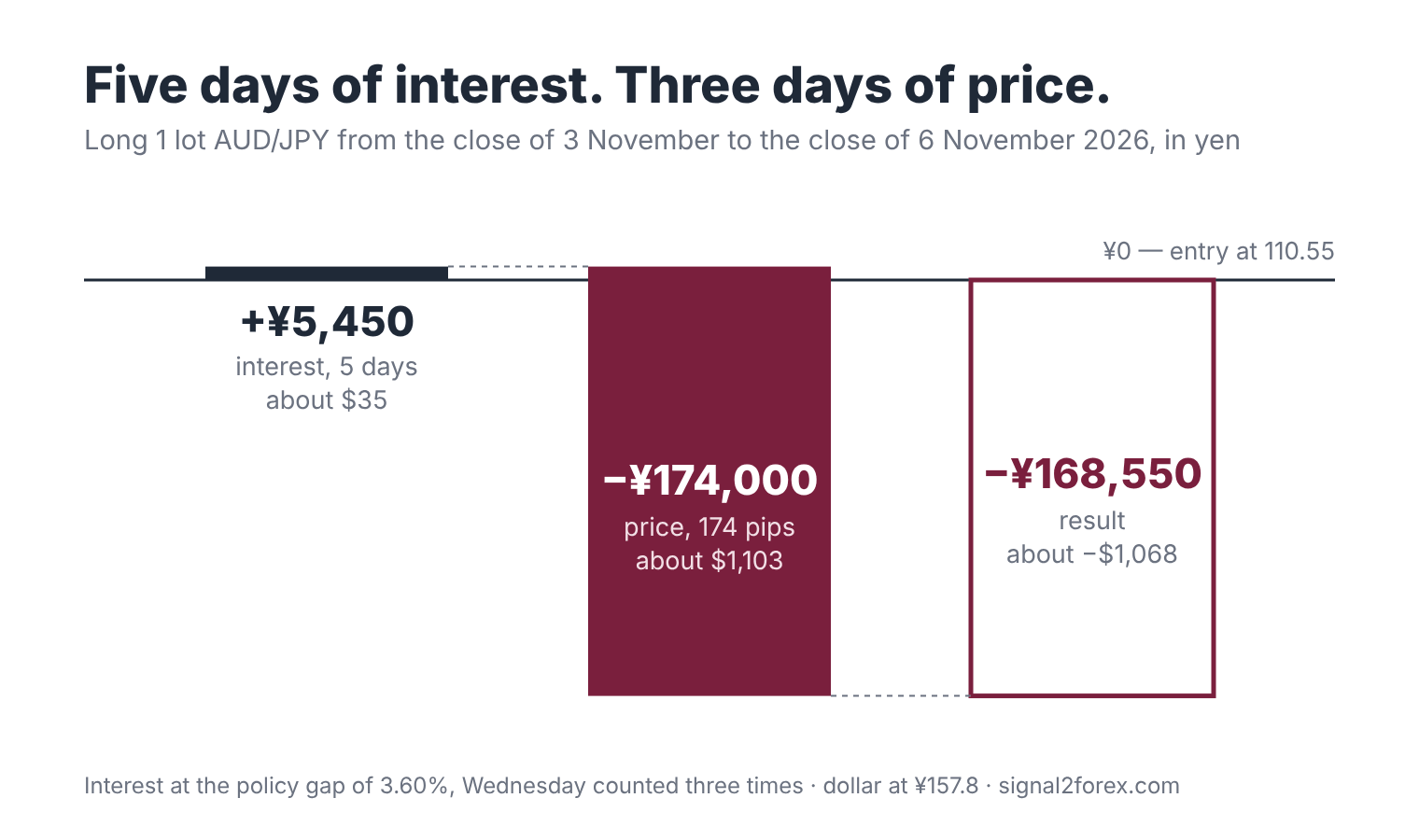
There is another side of this — baskı. With leverage of 1:20 the gap of 3.60% a year on the position becomes 72% a year on the margin, and this is the number that carry trading is usually sold with. But the fall of 1.6% in those three days becomes about 31% of the same margin. If you count the interest with leverage, you need to count the fall with the same leverage.
Gap and price
Most guides say that the pair rises when the gap grows. I do not see this in the numbers of this autumn. At the end of August the gap was 3.35 points and AUD/JPY stood near 112.66. Japan raised its rate in September, Australia raised twice, and by 6 November the gap was 3.60 points. The pair was 385 pips lower.
Why? I suppose because everybody knows the rate long before the decision. The price moves on what nobody knew — a split vote, a fall in stocks, a word about intervention. The gap tells you what you are paid for waiting. It does not tell you where the pair goes.
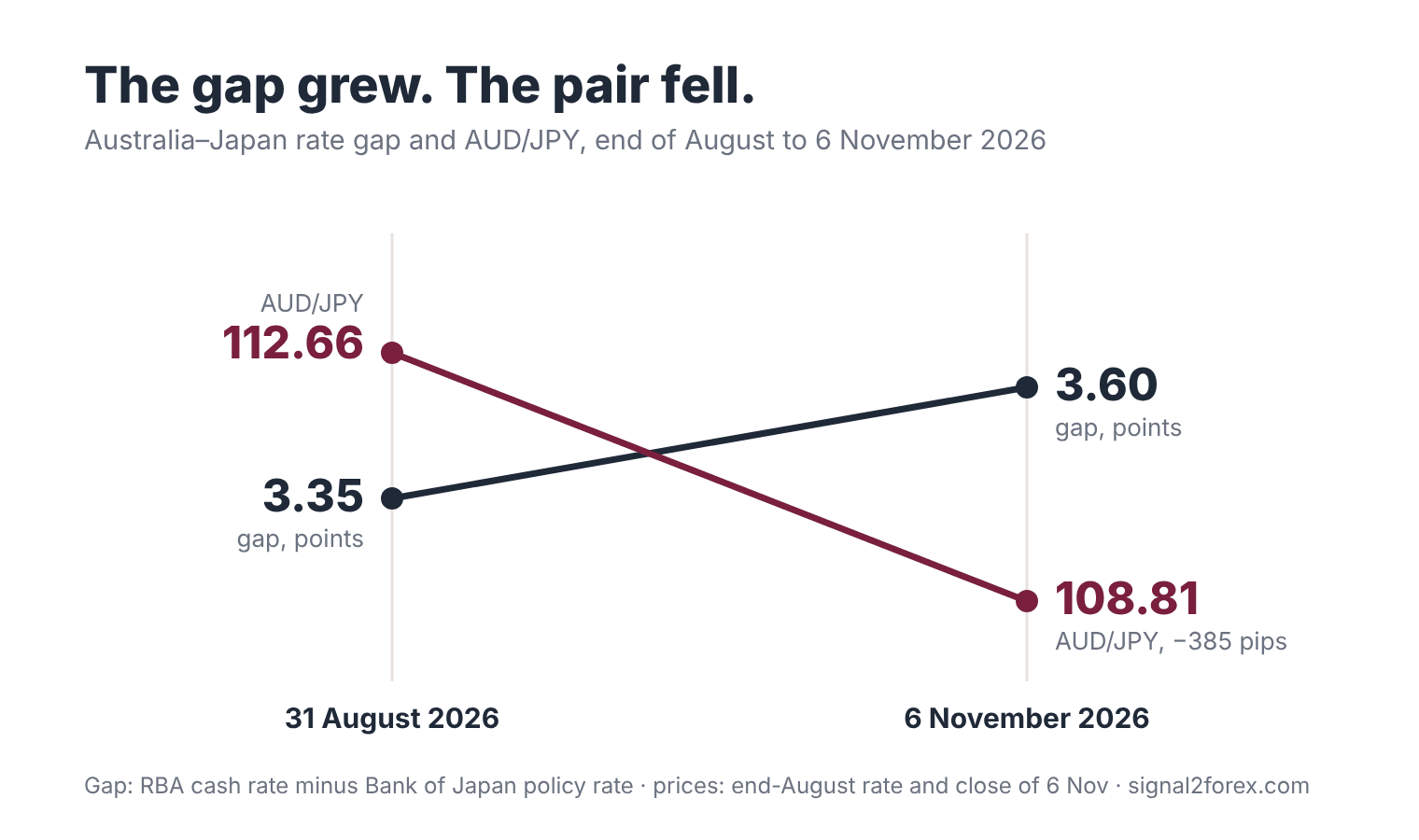
There is a simple way to compare the two. A year of interest on AUD/JPY at the present gap equals 398 pips of price. The range of the pair over the last 52 weeks is from 98.81 to 115.04 — this is 1,623 pips. So in one year the price covered a distance equal to four years of interest.
August 2024 as a warning
One more example — older and larger. On 11 July 2024 AUD/JPY traded near 109.30. Australia paid 4.35%, Japan raised its rate to only 0.25% on 31 July, and the gap was above four points. On 5 August 2024 the pair touched 90.15.
This is about 1,915 pips in less than four weeks — more than four years of carry at that gap. The Bank for International Settlements studied those days in its Bulletin No 90. Its picture is simple: positions built with leverage were closed quickly when volatility jumped. People open carry positions slowly, over months, and all in one direction. They close them on the same day.
Four checks before the trade
So is carry trading a bad idea? No. Is it income without risk? Also no. For me it is a trend trade with a small daily bonus, and I would check it in this order.
The first check — the swap long value at your own broker, in money per lot per night. Second — the trend on the daily chart, because holding a falling pair for one pip a day makes no sense.
The third check — the size. A position that lives for months needs a wide stop, 300 or 400 pips on this pair, so the lot has to be small enough for that stop and far from a marj çağrısı. The fourth check — the calendar of both central banks.
The robots I build, Forex V Portföyü among them, trade H1 signals and do not hold a position for the interest. For them swap is a line of cost in the account history, next to the spread. But this line is worth reading on every account. A system that holds positions over Wednesday on the wrong side pays three days of swap each week, and nobody notices it.
The calendar is close. The Reserve Bank of Australia decides on 8 December 2026 and the Bank of Japan on 18 December 2026. A Reuters poll in October expected Japan to go to 1.50%. If that happens and Australia waits, the gap returns to 3.35 points. I do not know whether the pair will fall or rise on that day — the first week of November showed that the gap and the price can go different ways.
The swap value at your broker, the trend, the size of the position, the dates of two central banks — all this decides a carry trade more than the gap itself. The more of the price risk you count before you open, the steadier the interest looks after.
Rates: Reserve Bank of Australia, decision of 3 November 2026; Bank of Japan, statement of 30 October 2026. History: BIS Bulletin No 90, August 2024. Prices: AUD/JPY daily closes up to 6 November 2026.


 Signal2forex.com - En iyi Forex robotları ve sinyalleri


