
By Uładzimir Leuczankou, founder of Signal2Forex · written on 11 November 2026, the day after the US inflation report
What is a margin call in forex? A message from the broker that asks for more money — this is the usual answer. I suppose that is an answer too. But for me a margin call is a number in the terminal. It is the moment when the equity of the account falls to the size of the margin that holds the open positions. On most MetaTrader accounts this is a margin level of 100%.
At 50%, or lower with some brokers, the server starts to close positions without asking. This second line is the stop out. And nobody calls. The line with the account numbers changes colour, new orders are refused, and the price keeps moving. So the useful question for me is a different one. How many pips of room did I leave when I chose the lot size? And is that room bigger than an ordinary bad day?
| Poziom marży | What the terminal does | What is left to you |
|---|---|---|
| Powyżej 100% | Nothing. It accepts new orders while free margin is above zero | Everything — add, reduce, wait |
| 100% — margin call level | The account goes into the Margin Call state. No new positions | Close a part or add money |
| 50% — stop out level | The server closes positions, the largest loss first | Nic |
The broker sets both levels. 100% and 50% are common, and 50% is the required stop out for retail accounts in the European Union. Your numbers are in the account terms.
Margin call in forex — five numbers
The Trade tab of MetaTrader shows five numbers in one row — balance, equity, margin, free margin and margin level. Balance is the money on the account without the open trades. Equity is the balance plus or minus the floating result of the open positions. This is the number that moves with every tick.
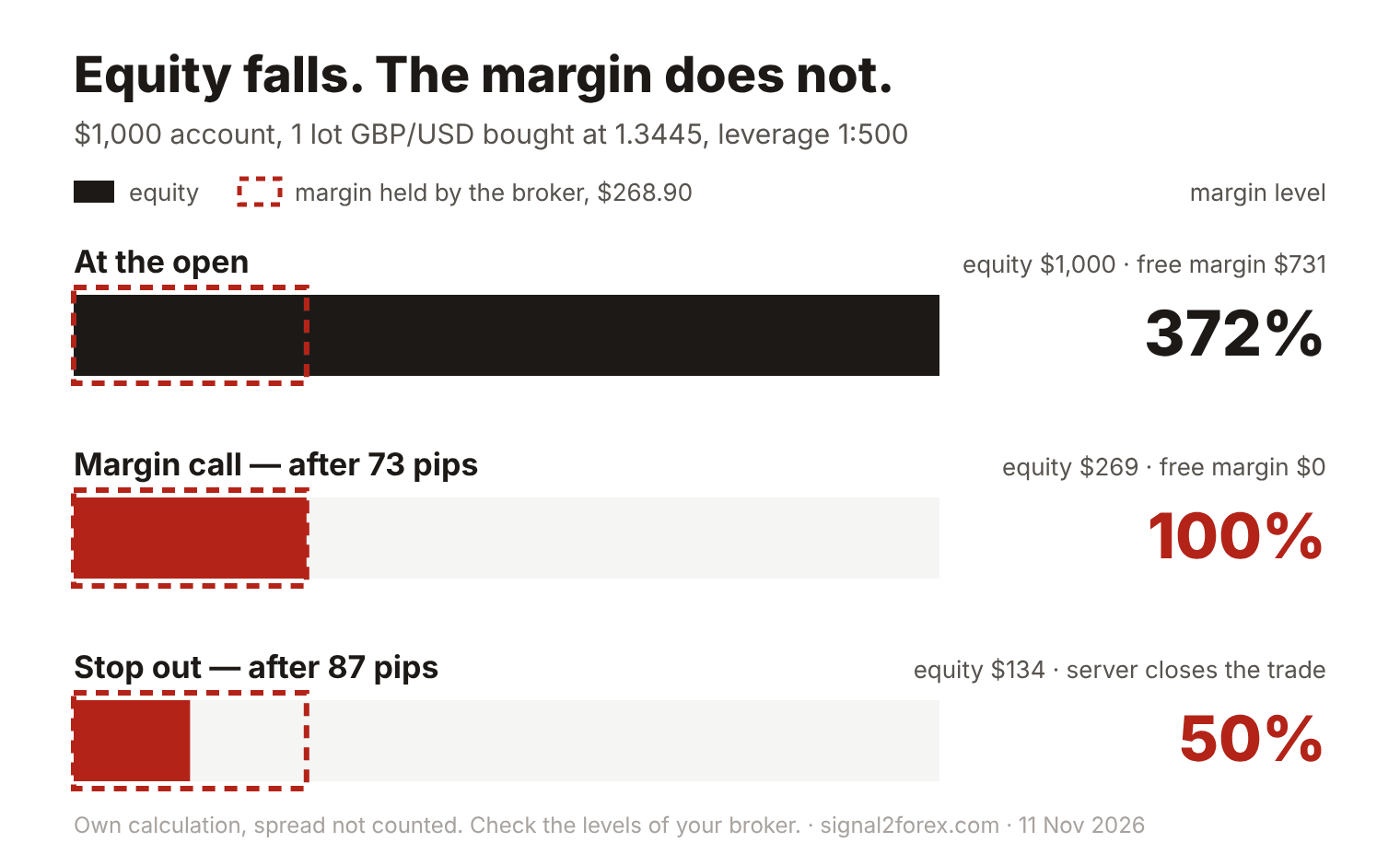
Margin is the deposit that the broker blocks while a position is open. The formula is simple — contract size multiplied by the price and divided by the leverage. One standard lot of GBP/USD is 100,000 pounds. At a price of 1.3445 this is a position of $134,450. With leverage of 1:500 the margin is $268.90. With 1:30 it is $4,481.67 for the same lot. I wrote about margin itself osobno.
Free margin is equity minus margin. Margin level is equity divided by margin and multiplied by 100. On a $1,000 account with that one lot at 1:500 the margin level at the open is 1,000 ÷ 268.90 × 100 = 372%. It sounds like a lot. It is 73 pips.
The developer of the platform describes the two limits briefly. At the margin call level “the account switches to the Margin Call state”. At the stop out level orders are cancelled and positions are closed. Both lines are from the MetaQuotes notes to build 2340 of MetaTrader 5.
For me as a programmer these are two account properties that a robot can read before it sends an order — ACCOUNT_MARGIN_SO_CALL and ACCOUNT_MARGIN_SO_SO. A broker can set them in percent or in money, so the robot needs to read the mode too. Does your robot know where these two lines are? It is a fair thing to check before the first real order.
People type the question in different ways — what is margin call in forex, what is a margin call forex, fx margin call. The margin call meaning in forex is the same in all of them: equity has fallen to the margin.
In stocks a margin call is a request with a deadline of several days. An fx margin call on a retail account has no deadline. The server does not wait for a transfer from the bank. If you trade with a small account, you need to treat the 100% line as the end of your choices.
One day in the pound
People look for a margin call forex example with real prices. Tuesday gave one. On 10 November 2026 GBP/USD traded near 1.3445 in the early hours. Five days before, the Bank of England had raised its rate to 4% by a vote of 8–1, and buying the pound looked like a reasonable trade.
At 13:30 GMT the US Bureau of Labor Statistics published the October inflation report. Prices rose 0.4% in the month and core prices 0.3% — both one tenth above the forecasts. The dollar went up. By 15:16 GMT the pound was at 1.3396, by 17:20 GMT near 1.3330, and the day ended around 1.3335. This is a fall of 110 pips in one day. A strong day for this pair, but not a rare one.
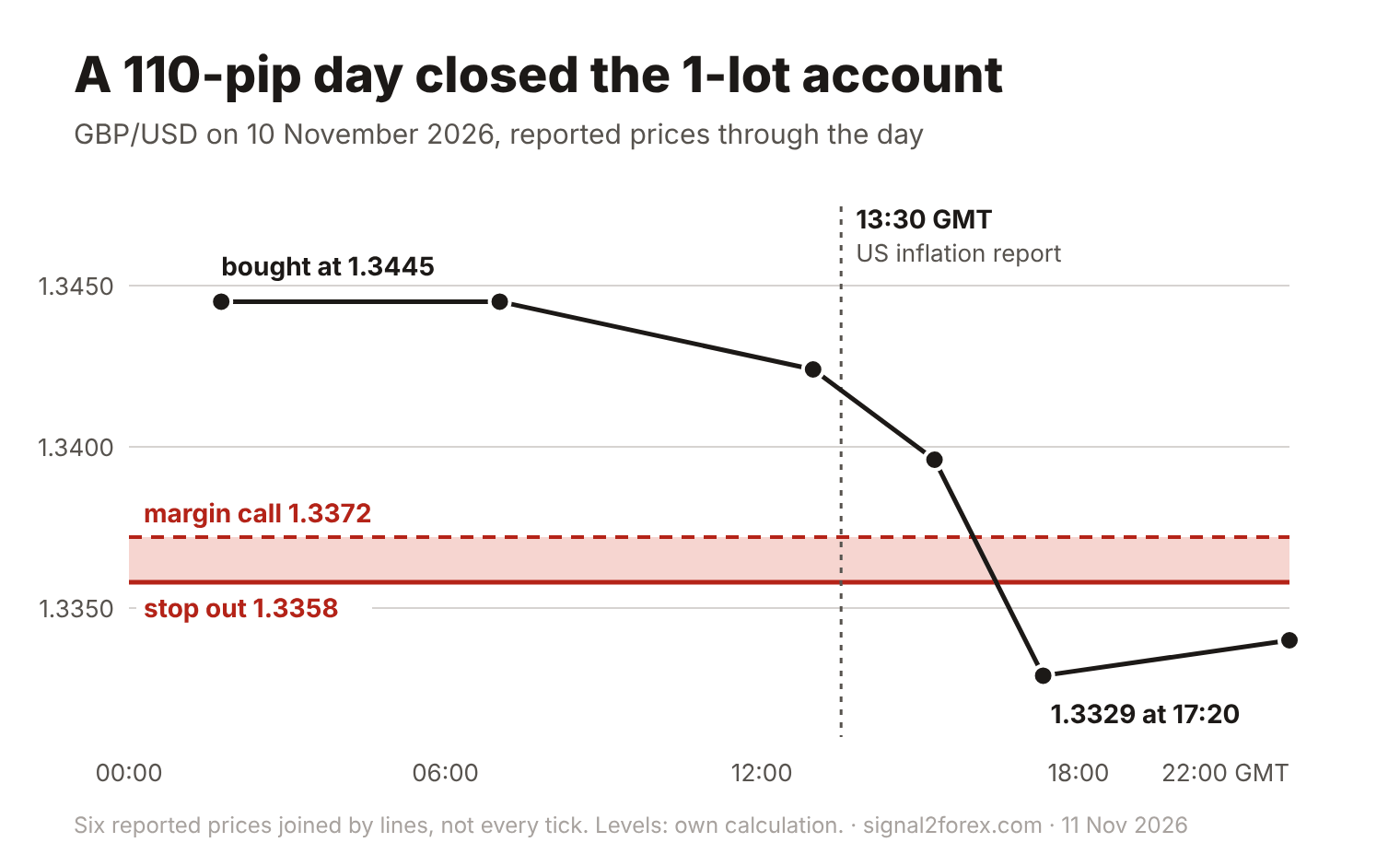
Now three accounts of $1,000 that bought at 1.3445. I leave the spread out to keep the arithmetic clean.
| Account and position | Margin call | By the evening |
|---|---|---|
| 1:500, 1.00 lot. Margin $268.90, $10 per pip | After 73 pips, at 1.3372 | Stop out after 87 pips, at 1.3358. About $134 left |
| 1:30, 0.20 lot. Margin $896.33, $2 per pip | After 52 pips, at 1.3393 | Loss $220, margin level 87%. Still open, no new orders |
| 1:500, 0.10 lot. Margin $26.89, $1 per pip | After 973 pips | Loss $110, margin level 3,310% |
What happened to them? The first account did not survive an ordinary data release. On a $100 cent account the same story is a 0.10 lot and about $13 left.
The second account is the European one. Its 30:1 limit did not let the trader open more than 0.22 lot. But the margin call came even earlier — after 52 pips — because the margin took almost all of the equity. And the third account? It lost 11%, and nothing else happened to it.
This is the forex margin call example that I would show to every beginner. Same price, same day, same money — three different endings. If you want to hold a position through a data release, you need to know the distance to the margin call in pips before you open it.
A warning without a call
Most margin call forex trading guides describe two calm steps — first a warning, then time to decide. I do not see it this way. When a beginner asks me what is a margin call in forex, I start from the second step, because the first one is often too short to use. In the first account above the distance between 100% and 50% was 14 pips.
How long is 14 pips? After a data release it can be less than a minute. A person who is at work or asleep will read the warning later, in the history of the account.
So what is margin call and how to avoid it? The first half of my answer is short — do not plan to react to it. A margin call is not a tool for managing a trade. It is a sign that the size was wrong at the open, and the open is the only place where it can be fixed cheaply.
If the line is already red, I see two clean moves — to close a part of the position or to close all of it. Opening the opposite trade, a lock, looks like a third way. On many accounts it does not free the margin, and it adds a second spread and a second swap.
The stop out is not only the protection of the broker, but also a rule of the regulator. Since 1 August 2018 European brokers have to close the positions of a retail client when equity falls to 50% of the required margin. The 50% is counted for the whole account.
To samo ESMA measures of 2018 limited leverage to 30:1 on major pairs and added negative balance protection. A retail client cannot lose more than the money on the account. National regulators later made these rules permanent. ESMA wrote at that time that 74–89% of retail accounts lose money on such products.
The reason for this protection has a date. On 15 January 2015 the Swiss National Bank removed the floor of 1.20 francs per euro, and EUR/CHF fell by thousands of pips within minutes. There were no prices at the stop out levels. Positions were closed far below them, and many accounts ended below zero.
I do not know how your broker fills a stop out in such a gap. But I am sure of one thing — the stop out level only starts the closing. The price is the one that the market gives at that second.
Outside Europe the numbers are different. In the United States the minimum margin for major pairs is 2%, which is leverage of 50:1. Many offshore brokers give 1:500 or 1:1000 and put the stop out at 20% or lower. A low stop out looks generous. It only means that less money is left when the server closes the trade.
Size before leverage
The usual advice against a forex margin call is to choose low leverage. I only half agree. Take the same 0.10 lot from the table. The 1:500 account reaches its margin call after 973 pips. A 1:30 account with the same lot reaches it after 552 pips, because the broker blocks $448 of margin instead of $27. Lower leverage means a lower margin level from the first second.
Leverage is dangerous in another way — it permits a size that the account cannot carry. With 1:500 the terminal lets a $1,000 account buy three lots of the pound. The room to the margin call is then 6 pips. A quiet hour in this pair moves more. There is more about this in my article on dźwignia na rynku forex.
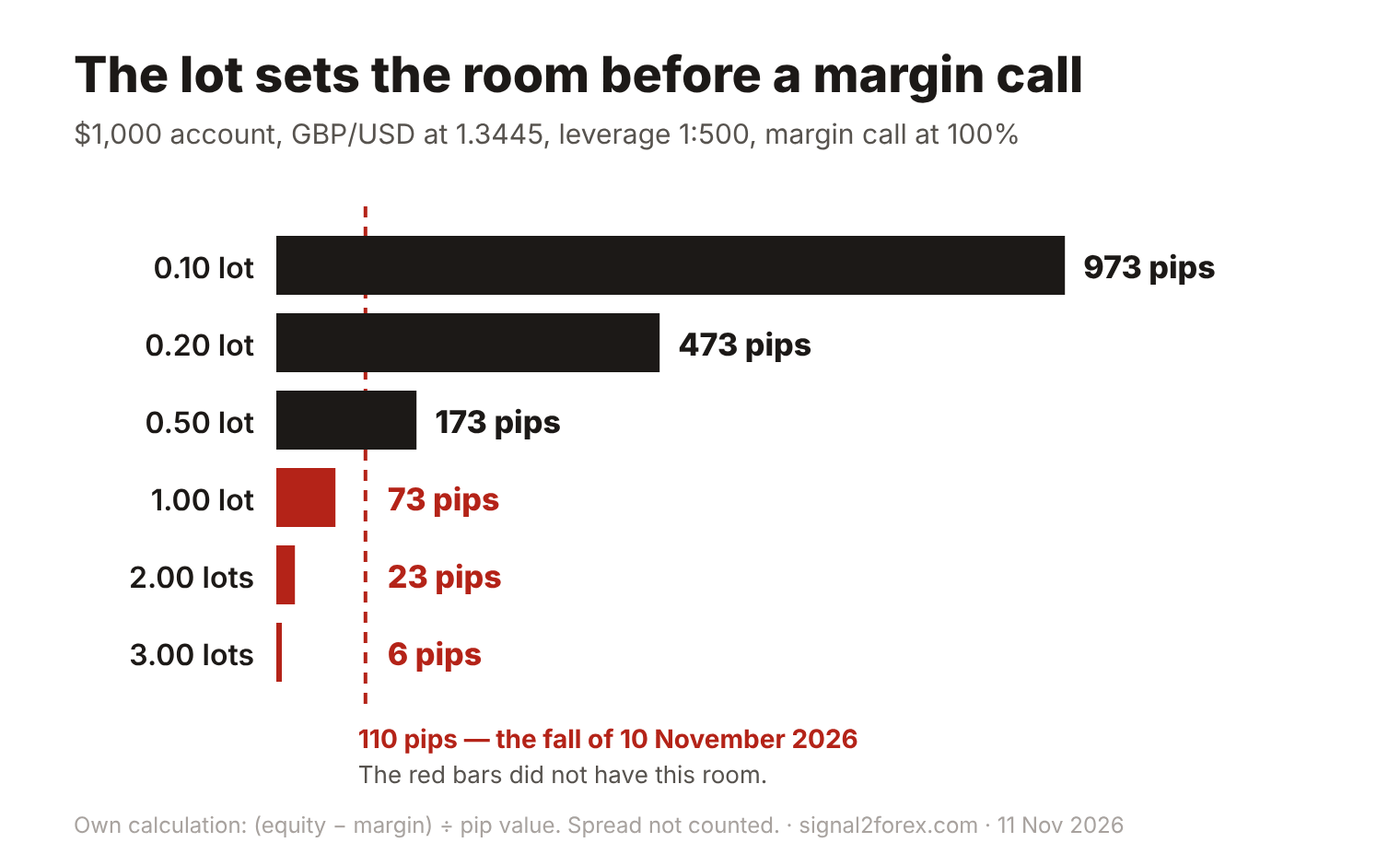
This is why I count from the other side. First the stop in pips, then the money that I agree to lose, and only then the lot. A stop of 50 pips and a risk of 1% on $1,000 is $10, and this gives 0.02 lot. On a $100 cent account it is $1 and 0.2 of a cent lot. The margin for 0.02 lot at 1:500 is $5.38, and the margin level is above 18,000%.
With such numbers the question of a margin call forex traders fear so much does not come up at all. The stop-loss closes the trade long before the margin level starts to matter. If you are not sure what one pip costs on your pair, artykuł o pestkach has the arithmetic.
Four habits for distance
The first habit — the size from the stop, as above. This is the base. Without it the other habits only move the problem to another day.
The second habit — the margin for all positions together. The margin level is one number for the whole account. Our Portfel Forex V runs 28 robots on 14 pairs, and several of them can hold positions at the same time. When I think about the deposit for such a set, I add the margin of every position that can be open at once. I look at the worst hour.
The third habit — a personal floor far above the floor of the broker. I would not open a new position if the margin level after it is below 1,000%. This is my own limit, not a standard. Why so high? It keeps the account in the part of the scale where one release of data changes nothing.
The fourth habit — attention to the hours when the margin level changes without a move on the chart. Spreads widen around 22:00 GMT, when the trading day rolls over, and before big news. Equity is counted from the worse price, so it falls with the spread. Some brokers raise the margin requirement before weekends and elections. And on Monday the market can open with a gap.
One more thing — a new deposit after the warning. It moves the red line further away, but it does not change the trade. If the size was wrong, the new money now stands behind the same wrong size. Sometimes this saves a good position. More often it only makes the loss bigger, and I would first cut the size.
The size from the stop, the margin of all positions together, a personal floor, the hours of wide spreads — all this is one thing. It is the distance between the equity and the margin. The more distance you leave at the open, the steadier the account stands on a day like 10 November.


 Signal2forex.com - Najlepsze roboty i sygnały Forex


