First published: 21 February 2019 · Reviewed and updated: 21 September 2026
Hawkish and dovish are the two words traders use to describe what a central bank is about to do with interest rates. They are the single most reliable driver of currency direction, which is why every forex trader needs to read them correctly — and why September 2026, when four major central banks moved in nine days, is such a useful case study.
Quick answer
Hawkish means a central bank favours higher interest rates to bring inflation down. This is normally bullish for its currency, because higher yields attract capital.
Dovish means a central bank favours lower interest rates to support growth and jobs. This is normally bearish for its currency, because capital moves to higher-yielding alternatives.
The forex rule: trade the surprise, not the decision. Price already contains what the market expects, so a currency only moves when the outcome is more hawkish or more dovish than what was priced in beforehand.
Hawkish /ˈhɔː.kɪʃ/ adjective · monetary policy
Describing a central bank, a policymaker or a statement that favours higher interest rates and tighter monetary policy in order to bring inflation down. In forex, a hawkish shift usually strengthens the currency.
Pronunciation: HAW-kish (first syllable rhymes with talk). Synonyms: restrictive, contractionary, tight, aggressive on inflation. Opposite: dovish. Noun: hawkishness. Person: a hawk, or monetary hawk.
“The Fed’s unanimous September 2026 hike was a clearly hawkish move, and the dollar held its bid.”
Dovish /ˈdʌv.ɪʃ/ adjective · monetary policy
Describing a central bank, a policymaker or a statement that favours lower interest rates and looser monetary policy in order to support growth and employment. In forex, a dovish shift usually weakens the currency.
Pronunciation: DUV-ish (first syllable rhymes with love, not stove). Synonyms: accommodative, expansionary, easy, growth-focused. Opposite: hawkish. Noun: dovishness. Person: a dove.
“Traders read the central bank’s dovish tone as a signal to sell the currency.”
1. What hawkish and dovish actually mean
Both words describe a central bank’s policy stance — the direction it is leaning, not just the rate it has set today. A central bank has two jobs that pull against each other: keeping inflation near target, and supporting employment and growth. Which job it currently prioritises is what makes it hawkish or dovish.
- Hawkish — inflation is the priority. Expect higher rates, tighter policy, a shrinking balance sheet.
- Dovish — growth and jobs are the priority. Expect lower rates, looser policy, an expanding balance sheet.
- Neutral — neither is dominant. Statements lean on phrases such as “data-dependent” and “meeting by meeting”.
For a forex trader the terms are shorthand for something specific: the expected path of interest rates. That path, compared with the path expected for the other currency in the pair, is what moves EUR/USD, GBP/USD or USD/JPY.
Where the terms come from
The metaphor dates from 1960s policy debate. Hawks are birds of prey — aggressive, quick to strike at inflation. Doves symbolise peace and accommodation — patient, focused on jobs and growth. The labels stuck because they compress a policymaker’s entire reaction function into one word.
Hawkish and dovish used in a sentence
- “The Bank of England delivered a hawkish hold: rates unchanged, but three of nine members voted for a rise.”
- “The dollar fell after the Fed’s dovish statement signalled rate cuts ahead.”
- “Her hawkishness has been consistent: she dissented in favour of a hike at three straight meetings.”
- “A dovish pivot from the ECB would put the euro under pressure against the dollar.”

2. Hawkish meaning and the signals to watch
Hawkish describes contractionary policy — slowing an economy down to bring prices under control. A central bank or an individual policymaker is read as hawkish when the communication points towards:
- raising the policy rate, or raising it faster than previously signalled;
- shrinking the balance sheet through quantitative tightening;
- revising inflation forecasts upward;
- describing growth as solid or resilient, implying the economy can absorb higher rates.
Language that signals a hawkish stance
- “Inflation remains elevated” — the exact phrase in the FOMC statement of 16 September 2026, published alongside a rate rise.
- “Vigilant” — ready to act; a classic tightening cue.
- “We are a long way from neutral” — more increases to come.
- “Policy may have to tighten” — the Bank of England’s September 2026 conditional warning.
- “Upside risks to inflation” — the forecast balance is tilted towards more tightening.
Why a hawkish stance lifts a currency
Higher policy rates raise the return on assets denominated in that currency. International capital moves towards the better risk-adjusted yield, and demand for the currency rises with it. The effect shows up in the forward market long before the rate actually changes, because currency pricing runs on expectations.
Trading rule: a hawkish shift is normally bullish for the currency — but only to the extent that it was not already expected.
3. Dovish meaning and the signals to watch
Dovish is the opposite of hawkish: expansionary policy aimed at supporting a soft economy. A central bank is read as dovish when the communication points towards:
- cutting the policy rate, or cutting it sooner than previously signalled;
- quantitative easing, or slowing the pace of balance-sheet reduction;
- revising growth forecasts downward;
- describing inflation as temporary, transitory or already on its way back to target.
Language that signals a dovish stance
- “Inflation is transitory” — no urgency to tighten.
- “Patient” — no imminent change; historically a strong easing cue.
- “Rates are close to neutral” — the tightening cycle is near its end.
- “Downside risks to growth” — the balance of risk favours support.
- “Well positioned to respond” — flexibility framed as readiness to ease.
Why a dovish stance weighs on a currency
Lower expected rates cut the yield on that currency’s assets. Capital rotates towards currencies with a better expected return, and the exchange rate falls. The mechanism is the same as the hawkish case, simply reversed — and just as dependent on expectations.
Trading rule: a dovish shift is normally bearish for the currency — again, only to the extent that it was not already priced in.
4. Hawkish vs dovish: comparison table
| Feature | Hawkish | Dovish |
|---|---|---|
| Priority | Bring inflation down | Support growth and employment |
| Interest rates | Raise, or hold higher for longer | Cut, or hold lower for longer |
| Balance sheet | Shrink — quantitative tightening | Expand — quantitative easing |
| View of inflation | Persistent, elevated, a risk to anchor | Temporary, easing, close to target |
| View of growth | Solid enough to absorb tighter policy | Fragile, needs support |
| Effect on the currency | Usually appreciates | Usually depreciates |
| Effect on gold and growth equities | Usually negative | Usually positive |
| Bond yields | Short-dated yields rise | Short-dated yields fall |
| Typical phrase | “Inflation remains elevated” | “Inflation is transitory” |
| September 2026 example | Fed, ECB and BoJ all raised rates | No major central bank currently easing |
The direction of the currency reaction follows this table; the size of it depends entirely on how much was priced in before the announcement.
5. Hawkish vs dovish vs bullish vs bearish
These four words get mixed up constantly, and the distinction matters. Hawkish and dovish describe the central bank. Bullish and bearish describe the price. One is a cause, the other is an effect — and the effect is not the same across every asset.
| Asset | Hawkish shift | Dovish shift |
|---|---|---|
| The central bank’s own currency | Bullish | Bearish |
| Gold | Bearish — higher real yields raise the cost of holding it | Bullish |
| Growth and technology equities | Bearish — future earnings discounted harder | Bullish |
| Long-dated government bonds | Bearish — prices fall as yields rise | Bullish |
| Carry trades funded in that currency | Bearish — funding becomes more expensive | Bullish |
So “hawkish is bullish” is only true of the currency. For most other assets a hawkish central bank is the bearish side of the trade.
Test yourself: “Inflation remains elevated and the Committee is vigilant.” — hawkish or dovish?
Hawkish. “Elevated” inflation plus “vigilant” signals readiness to tighten. Bullish for the currency, bearish for gold — provided the market had not already priced that language in.
6. Dovish hike, hawkish cut and other variants
Most of the confusion in this topic comes from the compound terms, because several of them appear to contradict themselves. They only make sense once you accept that forex prices the path of rates, not the level.
- Dovish hike
- A rate increase delivered with soft guidance — a split vote, or a hint that this increase may be the last. The currency can fall despite the higher rate, because the expected path beyond today has been lowered.
- Hawkish cut
- A rate cut delivered with firm guidance that no more cuts are coming, sometimes with dissents against cutting at all. The currency can rise, because the market had priced in more easing than it received.
- Hawkish hold
- No change in the rate, but language or dissenting votes pointing to a possible rise. The Bank of England on 17 September 2026 is the textbook case: unchanged at 3.75%, but a 6–3 vote and an explicit warning that policy may have to tighten.
- Dovish hold
- No change in the rate, with language pointing towards a future cut — often a first step towards a pivot.
- Dovish pivot
- A full turn from a tightening bias to an easing bias. Most of the currency weakness happens before the first cut lands, as the market re-prices the path.
- Hawkish pivot
- The reverse: an easing bias replaced by a tightening bias. The Fed’s move from three cuts in late 2025 to a hike in September 2026 is a live example.
- Hawkish tilt, hawkish shift, hawkish bias
- A small hardening of tone rather than a policy change: one more dissenting vote, an easing reference removed from the statement, an inflation forecast revised up. These move currencies precisely because they change the expected path.
- Hawkishness and dovishness
- The noun forms, used to describe the degree of a stance: “the hawkishness of the projections surprised the market”.
- Monetary hawk, monetary dove
- The individual policymakers. Vote splits and speeches reveal where each sits, which is why dissent counts are watched so closely.
7. How policy actually moves currency pairs
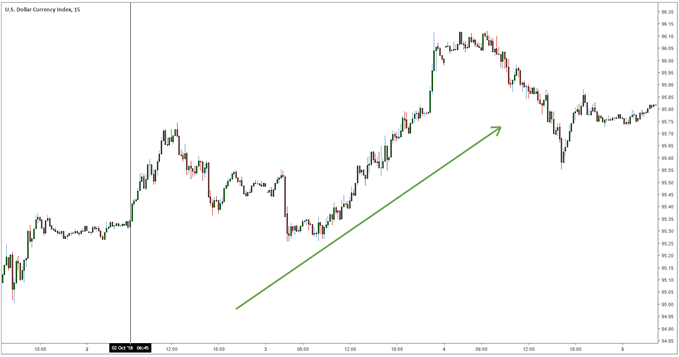
A currency pair is a relative price, so what matters is never one central bank in isolation — it is the rate differential between the two, and how that differential is expected to change. The chart below shows the four differentials that matter most, and the turn that happened in 2026.
The mechanism, step by step
- A central bank signals a higher expected rate path.
- Short-dated government bond yields in that currency rise within seconds.
- The yield advantage over the other currency in the pair widens.
- Capital flows towards the higher yield, and the currency appreciates.
Step one is the whole trade. By the time a rate change is actually implemented, the currency has usually already moved — which is why forward guidance, the vote split and the projections matter more to a forex trader than the headline number.
Why the surprise is the trade
September 2026 produced the cleanest illustration of this principle in years. The Bank of Japan raised its policy rate to around 1.25% on 18 September, the highest level since 1995. Prediction markets and economist surveys had put the probability of that hike at close to certainty beforehand. The rate went up — and the yen weakened, because the decision contained no new information, and traders turned instead to the two dissenting votes and the guidance.
The lesson: a rate rise is not automatically bullish for a currency. What is bullish is a rate path that turns out higher than the market had already assumed. Always check the pricing before the event, not just the outcome after it.
8. Where the major central banks stand now
As of 21 September 2026, every major central bank leans hawkish — an unusual alignment driven by an energy-price shock that has kept headline inflation above target across the developed world. The differences are in degree, and that is where the currency trades are.
| Central bank | Policy rate | Latest decision | Stance | Next meeting |
|---|---|---|---|---|
| Federal Reserve | 3.75–4.00% | 16 Sep 2026: +25 bp, unanimous 12–0 | Hawkish — actively tightening; 16 of 18 participants project at least one further rise this year | 28 Oct 2026 |
| European Central Bank | 2.50% deposit rate | 10 Sep 2026: +25 bp on all three key rates | Hawkish — second rise of 2026; inflation forecasts revised up for 2027 and 2028 | 29 Oct 2026 |
| Bank of England | 3.75% | 17 Sep 2026: hold, 6–3 vote | Hawkish hold — three members voted for 4.00%; the MPC warned policy may have to tighten | 5 Nov 2026 |
| Bank of Japan | around 1.25% | 18 Sep 2026: +25 bp, 7–2 vote | Hawkish — highest rate since 1995; hiking interval has shortened from six months to three | Late Oct 2026 |
Stances are read directly from the official statements, vote records and projections linked in Sources. Rates as of 21 September 2026.
9. Real decisions, 2024–2026
Federal Reserve: from three cuts to a hike in nine months
The Fed held at 5.25–5.50% through most of 2024 — a hawkish hold that kept the dollar well bid — then cut through late 2024 and again in September, October and December 2025, reaching 3.50–3.75%. That was the dovish phase, and the dollar softened with it.
It reversed in 2026. Three FOMC members dissented in favour of a hike as early as the July meeting. On 16 September 2026 the Committee raised the target range by 25 basis points to 3.75–4.00% on a unanimous 12–0 vote — its first increase since 2023 — stating that “inflation remains elevated” and that the action would “support a timelier return to the Committee’s 2 percent goal”. The projections were the hawkish part: 16 of 18 participants saw at least one more increase in 2026, and four saw two.
ECB: two hikes in one year after a long easing cycle
The ECB cut its deposit rate steadily from 4.00% in early 2024 to 2.00% by June 2025, then held. The energy shock changed the calculus: it raised rates to 2.25% in June 2026 and again on 10 September 2026, taking the deposit facility to 2.50%, the main refinancing rate to 2.65% and the marginal lending rate to 2.90%. Staff projections put inflation at 3.0% in 2026, revised up to 2.5% for 2027 and 2.1% for 2028, with growth upgraded to 0.9% and 1.4%. President Lagarde framed risks as tilted to the downside for growth and to the upside for inflation, and repeated that decisions are taken meeting by meeting.
Bank of England: the hawkish hold
Bank Rate was cut by a cumulative 1.5 percentage points between August 2024 and December 2025, reaching 3.75%, and has been held there ever since. On 17 September 2026 the MPC held again by 6–3, with three members voting for an immediate rise to 4.00%. UK CPI inflation was 3.1% in August 2026 and the Committee expects it to rise further, warning that if the energy shock persists “it is likely that policy may have to tighten”. Alongside the rate decision, the MPC set a multi-year path to reduce its gilt holdings to zero through £20 billion of annual sales.
Bank of Japan: normalisation, accelerating
The BoJ left negative rates behind in March 2024 and has tightened in steps since: 0.25% in July 2024, 0.50% in January 2025, 0.75% in December 2025, 1.00% in June 2026 and around 1.25% on 18 September 2026 — the highest since 1995 — on a 7–2 vote. The interval between hikes has compressed from roughly six months to three, the fastest pace under Governor Ueda. As described above, the yen weakened anyway, because the move was fully anticipated.
10. How to trade a policy decision
Before the announcement
Pre-announcement checklist
- Establish what is priced in. Read the probability from rate futures or overnight index swaps. This is the baseline everything is measured against.
- Re-read the previous statement. The trade is in the difference between the two texts, so know the exact wording you are comparing to.
- Note the current vote split. A move from 7–2 to 6–3 is a hawkish shift even with no rate change.
- Check whether projections are due. Meetings with updated forecasts or a dot plot carry far more risk than meetings without.
- Identify the pair with the widest policy divergence. A hawkish bank against a dovish one gives a cleaner trade than a hawkish bank against another hawkish one.
- Define risk before the release. Size the position, set the stop beyond the pre-announcement range, and accept that spreads will widen.
Scenario A: the outcome is more hawkish than priced
- Expect the currency to rally and short-dated yields to rise.
- The cleanest expression is long that currency against one whose central bank has a dovish or neutral bias.
- Watch for the fade: if the hawkish element was in the headline but the guidance was soft, the initial move often reverses within the hour.
Scenario B: the outcome is more dovish than priced
- Expect the currency to fall, with gold and rate-sensitive equities supported.
- Consider waiting for the first retracement — the initial spike is usually the worst entry of the session.
- Check the dissents before concluding the pivot is real. One soft statement is not a trend.
Scenario C: the outcome matches expectations
- The rate itself is a non-event; the reaction comes from the projections, the vote and the press conference.
- This was the Bank of Japan in September 2026 — a fully priced hike that left the currency weaker.
- If nothing in the communication differs from the previous meeting, the correct trade is often no trade.
11. Phrase-by-phrase reference table
| Phrase in the statement | Signal | Usual currency implication |
|---|---|---|
| “Inflation remains elevated” | Hawkish | Supportive |
| “Vigilant” | Hawkish | Supportive |
| “We are a long way from neutral” | Hawkish | Supportive |
| “Policy may have to tighten” | Hawkish | Supportive |
| “Upside risks to inflation” | Hawkish | Supportive |
| “Inflation is transitory” | Dovish | Negative |
| “Patient” | Dovish | Negative |
| “Rates are close to neutral” | Dovish | Negative |
| “Downside risks to growth” | Dovish | Negative |
| “Data-dependent”, “meeting by meeting” | Neutral | Little on its own — read the forecasts |
| A dissent count that rises | Shift towards that side | Moves even without a rate change |
Context decides the size of the reaction: a hawkish phrase arriving when the market expected dovish language has far more impact than the same phrase when it was anticipated.
12. Frequently asked questions
What does hawkish mean in trading?
Hawkish describes a central bank stance focused on bringing inflation down through higher interest rates and tighter policy. For traders it is shorthand for a rising expected rate path, which is usually bullish for that central bank’s currency because higher yields attract capital.
What does dovish mean in forex?
Dovish describes a central bank stance focused on supporting growth and employment through lower interest rates and looser policy. In forex a dovish shift is usually bearish for the currency, because the expected yield falls and capital moves to higher-yielding currencies.
What is the difference between hawkish and dovish?
Hawkish means fighting inflation with higher rates and tighter policy, and the currency usually strengthens. Dovish means supporting growth with lower rates and looser policy, and the currency usually weakens. The size of the market reaction depends on how much of the stance was already priced in before the announcement.
Is hawkish bullish or bearish?
Hawkish is usually bullish for the currency but bearish for rate-sensitive assets such as gold, long-duration bonds and growth stocks. Dovish is the mirror image: bearish for the currency, usually supportive for gold and equities. Hawkish and dovish describe the central bank; bullish and bearish describe the price.
What is the opposite of hawkish?
The opposite of hawkish is dovish. A hawkish policymaker favours higher rates and tighter policy; a dovish policymaker favours lower rates and looser policy. The noun forms are hawkishness and dovishness, and a policymaker in between is described as neutral or centrist.
Is the Fed hawkish or dovish right now?
As of 21 September 2026 the Federal Reserve is hawkish and actively tightening. On 16 September 2026 the FOMC raised the target range by 25 basis points to 3.75–4.00% on a unanimous 12–0 vote, its first increase since 2023, saying inflation remains elevated. The September projections showed 16 of 18 participants expecting at least one further increase this year. The next decision is on 28 October 2026.
What is a dovish hike?
A dovish hike is a rate increase paired with soft guidance, for example a split vote or a hint that the increase may be the last in the cycle. Because forex prices the expected path of rates rather than the level, a dovish hike can weaken the currency even though the rate has just gone up.
What is a hawkish cut?
A hawkish cut is a rate cut delivered with firm guidance that further cuts are unlikely, sometimes with dissenting votes against the cut. The currency can rise on the announcement because the market had priced in more easing than the central bank delivered.
What is a hawkish hold?
A hawkish hold is an unchanged policy rate combined with language or dissenting votes that point to a possible increase. The Bank of England on 17 September 2026 held Bank Rate at 3.75% by a 6–3 vote, with three members voting for an immediate rise to 4%, and warned that policy may have to tighten.
What does a dovish pivot mean for forex traders?
A dovish pivot is a shift from a tightening bias to an easing bias. The currency typically weakens as the market prices in cuts, and most of that move happens before the first cut is actually delivered. Traders usually respond by selling that currency against one whose central bank still has a hawkish bias.
How do you trade a hawkish surprise?
Compare the outcome with what was priced in beforehand using rate futures or overnight index swaps. If the decision, the vote split or the projections are more hawkish than that baseline, the currency normally rallies. Position sizes should be set before the release, with stops placed beyond the pre-announcement range, because spreads widen and slippage is common in the first minutes.
Why did the yen fall after the Bank of Japan raised rates in September 2026?
Because the increase was almost fully priced in. The Bank of Japan raised its policy rate to around 1.25% on 18 September 2026, the highest level since 1995, but market pricing had put the probability near certainty beforehand, so the decision itself carried no new information. The yen weakened as traders focused on the two dissenting votes and the guidance instead. It is a clean example of the rule that forex trades the surprise, not the decision.
Why does a single word in a central bank statement move markets?
Because the market prices an expected path of interest rates, not just today’s rate. Replacing a word such as “patient” with “vigilant”, or dropping a reference to future easing, re-prices that entire path, so the currency can move instantly even though no rate has changed. This is why traders compare each statement word by word with the previous one.
How do you pronounce hawkish and dovish?
Hawkish is pronounced HAW-kish, with the first syllable rhyming with “talk”. Dovish is pronounced DUV-ish, with the first syllable rhyming with “love” rather than with “stove”. The Listen buttons in the definition boxes on this page read both terms aloud in a sentence.
Which central banks are hawkish and which are dovish right now?
As of 21 September 2026 all four majors lean hawkish. The Federal Reserve raised rates on 16 September to 3.75–4.00%, the ECB raised its deposit rate to 2.50% on 10 September, the Bank of Japan raised its policy rate to around 1.25% on 18 September, and the Bank of England held Bank Rate at 3.75% on 17 September with three of nine members voting for an increase. No major central bank currently has an easing bias.
What is a hawkish tilt or hawkish bias?
A hawkish tilt, also called a hawkish shift or hawkish bias, is a small hardening of tone rather than a change in the rate itself. Typical signs are an extra dissenting vote, the removal of an easing reference from the statement, or an upward revision to the inflation forecast. These shifts move currencies because they change the expected rate path.
13. Sources
Every rate, vote split and quotation on this page is taken from the primary source:
- Federal Reserve — FOMC statement of 16 September 2026, implementation note and Summary of Economic Projections: federalreserve.gov
- Federal Reserve — FOMC meeting calendar and past statements: federalreserve.gov/monetarypolicy/fomccalendars.htm
- Federal Reserve — H.15 Selected Interest Rates: federalreserve.gov/releases/h15
- European Central Bank — monetary policy decisions and staff projections: ecb.europa.eu
- European Central Bank — key ECB interest rates, historical series: ecb.europa.eu/stats
- Bank of England — Monetary Policy Summary and minutes, September 2026: bankofengland.co.uk
- Bank of Japan — monetary policy decisions and statements: boj.or.jp/en/mopo
- Bank for International Settlements — effective exchange rate indices: bis.org/statistics/eer.htm
Charts on this page are drawn by the Signal2Forex research desk directly from the policy statements listed above. Figures are current as of 21 September 2026.
Go deeper on central bank power: read how central banks impact the forex market — interest rates, quantitative easing, forward guidance and the tools that move currencies every day.
Track the divergence: see Weekly Focus: team dovish or hawkish to prevail? for how policy divergence between central banks plays out week by week.


 Signal2forex.com - Best Forex robots and signals


