Interest rates are the single most important fundamental driver of currency values in the forex market. This comprehensive guide explains what interest rates are, how they affect currencies, how to trade interest rate differentials, and proven strategies to profit from central bank decisions in 2026.
1. What Are Interest Rates and Why Do They Matter to Forex Traders?
When traders talk about interest rates, they are usually referring to central bank interest rates — the rate at which a central bank lends money to commercial banks. These rates are the most powerful tool central banks have to control inflation, manage economic growth, and influence their currency’s value. The central bank has several monetary policy tools it can use to influence the interest rate. The most common are open market operations (the purchase and sale of securities to influence interest rates) and the discount rate (the rate charged to commercial banks on loans from their regional Federal Reserve Bank’s lending facility).
Interest rates are of utmost importance to forex traders because when the expected rate of interest rates change, the currency generally follows. Central banks have two main tasks: to manage inflation and promote stability for their country’s exchange rate. They do this by changing interest rates and managing the nation’s money supply. When inflation is ticking upwards, above the central bank’s target, they will increase the central bank rate, which can restrict the economy and bring inflation back in check.
The economic cycle and interest rates: Economies are either expanding or contracting. When economies are expanding, everyone is better off, and when economies are contracting (recession), they are worse off. The central bank aims to keep inflation in check while allowing the economy to grow at a modest pace, all by managing the interest rate. When economies are expanding (GDP growth positive), consumers start to earn more. More earning leads to more spending, which leads to more money chasing fewer goods — triggering inflation. If inflation is left unchecked it can be disastrous, so the central bank attempts to keep inflation at its target level, which is 2% (for most central banks), by increasing interest rates. Increased interest rates make borrowing costlier and helps reduce spending and inflation.
📌 Key Definition: Interest rates are the cost of borrowing money. Central bank interest rates are the primary tool used to control inflation and influence currency values. Higher rates typically strengthen a currency; lower rates typically weaken it.
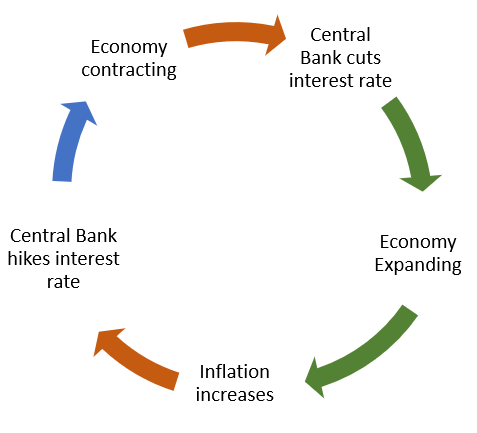
Fig 1: Central bank interest rates as of 2026 — the Federal Reserve, ECB, Bank of England, Bank of Japan, and RBA.
2. How Do Interest Rates Affect Currencies?
The way interest rates impact the forex markets is through a change in expectations of interest rates that lead to a change in demand for the currency. When a country raises interest rates, its currency typically appreciates because higher rates attract foreign investment seeking higher yields. Conversely, when a country lowers interest rates, its currency typically depreciates as investors seek better returns elsewhere.
Imagine you are an investor in the UK that needs to invest a large sum of money in a risk-free asset, like a government bond. Interest rates in the US are on the rise so you start to buy US Dollars to invest in the US government bonds. You are not alone in investing in the country with higher interest rates. Many other investors follow the increase in yield and so increase the demand for US Dollars which appreciates the currency. This is the essence of how interest rates affect currencies.
The scenario table below illustrates the possible outcomes:
| Market Expectation | Actual Result | Resulting FX Impact | Example (2026) |
|---|---|---|---|
| Rate Hike | Rate Hold | Depreciation of currency | Fed expected to hike, holds → USD weakens |
| Rate Cut | Rate Hold | Appreciation of currency | ECB expected to cut, holds → EUR strengthens |
| Rate Hold | Rate Hike | Appreciation of currency | BoE expected to hold, hikes → GBP strengthens |
| Rate Hold | Rate Cut | Depreciation of currency | RBA expected to hold, cuts → AUD weakens |
| Hawkish Statement | — | Currency appreciates | Forward guidance signals future hikes |
| Dovish Statement | — | Currency depreciates | Forward guidance signals future cuts |
Real-world example (2026): When the Reserve Bank of Australia was expected to keep interest rates on hold but instead hiked them, the market was surprised. The AUD/USD appreciated significantly as traders adjusted their positions to reflect the unexpected tightening.
⚠️ Important: The market reacts to expectations of rate changes, not just the actual rate decision itself. If the market has already priced in a rate hike, the currency may not move much when the hike is announced.
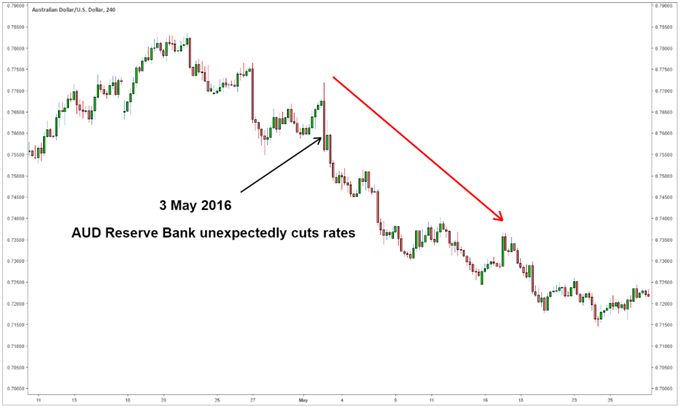
Fig 2: How higher interest rates attract foreign capital and strengthen a currency.
3. Understanding Forex Interest Rate Differentials
Interest rate differentials are simply differences in interest rates between two countries. If a trader expects the US to unexpectedly hike interest rates, he/she anticipates the US dollar may appreciate. To increase the trader’s chances of success, the trader can buy the US Dollar against a currency with low interest rates as the two currencies are diverging in the direction of their respective interest rates.
Interest rates and their differentials have a large influence on the appreciation and depreciation of the currency pair. The changes in interest rate differentials are correlated to the appreciation and depreciation of the currency pair. The chart below compares the AUD/USD currency pair (candlestick graph) and the difference between the two-year AUD government bonds and the two-year USD government bonds (orange graph). The relationship shows that as the AUD bonds yield decreases relative to the USD bonds, so does the currency.
Interest rate differentials are widely used in carry trades. In a carry trade, money is loaned from a country with a low rate and invested in a country with a higher interest rate. For example, a trader might borrow in Japanese Yen (low rate) and invest in US Dollars (higher rate) to profit from the interest rate differential. However, there are risks involved with the carry trade, such as the currency invested in depreciating relative to the currency used for funding the trade.
💡 Pro Tip: The wider the interest rate differential between two countries, the stronger the potential impact on their currency pair. Traders should monitor central bank policy divergence closely.
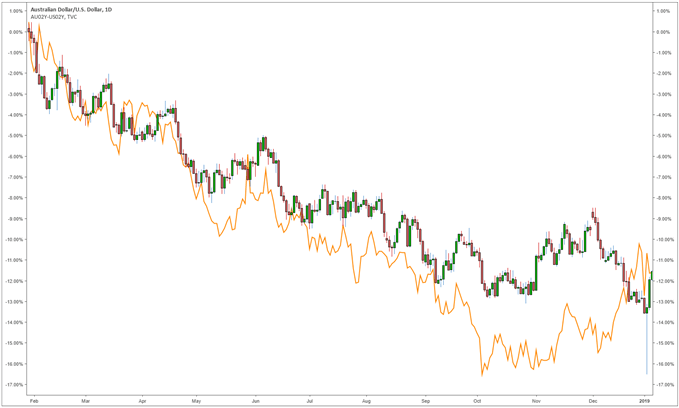
Fig 3: AUD/USD currency pair compared to the two-year AUD and USD government bond yield differential.
4. How to Forecast Central Bank Rates and the Impact on FX Markets
Fed funds futures are contracts traded on the Chicago Mercantile Exchange (CME) that represent the market’s expectations of where the daily official federal funds rate will be when the contract expires. The market always has its own forecast of where the interest rate will be. A trader’s job is to forecast a change in those expectations.
For a trader to forecast central bank rates, they will need to keep a close eye on what the central bankers are currently monitoring. Central bankers try to be as transparent as possible to the public about when they expect to increase interest rates and which economic data they are currently monitoring. The central bankers decide to increase or decrease interest rates based on several economic data points. You can keep up to date with the release of these data points using an economic calendar.
Key economic indicators to monitor:
- Inflation (CPI): The primary driver of rate decisions. High inflation → Rate hikes.
- Employment (NFP): Labour market health. Strong jobs → Rate hikes.
- GDP Growth: Economic expansion. Strong growth → Rate hikes.
- Retail Sales: Consumer spending. Strong spending → Rate hikes.
- PMI Data: Business activity. Strong PMI → Rate hikes.
- Wage Growth: Inflation pressure. Rising wages → Rate hikes.
The trader must be in tune with the central bank policy makers and almost try to forecast what their actions will be before they state it to the public. This way the trader can reap the benefits of the market’s change in expectations. This method of trading is based on fundamental analysis, which is different to trading using technical analysis.
✅ Key Takeaway: Forecasting central bank rates requires monitoring economic data, following central bank communication, and understanding market expectations. The most successful traders combine these elements to anticipate rate changes before they happen.
5. Forex Interest Rate Trading Strategies
There are several proven trading strategies that incorporate interest rates and central bank decisions. Here are the most effective approaches:
Strategy #1 — News Trading (Rate Decision Trading)
Forex traders can opt to trade the result of the interest rate news release, buying or selling the currency the moment the news releases. This strategy requires fast execution and a clear understanding of how the market is likely to react to different outcomes.
- Setup: Identify the upcoming rate decision and the market’s consensus expectation
- Entry: Enter immediately after the news release in the direction of the surprise
- Stop-Loss: Place a tight stop-loss to manage volatility
- Take-Profit: Target the first support or resistance level
Strategy #2 — Differential Trading (Carry Trade)
Advanced forex traders may attempt to forecast changes in central banker’s tones, which can shift market expectations. Traders will do this by monitoring key economic variables like inflation, and trade before central banker’s speeches. In a carry trade, money is loaned from a country with a low rate and invested in a country with a higher interest rate.
- Setup: Identify a currency pair with a wide interest rate differential
- Entry: Buy the high-yielding currency and sell the low-yielding currency
- Stop-Loss: Place stop-loss based on technical levels
- Take-Profit: Hold for the interest rate differential or set a target based on technical analysis
Strategy #3 — Expectation Trading (Forward Guidance)
This strategy involves trading changes in market expectations rather than the actual rate decision. Traders monitor central bank speeches, economic data, and market pricing to anticipate shifts in expectations.
- Setup: Monitor central bank communication and economic data
- Entry: Enter when expectations shift (e.g., from rate cut to rate hold)
- Stop-Loss: Place stop-loss based on technical levels
- Take-Profit: Target the next support or resistance level
Strategy #4 — Pullback Trading
Another method is to wait for a pullback on the currency pair after the interest rate result. If the central bank unexpectedly hiked rates, the currency should appreciate. A trader could wait for the currency to depreciate before executing a buy position — anticipating that the currency will continue to appreciate.
- Setup: Wait for the rate decision and the initial market reaction
- Entry: Enter on a pullback to a key support or moving average
- Stop-Loss: Place stop-loss below the pullback low
- Take-Profit: Target the previous high or the next resistance level
⚠️ Important: All trading strategies carry risk. Always use stop-loss orders and maintain a positive risk-reward ratio (minimum 1:2). Never trade with money you cannot afford to lose.
6. Key Concepts: Interest Rates and Forex
Understanding these key concepts is essential for any trader looking to trade interest rates effectively:
- The interest rate decisions themselves tend to be less important than the expectations for future interest moves. The market prices in expected rate changes well in advance. The actual surprise — the deviation from expectations — is what moves the market.
- Trading currencies with increased interest rate differentials could increase the probability of successful trades. The wider the differential, the stronger the potential move.
- It is important to keep up to date with economic data using an economic calendar to forecast potential changes in market expectations. Data releases like CPI, NFP, and GDP can shift expectations significantly.
- Central bank forward guidance is a powerful tool. When central bankers signal their future intentions, markets react immediately.
- Hawkish vs Dovish: A hawkish central bank favours higher rates to control inflation (which strengthens the currency). A dovish central bank favours lower rates to stimulate growth (which weakens the currency).
📌 Key Insight: The most successful interest rate traders focus on changes in expectations, not just the actual rate decisions. By anticipating shifts in central bank communication and economic data, traders can position themselves ahead of the market.
7. Interest Rates & Forex Reference Table
Use this reference table to quickly understand key terms, identify central bank rates, and follow a trading checklist.
Part 1: Central Bank Interest Rates (2026)
| Central Bank | Currency | Current Rate | Next Meeting | Market Expectation |
|---|---|---|---|---|
| Federal Reserve | USD | 3.50–3.75% | July 2026 | Hold |
| European Central Bank | EUR | 3.50% | July 2026 | Hold/Cut |
| Bank of England | GBP | 5.25% | August 2026 | Hold |
| Bank of Japan | JPY | -0.10% | July 2026 | Hold |
| Reserve Bank of Australia | AUD | 4.35% | August 2026 | Hold |
| Reserve Bank of New Zealand | NZD | 5.50% | July 2026 | Hold |
| Bank of Canada | CAD | 4.75% | July 2026 | Hold |
Part 2: Interest Rate Scenario Impact on FX
| Market Expectation | Actual Result | Resulting FX Impact | Example (2026) |
|---|---|---|---|
| Rate Hike | Rate Hold | Depreciation of currency | Fed expected to hike, holds → USD weakens |
| Rate Cut | Rate Hold | Appreciation of currency | ECB expected to cut, holds → EUR strengthens |
| Rate Hold | Rate Hike | Appreciation of currency | BoE expected to hold, hikes → GBP strengthens |
| Rate Hold | Rate Cut | Depreciation of currency | RBA expected to hold, cuts → AUD weakens |
| Hawkish Statement | — | Currency appreciates | Forward guidance signals future hikes |
| Dovish Statement | — | Currency depreciates | Forward guidance signals future cuts |
Part 3: Key Economic Indicators to Monitor
| Indicator | Why It Matters | Impact on Interest Rates |
|---|---|---|
| Inflation (CPI) | Primary driver of rate decisions | High inflation → Rate hikes |
| Employment (NFP) | Labour market health | Strong jobs → Rate hikes |
| GDP Growth | Economic expansion | Strong growth → Rate hikes |
| Retail Sales | Consumer spending | Strong spending → Rate hikes |
| PMI Data | Business activity | Strong PMI → Rate hikes |
| Wage Growth | Inflation pressure | Rising wages → Rate hikes |
Part 4: Quick Reference Checklist
8. Frequently Asked Questions (FAQ)
How do interest rates affect forex trading?
Higher interest rates typically strengthen a currency by attracting foreign investment seeking higher returns. Lower rates weaken a currency as investors seek better returns elsewhere.
What is the relationship between interest rates and currency values?
When a country raises interest rates, its currency typically appreciates because higher rates attract foreign capital. Conversely, rate cuts usually lead to currency depreciation.
What are interest rate differentials in forex?
Interest rate differentials are the difference in interest rates between two countries. They are a key driver of currency pair movements and are widely used in carry trades.
How can I trade interest rate decisions?
You can trade the actual rate decision (news trading), trade interest rate differentials (carry trade), or trade changes in market expectations.
What is the carry trade strategy?
The carry trade involves borrowing in a low-interest-rate currency and investing in a high-interest-rate currency to profit from the interest rate differential.
Which central bank decisions impact forex the most?
The Federal Reserve (USD), European Central Bank (EUR), and Bank of England (GBP) have the most significant impact on forex markets due to the size and importance of their currencies.
How do I forecast central bank rate changes?
Monitor economic data (inflation, employment, GDP), follow central bank forward guidance, and track market expectations using Fed funds futures.
What is the difference between hawkish and dovish?
Hawkish means favouring higher interest rates to control inflation, which typically strengthens the currency. Dovish means favouring lower rates to stimulate growth, which typically weakens the currency.
How do interest rate expectations affect currency pairs?
Currency markets react to expectations of future rate changes, not just actual rate decisions. If the market expects a rate hike, the currency often appreciates in advance.
What is the impact of interest rate hikes on the US dollar?
Interest rate hikes by the Federal Reserve typically strengthen the US dollar as higher rates attract foreign capital seeking better returns.
How do interest rate cuts affect emerging market currencies?
Rate cuts in developed economies can weaken the currency, which may strengthen emerging market currencies as investors seek higher yields elsewhere.
What is the best strategy for trading interest rate news?
The best strategy depends on your trading style. News trading works for short-term traders, while carry trades and differential trading work for longer-term traders.
9. Conclusion
Interest rates are the single most important fundamental driver of currency values in the forex market. By understanding what they are, how they affect currencies, and how to trade them, you can significantly improve your trading results.
Key takeaways from this guide:
- ✅ Interest rates are set by central banks to control inflation and manage economic growth
- ✅ Higher rates typically strengthen a currency; lower rates typically weaken it
- ✅ Expectations matter more than actual rate decisions
- ✅ Interest rate differentials are a key driver of currency pair movements
- ✅ Effective strategies include news trading, carry trades, expectation trading, and pullback trading
- ✅ Risk management is essential — always use stop-loss orders and maintain a 1:2 risk-reward ratio
📌 Final Advice: Trading interest rates can be highly rewarding, but it requires education, discipline, and patience. Start with a demo account, learn the fundamentals, develop a trading plan, and always manage your risk. The key to success is not how much you make on winning trades, but how much you protect your capital on losing trades.
Continue your trading education — explore the guides below to deepen your understanding of forex trading and technical analysis.
📞 Need Help? Contact Us
Our support team is ready to assist you with any questions about interest rates, forex trading, or our products and services.
📌 Support Hours: Our team is available 24/5 via WhatsApp, Telegram, and Live Chat. We respond to all inquiries within 24 hours on business days.


 Signal2forex.com - Best Forex robots and signals


