
By Uladzimir Leuchankou, founder of Signal2Forex · readings from 6 November 2026
What is IG client sentiment? The usual answer is a percentage — 63% of IG accounts are long EUR/USD, 37% are short — plus a rule that says do the opposite of the crowd. I suppose that is an answer too. But for me the number is not a trade.
It is a count of people, and people are late to most moves. This page, written in November 2026, is about what that count can tell you and what it cannot.
| Market | IG accounts long / short | Price on 6 Nov 2026 |
|---|---|---|
| EUR/USD | 63% / 37% | 1.1138, flat on the day |
| GBP/USD | 53% / 47% | 1.3359, down 0.68% |
| USD/JPY | 39% / 61% | 158.45, up 0.49% |
IG client sentiment on the evening of Friday 6 November 2026, the last reading before the weekend. The split is rounded to 1% by IG and refreshes every 15 minutes.
What the number counts
IG sentiment is a count of accounts, not of money. IG looks at every client account with an open position in a market and sorts it into one of two bins — long or short. An account with one mini lot and an account with fifty standard lots each count as one. The page shows the split to the nearest 1% and refreshes it every 15 minutes.
That is the whole IG client sentiment index — two bins and a clock.
This matters because the number is small next to the market. The Bank for International Settlements counted $9.6 trillion of FX turnover per day in April 2025. Retail accounts at one broker are a thin slice of that. So the IG sentiment report does not tell you where the big money sits. It tells you where the small money sits — and the small money has a habit. It buys dips that keep falling and sells rallies that keep rising.
The data used to live on a separate site. The IG client sentiment DailyFX page closed on 4 September 2024, when IG redirected DailyFX to its own site. Today the split sits on each market page of the IG platform, under the price. The old IG client sentiment API that fed third-party dashboards went away with DailyFX. If you see a site still quoting an IG client sentiment forex feed, check the date on it first.
IG sentiment as a contrarian signal
Why would you trade against people? Because of where their stops are. A trader who is long EUR/USD at 1.1140 has a stop somewhere below — 1.1100, maybe 1.1080. When 63% of accounts are long, most of those stops sit under the price. A small push down hits the first stops, the stops sell, and the push grows. This is the mechanism behind the old saying that the crowd is wrong.
Retail traders are not foolish. Their exits are simply clustered on one side.
So the IG sentiment indicator reads like this: a crowd that is long is fuel for a fall, a crowd that is short is fuel for a rise. The strength of the signal is the distance from 50/50. At 53/47 — GBP/USD on Friday — there is no crowd, only noise. At 63/37 there is a lean. At 75/25 there is a one-sided market, and that is where the sharp moves start.
The numbers behind the lean are worth running once. Take the EUR/USD split of 63 long against 37 short — a ratio of 1.7 to 1. Say 100 accounts each hold one mini lot of 10,000 units, so one pip is $1. A 40-pip drop costs the 63 long accounts $40 each, $2,520 in total, and pays the 37 short accounts $1,480.
On a cent account with 0.01 lot the same drop is $0.40 per account. On a $10,000 account with one standard lot it is $400. The crowd loses more than it wins on that move. The stops in its way make the move longer than it would otherwise be.
Three markets, one evening
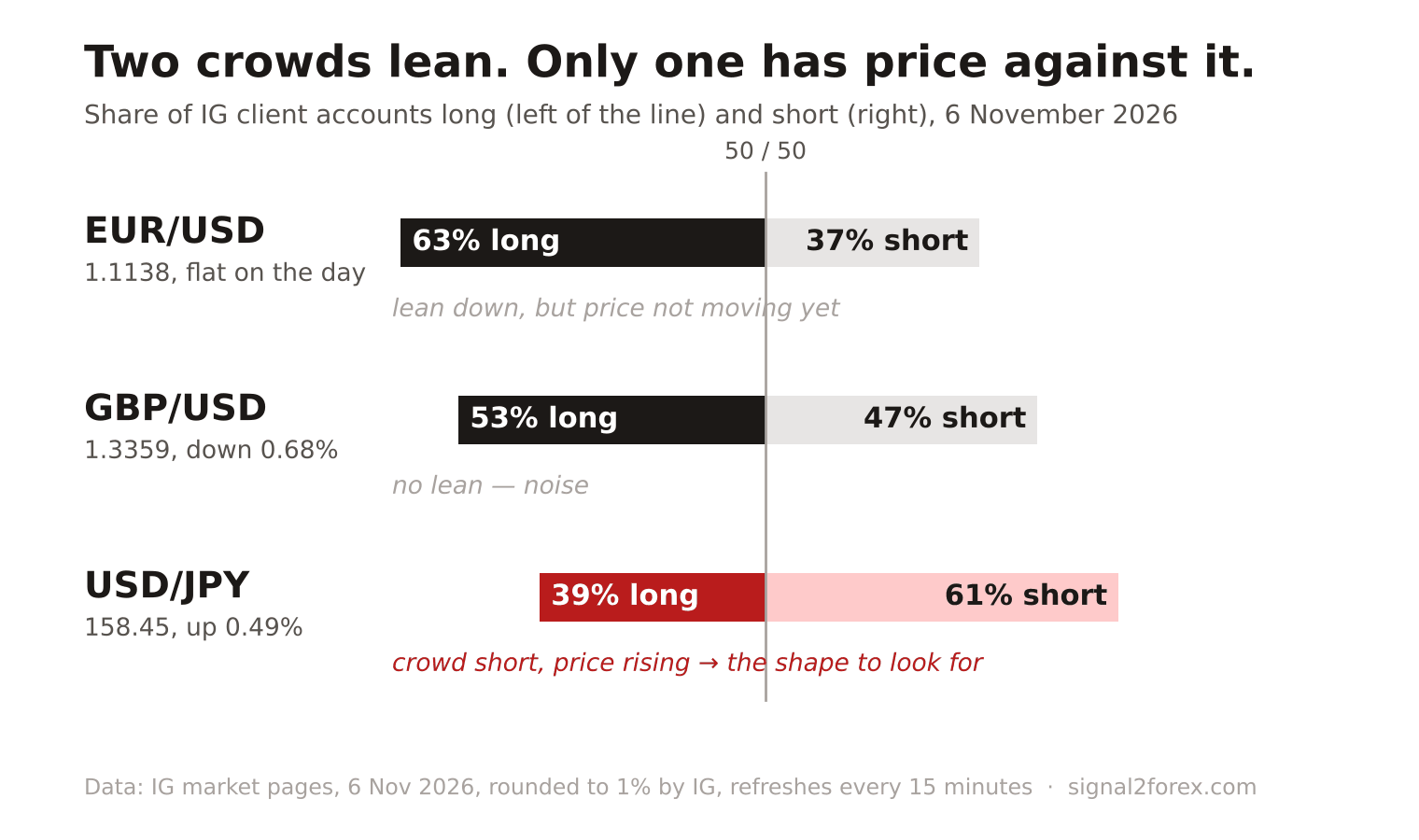
The three splits in the table came from the IG market pages on the evening of 6 November 2026. They show three different shapes, and the shapes matter more than the percentages.
EUR/USD. 63% long, price at 1.1138 and flat on the day. The lean is clear and it points down. This is the reading where most articles on IG trading sentiment stop. For me it is only half of a signal. The other half is that price has not moved yet, so nothing confirms the lean. A long crowd in a flat market can stay long for weeks.
GBP/USD. 53% long, price down 0.68% to 1.3359. No lean. The pound fell on Friday and the crowd did not take a side. I would not read this as a signal in either direction.
USD/JPY. 61% short, price up 0.49% to 158.45, with a day range from 157.25 to 158.62. Here the two halves agree — the crowd is short and the price is rising against it. This is the shape I look for: a lean plus a price that is already going the other way. Whether it holds into next week I do not know. One line from the Bank of Japan can change it.
Five ways to misread it
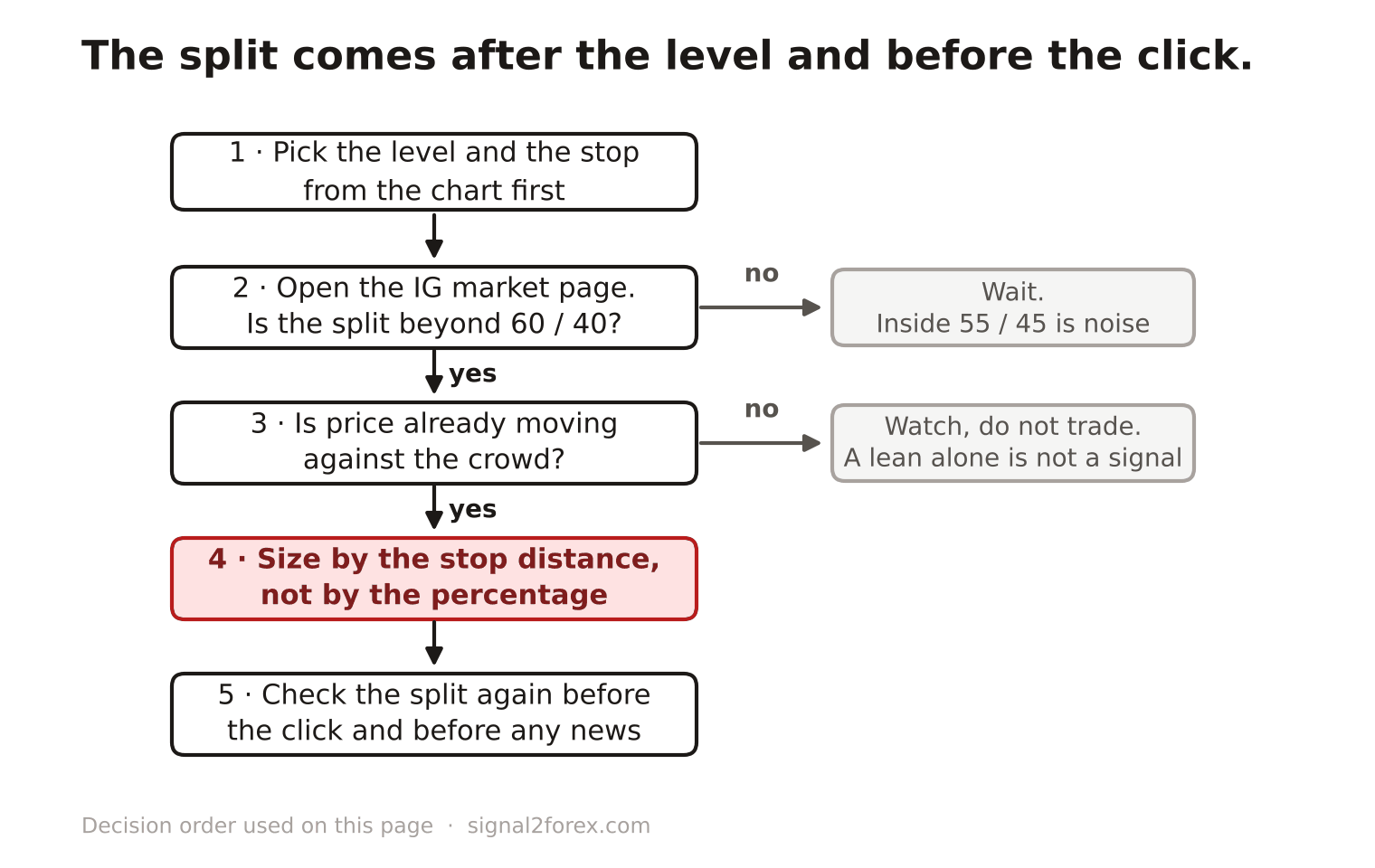
There are more ways to lose with this data than to win with it. The first mistake — trading the number alone. 63% long is a condition, not an entry. Without a level and a stop it is a guess with a percentage attached to it.
The second — reading 53/47 as a signal. Anything inside 55/45 is noise, and noise refreshes every 15 minutes like everything else on the page. The third — forgetting the clock. A news release can flip the split inside an hour. A reading from the Asian session is stale by the London open.
The fourth — mixing it up with the COT report. The CFTC Commitments of Traders report counts futures contracts held by large speculators and comes out on Friday for Tuesday positions. That is big money with a three-day delay. IG sentiment is small money in near real time. The two answer different questions, and I wrote about the first one in the COT report guide.
The fifth — expecting it inside MetaTrader. There is no IG feed in MT4 or MT5. An indicator that claims to show IG sentiment inside the terminal is reading a web page, and when IG changes that page the indicator shows zeros.
| Mistake | What happens | What to do instead |
|---|---|---|
| Number as entry | You buy or sell with no level and no stop | Pick the level first, then look at the split |
| 53/47 as a lean | You trade noise | Ignore anything inside 55/45 |
| Old reading | The split flipped on news while you waited | Check again before you click, not after |
| COT and IG mixed | Weekly big money read as live small money | Use COT for the week, IG for the session |
| Terminal indicator | Shows zeros when the page changes | Read the IG page itself |
Each mistake and its fix. The fix is always the same kind of thing — a level, a stop, a time check.
Sentiment inside my robots
Do my robots read IG sentiment? No. The Forex V Portfolio trades 14 pairs on the H1 chart from price and a spread filter, and nothing else. MetaTrader has no sentiment feed, and I did not want a robot that depends on a web page staying online. If I ever add one more filter to it, that filter will be the spread, not the crowd — the spread is in the terminal, the crowd is not.
Here is where I disagree with most pages on this topic. They present IG market sentiment as an edge in itself. For me the edge, if there is one, is in the stops that a crowded side leaves behind, and a robot captures that through price alone. A trend robot that buys a break above Friday’s high on USD/JPY is already trading against the 61% short crowd. It does not need to know the number.
The number explains the move after the fact. For a person reading a chart that explanation is useful. For a robot it is one more thing that can break.
One more thing. Sentiment is not only an IG product. The wider sentiment analysis page covers the other sources, and the trend strategies page goes deeper on using the split with a moving average. This page is only about reading the number correctly.
Quick answers
| Question | Short answer | Where on this page |
|---|---|---|
| Is the IG client sentiment report free? | Yes, on every IG market page, no account needed | What the number counts |
| Is there still an IG client sentiment API? | No public one since DailyFX closed in September 2024 | What the number counts |
| What split is a signal? | Beyond 60/40, and only with price moving against the crowd | Contrarian signal |
| IG sentiment or the COT report? | COT for the week, IG for the session | Five ways to misread it |
| Forex only? | No — indices, gold and shares have the same split. The forex IG client sentiment pages are just the most read | What the number counts |
Five questions that arrive by email most often, with the section that answers each in full.
Not everyone agrees
Not everyone agrees with the contrarian reading. The counter-argument goes like this: a crowd can be right for a long time, and trends exist because many people lean the same way. IG’s own risk warning says 80% of its retail accounts lose money. The critics say that money goes to costs and leverage, not to being on the wrong side. There is something in this.
A 63% long crowd in a rising market is a trend with company. Selling it because of the percentage is how a contrarian loses a whole year.
My answer is the second half of the USD/JPY example. The lean only counts when price already moves against it. Crowd plus price, with a stop set before either, is the only version of this I would put money behind.
A count of accounts, a distance from 50/50, a price that confirms or does not, a clock that resets every 15 minutes, and a stop that you set before you look at any of it — this is the whole use of IG sentiment for me. The more of these you check before you act, the steadier your trading becomes.


 Signal2forex.com - Best Forex robots and signals


