
📑 Table of Contents
- 1. What Is FOMO in Trading?
- 2. The Psychology Behind FOMO Trading
- 3. Signs You Are a FOMO Trader
- 4. What Triggers FOMO in Trading?
- 5. FOMO Trading vs Disciplined Trading
- 6. The FOMO Trading Cycle
- 7. How to Overcome FOMO in Trading
- 8. FOMO Prevention Checklist
- 9. FOMO vs Other Emotional Trading Mistakes
- 10. Frequently Asked Questions
1. What Is FOMO in Trading?
FOMO (Fear of Missing Out) in trading is the emotional anxiety that traders experience when they believe others are making profits and they are being left behind. It is a psychological phenomenon that leads to impulsive trading decisions, often resulting in poor entries, excessive risk-taking, and abandoning carefully constructed trading plans.
The term “FOMO” was added to the English language relatively recently, but its impact on trading psychology has been recognised for decades. In the context of financial markets, FOMO manifests as an overwhelming urge to enter a trade — any trade — simply because other traders appear to be profiting.
FOMO is particularly dangerous because it bypasses rational decision-making. When FOMO takes hold, traders stop analysing charts, ignore their trading plans, and act purely on emotion. The result is almost always the same: entering at the worst possible time, often at the top of a move, and suffering losses when the market inevitably reverses.

2. The Psychology Behind FOMO Trading
FOMO is rooted in fundamental human psychology. Understanding why your brain triggers FOMO is the first step to overcoming it.
Why Your Brain Triggers FOMO
Humans are wired to compare themselves to others. This evolutionary trait helped our ancestors survive by identifying threats and opportunities. In modern trading, this same mechanism causes us to measure our success against other traders’ apparent gains. When we see others profiting, our brain releases stress hormones that create a sense of urgency — the fear of being left behind.
Research shows that FOMO affects approximately 69% of millennials and is increasingly recognised as a significant factor in trading performance. While specific trader statistics vary, it is considered one of the most common psychological challenges in trading.
Common Emotional Drivers
- Greed: The desire for more profit can override rational decision-making.
- Fear: Fear of losing out on potential gains creates impulsive behaviour.
- Jealousy: Seeing others succeed can trigger feelings of inadequacy.
- Anxiety: The pressure to perform can lead to rushed decisions.
- Impatience: The desire for instant results undermines patience and discipline.
- Excitement: The thrill of a fast-moving market can cloud judgment.
The Herd Mentality Effect
Herd mentality is a powerful driver of FOMO. When traders see a crowd moving in one direction, they feel compelled to follow — even if the move is already overextended. This is particularly dangerous in financial markets, where the crowd is often wrong at extremes.
Trading psychology experts estimate that trading psychology accounts for 60–70% of trading success. Technical skills are only part of the equation — without emotional control, even the best strategies will fail.
3. Signs You Are a FOMO Trader
Recognising the signs of FOMO is essential for overcoming it. Here are the most common characteristics of a FOMO trader:
- Chasing price: You enter trades after the move has already started, often buying at the top or selling at the bottom.
- Entering without confirmation: You skip waiting for confirmation signals because you fear the trade will pass you by.
- Abandoning your trading plan: You ignore your rules and enter trades that don’t meet your criteria.
- Risks too much capital: You increase position sizes to “catch up” on perceived missed profits.
- Closing trades prematurely: You exit profitable trades too early out of fear of losing gains, or hold losing trades too long hoping for a reversal.
- Feeling anxious or excited about missing opportunities: You experience emotional distress when you see others profiting.
- Checking charts compulsively: You constantly monitor price movements, unable to step away.
- Social media addiction: You spend excessive time on #FinTwit or other trading forums, comparing yourself to others.
- Regret after trades: You frequently feel regret about entries, exits, or missed opportunities.
- Revenge trading: After a loss, you immediately enter another trade to recover.
4. What Triggers FOMO in Trading?
FOMO doesn’t appear out of nowhere — it is triggered by specific market conditions and external factors. Understanding these triggers helps you prepare for them.
Market Volatility
Rapid price movements create a sense of urgency. When the market is moving quickly, traders feel pressure to act immediately, fearing they will miss the move. This is particularly dangerous because fast-moving markets are often near exhaustion points.
Social Media and #FinTwit
Social media platforms, especially financial Twitter (#FinTwit), amplify FOMO by showcasing curated success stories and winning trades. This creates a false impression that everyone is making money, amplifying feelings of inadequacy and the fear of missing out.
Winning and Losing Streaks
- Winning streaks: Success can breed overconfidence, leading to reckless entries and larger positions.
- Losing streaks: Desperation to recover losses can push traders into impulsive trades without proper analysis.
News and Rumours
Breaking news or market rumours can create a fear of being “out of the loop.” Traders may enter positions based on incomplete information, driven by the fear that others know something they don’t.
5. FOMO Trading vs Disciplined Trading
The difference between a FOMO trader and a disciplined trader is stark. The table below highlights the key contrasts:
| Behaviour | FOMO Trader | Disciplined Trader |
|---|---|---|
| Entry | Chases price, enters without confirmation | Waits for setup, enters on confirmation |
| Exit | Closes early from fear, or holds too long from greed | Follows profit targets and stop-losses |
| Risk Management | Risks too much, no consistent position sizing | Risks 1-2% per trade, consistent sizing |
| Trading Plan | Ignores or doesn’t have one | Follows plan strictly |
| Emotional State | Anxious, greedy, excited | Calm, objective, patient |
| Response to Losses | Revenge trades, increases risk | Takes loss, reviews, moves on |
| Social Media | Follows others blindly | Uses for inspiration, not decisions |
📌 The disciplined trader follows a systematic approach, while the FOMO trader reacts emotionally to market movements.
6. The FOMO Trading Cycle
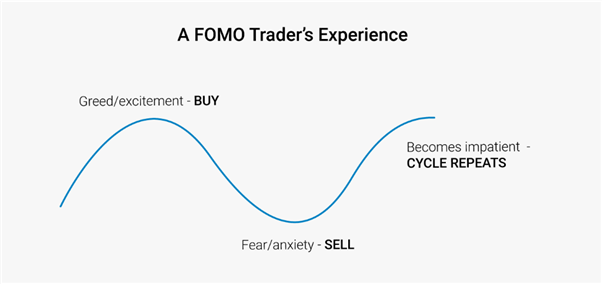
The FOMO trading cycle is a destructive pattern that repeats itself unless broken. Understanding this cycle is essential for breaking free from it.
Step 1 — See Others Succeed: You see other traders posting profits on social media or hear about winning trades from peers. This triggers feelings of inadequacy and jealousy.
Step 2 — Feel Urgency and Anxiety: You feel pressure to act immediately. Your brain releases stress hormones that override rational thinking.
Step 3 — Enter Trade Impulsively: You enter a trade without proper analysis or confirmation. You may increase position size to “catch up.”
Step 4 — Experience Regret: The trade goes against you, or you realise you entered at the wrong time. You feel regret and frustration.
Step 5 — Revenge Trade: You immediately enter another trade to recover the loss, often doubling down or increasing risk. This perpetuates the cycle.
Step 6 — Repeat: The cycle repeats, leading to a pattern of emotional trading and consistent losses.
Breaking this cycle requires self-awareness, discipline, and a commitment to following a trading plan.
7. How to Overcome FOMO in Trading
Overcoming FOMO is not easy, but it is essential for long-term trading success. Here are proven strategies to help you break free from FOMO:
Develop a Trading Plan
A well-defined trading plan is your best defence against FOMO. Your plan should include:
- Entry and exit criteria
- Risk management rules (position sizing, stop-losses)
- Profit targets
- Daily trade limits
Review your plan before every trading session and commit to following it, regardless of market conditions.
Practice Patience
Patience is a trader’s greatest virtue. The market will always provide opportunities — you don’t need to take every trade that appears. Wait for setups that meet your criteria, and accept that you will miss some trades.
Accept That You Will Miss Trades
No trader catches every move. Accepting this fact is liberating. The most successful traders in history have missed thousands of profitable opportunities — they focused on the ones that fit their system.
Use Stop-Losses and Position Sizing
Consistent risk management is your anchor in volatile markets. Always use stop-losses and never risk more than 1-2% of your capital on a single trade. This prevents emotional decisions and protects your account.
Keep a Trading Journal
Journaling is one of the most effective tools for overcoming FOMO. Record every trade, including your emotional state at the time of entry and exit. Reviewing your journal helps you identify patterns and triggers.
Detach from Social Media
Limit your exposure to #FinTwit and other trading forums during trading hours. Curate your feed to follow educational content rather than “flex” posts. Remember that social media shows curated success, not reality.
8. FOMO Prevention Checklist
Use this checklist before each trading session to protect yourself from FOMO:
| Action | Frequency | Status |
|---|---|---|
| Review trading plan before each session | Daily | ☐ |
| Set profit targets and stop-losses | Per trade | ☐ |
| Risk 1-2% of capital per trade | Per trade | ☐ |
| Take breaks after losses | As needed | ☐ |
| Journal every trade | Daily | ☐ |
| Review journal weekly | Weekly | ☐ |
| Limit social media during trading | Daily | ☐ |
📌 Print this checklist and review it before every trading session to stay disciplined.
9. FOMO vs Other Emotional Trading Mistakes
FOMO is just one of several emotional trading mistakes. Understanding how it compares to others helps you identify and address all forms of emotional trading.
| Mistake | Definition | Primary Driver | Prevention |
|---|---|---|---|
| FOMO Trading | Entering trades from fear of missing out | Fear, greed, social pressure | Trading plan, patience, acceptance |
| Revenge Trading | Trying to recover losses impulsively | Anger, frustration | Stop after losses, take breaks |
| Overtrading | Taking too many trades | Excitement, boredom | Trade limits, quality over quantity |
| Greed Trading | Holding too long for more profit | Greed | Profit targets, trailing stops |
📌 Each of these mistakes can be devastating to your trading account. The key to avoiding them is self-awareness and discipline.
10. Frequently Asked Questions
What is FOMO in trading?
FOMO (Fear of Missing Out) in trading is the emotional anxiety that traders experience when they believe others are making profits and they are being left behind. It leads to impulsive trading decisions, often resulting in poor entries, excessive risk-taking, and abandoning trading plans.
Why do traders experience FOMO?
Traders experience FOMO due to psychological triggers including greed, fear, social comparison, and herd mentality. Social media platforms like #FinTwit amplify this by showcasing curated success stories, making traders feel inadequate and pressured to act.
How do you overcome FOMO in trading?
Overcome FOMO by: developing and following a trading plan, accepting that you will miss trades, practising patience, using consistent position sizing, keeping a trading journal, and limiting social media exposure during trading hours.
What are the signs of a FOMO trader?
Signs include: chasing price moves, entering trades without confirmation, abandoning trading plans, risking too much capital, closing trades prematurely, and feeling anxious or excited about missing opportunities.
What triggers FOMO in trading?
Common triggers include: market volatility, winning or losing streaks, social media (#FinTwit), news and rumours, and seeing others’ apparent success on trading platforms.
What is the difference between FOMO trading and disciplined trading?
FOMO traders chase price and act on emotion, while disciplined traders wait for setups and follow a plan. FOMO traders risk too much and ignore stop-losses; disciplined traders use consistent position sizing and follow risk management rules.
Can FOMO affect all traders?
Yes, FOMO can affect traders of all experience levels — from beginners to professionals. It is a universal psychological phenomenon that becomes more pronounced in fast-paced, volatile markets.
How does social media cause FOMO in trading?
Social media platforms, especially financial Twitter (#FinTwit), showcase curated success stories and winning trades. This creates a false impression that everyone is making money, amplifying feelings of inadequacy and the fear of missing out.
What is the FOMO trading cycle?
The FOMO trading cycle begins with seeing others succeed, leading to anxiety and impulsive entry. The trader then experiences regret, potentially revenge trades, and repeats the cycle — often resulting in losses and emotional distress.
What percentage of traders experience FOMO?
FOMO affects approximately 69% of millennials and is increasingly recognised as a significant factor in trading performance. While specific trader statistics vary, it is considered one of the most common psychological challenges in trading.
📊 Master Technical Patterns: Enhance your trading psychology by combining emotional discipline with technical analysis. Learn how to identify reliable reversal signals with our complete guide to Harami candlestick patterns — a powerful two-candle reversal pattern that, when traded with discipline, can help you avoid the emotional pitfalls of FOMO by providing clear, objective entry and exit signals.
📈 Stay Informed, Stay Disciplined: FOMO often strikes when traders feel “out of the loop” on market-moving events. Stay ahead with our forex news and analysis section — your source for real-time market updates, economic data releases, and central bank announcements that can help you trade with confidence rather than fear.


 Signal2forex.com - Best Forex robots and signals


