
By Uladzimir Leuchankou, founder of Signal2Forex. Written on 4 November 2026.
A long wick candle is a candle with a shadow much longer than its body. During the period, price went far in one direction and came back before the close. The common test is simple — the wick must be at least twice the body. I ran that test on 90 daily GBP/USD candles from July to November 2026. It marked 25 of them, and the one-sided signals were right 7 times out of 12.
| Wick | What happened inside the candle | Where it matters most |
|---|---|---|
| Long upper wick | Price rose, then sellers pushed it back down before the close | After a rise, near a high where price stopped before |
| Long lower wick | Price fell, then buyers pushed it back up before the close | After a fall, near a low where price turned before |
| Both wicks long | Each side pushed, and neither kept the move | Often a quiet day — read it as a pause |
| Long wick in the middle of a range | A short spike between two levels | Usually noise, I skip it |
The table is short. The rest of the page shows why the test needs a second check, with real candles and prices.
Long wick candle meaning
What do long wicks mean in trading? Most guides answer — the market rejected a price. I suppose that is an answer too. But for me a wick is first a fact. Price was there, and by the close it was gone. The rejection is our reading of that fact, and a reading can be wrong.
Take a long upper wick candlestick. Buyers pushed price up during the day, then sellers sold into that move, and the candle closed far below its high. A candle with long lower wick is the mirror case — price fell, and buyers bought it back before the close. Long upper wicks and long lower wicks show the price where one side gave up. They say nothing about tomorrow.
Some traders call it a John Wick candle. If you found this page through a search for john wick candle trading, it is the same idea — trader slang for a long wick candle. The long wick candlestick meaning does not change with the time frame — a wick on M15 and a wick on the daily chart record the same thing over a different period.
I write trading robots, and in code a candle is four numbers — open, high, low and close. A robot does not see a hammer or a shooting star. It sees a rule that someone wrote, for example upper wick divided by body is 2 or more. This is why I always ask one question first. What exactly do you mean by long?
Two measuring rules
There are two common ways to measure a wick, and they often disagree. The first rule — compare the wick with the body. The second — compare the wick with the whole range of the candle, from the high to the low.
This rule goes back to Steve Nison and his 1991 book Japanese Candlestick Charting Techniques. For a hammer he wanted the lower shadow to be at least twice the height of the real body. Most long wick candlestick patterns online still use that number, some use 3×.
Here is the arithmetic on the GBP/USD candle of 30 October 2026. It opened at 1.3377, rose to 1.3434 and closed at 1.3390. The body is 1.3390 − 1.3377 = 13 pips. Its upper wick is 1.3434 − 1.3390 = 44 pips, so 44 ÷ 13 = 3.4, and the wick is 3.4× the body. The whole range was 60 pips, and 44 of them were wick — 73%.
On one standard lot of GBP/USD a pip is worth about $10. That wick was a $440 move per lot that came back within the same day — $4.40 on a 0.01 lot.
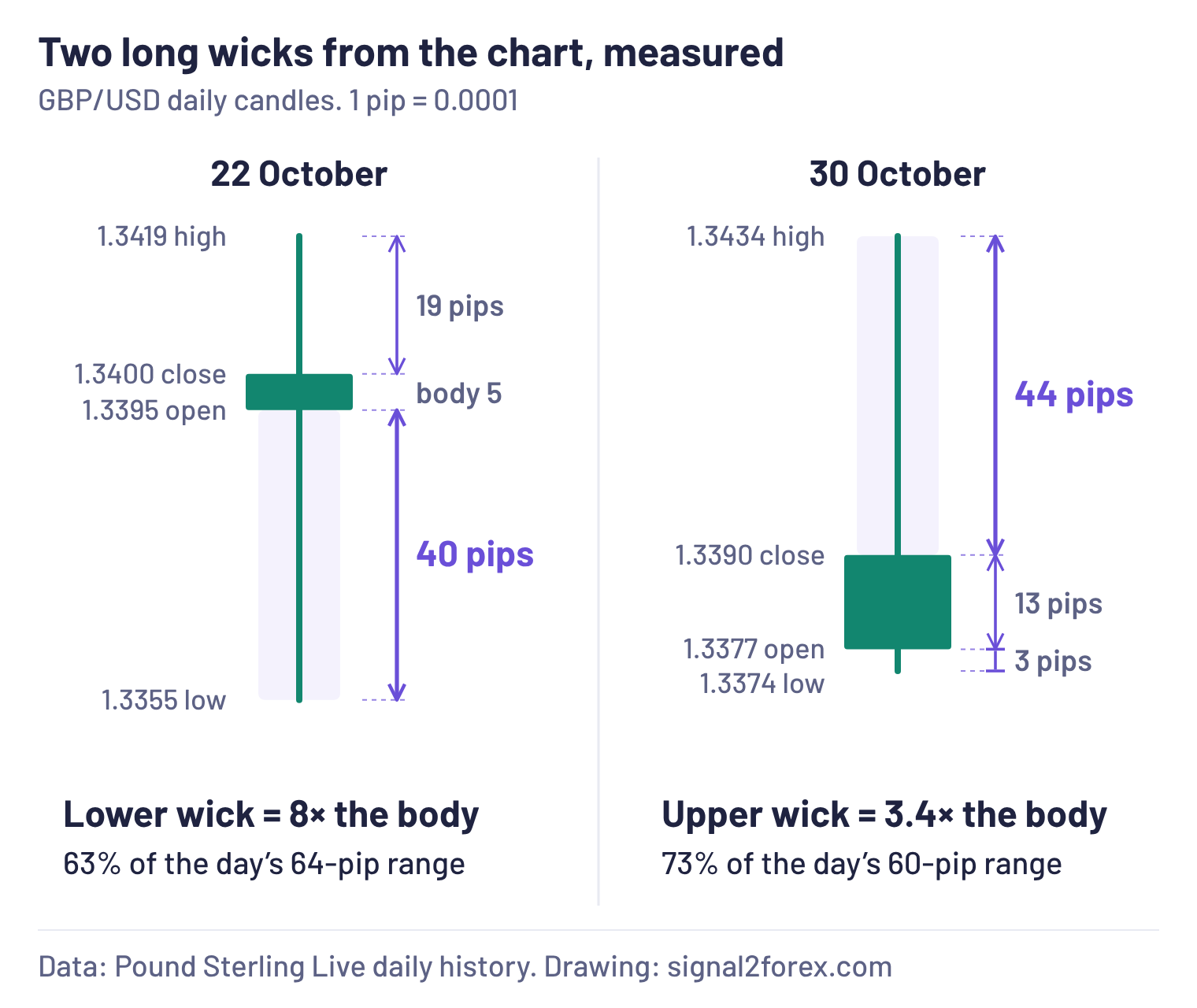
The body rule has one weak spot. When the body is tiny, any wick looks long. Long wicks on candlesticks with a tiny body are common on quiet days. On 22 October the body was 5 pips, so even the 19-pip upper wick passed the 2× test. By the rule that day had two long wicks at once, and such a candle says less than its ratio suggests.
Most articles stop at the 2× rule. I do not. The reason is 9 and 14 October. On 9 October GBP/USD moved only 44 pips from high to low, well below the usual 61 pips, and the rule marked both wicks as long.
Five days later the pair fell to 1.3137, the lowest price of 2026, and closed 57 pips above it. That was the longest wick of the month. The rule did not mark it, because the body was even bigger — 61 pips.
Which number should you trust then? For me both, so I add a second check. The wick must also be long in pips — at least half of a normal day. From July to November 2026 the median daily range of GBP/USD was 61 pips, so half is about 30 pips. If you trade another pair, you need to measure its own normal range first.
GBP/USD in October
Here is the whole picture — 18 daily candles from 9 October to 3 November 2026, taken from the public GBP/USD daily table of Pound Sterling Live. The circles mark wicks at least twice the body.
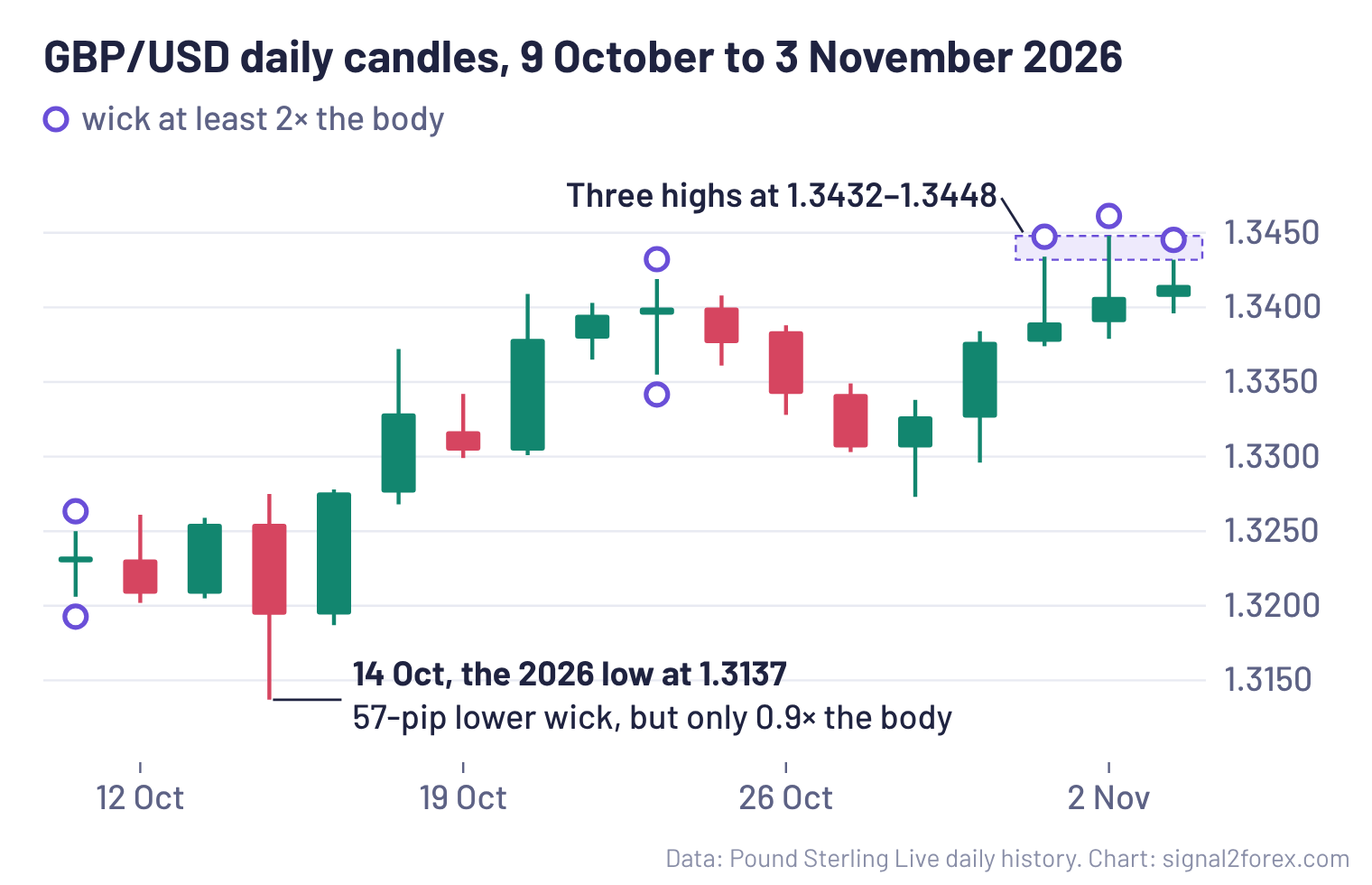
Start with 14 October. Say you bought at the close, at 1.3194, with a stop 10 pips below the wick at 1.3127. That is 67 pips of risk — $670 on one standard lot, $6.70 on a 0.01 lot. The next day GBP/USD closed at 1.3276, 82 pips higher.
Then 22 October. The pair had climbed 75 pips on 20 October. On the 22nd it dropped 40 pips during the day and closed almost where it opened. Over the next three sessions GBP/USD fell 94 pips, to 1.3306 at the close of 27 October. A lower wick after a rise is the shape traders call a hanging man, and here the usual bullish reading of a lower wick lost.
Then the end of the month. On 30 October, 2 November and 3 November the highs stopped at 1.3434, 1.3448 and 1.3432. This is what people mean by a multiple long wick candle pattern — several upper wicks in a row under one price. The usual reading says sellers wait there.
Did they? Not so far.
On 4 November, while I was writing this page, GBP/USD traded at 1.3474 — above all three wicks — and the daily candle was still open. Whether the move holds, I do not know. The Bank of England announces its decision on 5 November at 12:00 GMT, according to its MPC calendar. In September it held Bank Rate at 3.75%, and one candle on decision day can cancel three wicks.
Four months of numbers
One chart is a small sample, so I counted. I took all 90 GBP/USD daily candles from 1 July to 3 November 2026 and checked each rule. A signal counted as right if the next daily close moved the expected way — up after a long lower wick, down after a long upper wick.
| Rule | Candles marked | Next day went the expected way |
|---|---|---|
| Wick at least 2× the body | 25, and 12 of them had both wicks long | 7 of 12 one-sided signals |
| Wick at least half of the candle’s range | 31 | 13 of 30 |
| Wick at least 30 pips, the longer of the two | 26 | 15 of 26 |
| 2× the body and at least 30 pips | 10 | 6 of 10 |
Which rule did better? The body rule marked many quiet days — 19 of its 25 candles had a range below the 61-pip median. The range rule was right least often, 13 times out of 30. Both pip checks were right a little more than half of the time — 15 of 26 and 6 of 10. 3 November is not in the last column, because it has no next day yet.
Is 6 out of 10 a real edge? I do not know. Ten signals is a very small sample, and another four months could give 4 out of 10. What the table does show is simpler — on GBP/USD daily a long wick on its own was right about half of the time. For me this is the reason to look at the place where the wick printed before I look at its ratio.
Test yourself: was 9 October a long wick candle?
By the 2× rule — yes. Its body was 4 pips, and the wicks were 17 and 23 pips, four to six times the body. By the pip check — no. The whole day moved 44 pips, and neither wick reached 30 pips. I would skip it.
Your own candle, measured
Type the four prices of any candle from your terminal. The calculator shows each wick in pips, its size against the body and against the range, and the result of both checks. It starts with the 30 October candle. If you trade a yen pair, switch the pip size to 0.01 and put the normal daily range of your own pair in the last field, because 61 pips is only the GBP/USD number. Then press Measure.
Names that depend on place
The same wick gets four different names, and the name depends only on where the candle stands. A long lower wick after a fall is a hammer. The same shape after a rise is a hanging man. A long upper wick after a fall is an inverted hammer, and after a rise it is a shooting star.
So a long wick hammer candle and a hanging man can be the same four prices. Which one was 22 October? It was the second kind, and the price fell after it. The full rules for the first kind are in our hammer candlestick guide. A long upper and lower wick candlestick with almost no body is close to a doji, and the doji guide covers that case.
A long wick candle reversal needs a move before it and a level beside it. Without the move there is nothing to reverse, and without the level the wick is only a spike between two levels. Every threshold in the robots I write for the Forex V Portfolio goes through a backtest before it trades the real account that we stream on YouTube. A pattern name never gets into the code — only numbers do.
Quick answers
| Question | Short answer | |
|---|---|---|
| What is a long wick candlestick? | A candle whose wick is at least 2× its body. I also want the wick to be at least half of a normal day in pips. | Two measuring rules |
| What does a long upper wick mean? | Price rose and was sold back before the close. | Meaning |
| What does a long lower wick mean? | Price fell and was bought back before the close. | Meaning |
| Do candles with long wicks mean a reversal? | Sometimes. On GBP/USD daily the next day went the expected way about half of the time. | Four months of numbers |
| Is every long lower wick a hammer? | No. Only after a fall. After a rise the same shape is a hanging man. | Names |
| How do I measure long wick candlesticks in pips? | Subtract prices and divide by the pip size. On GBP/USD 0.0044 is 44 pips. The pip guide has the details. | Calculator |
One task for today. Open the daily chart of the pair you trade in MetaTrader 5 and press Alt+2 to switch it to candlesticks — the MetaTrader 5 Help lists this shortcut.
Look at the last 20 candles and mark every wick that is at least twice its body and at least half of a normal day. Then write down what the next candle did. Twenty candles take about ten minutes, and after that the word long becomes a number for you.
The more wicks you measure yourself — the body, the range, the place on the chart and the day after — the less you have to guess.
Data and references: GBP/USD daily history 2026, Pound Sterling Live, checked on 4 November 2026; Steve Nison, Japanese Candlestick Charting Techniques, 1991; Bank of England, upcoming MPC dates; MetaTrader 5 Help, chart management. Trading carries a risk of loss.


 Signal2forex.com - Best Forex robots and signals


