
First published: 19 December 2018 · Reviewed and updated: 21 September 2026
Forex is the largest market on earth — $9.6 trillion changes hands every day — and yet in its modern form it is younger than the pocket calculator. It exists because a fixed-rate system broke down in the early 1970s, and almost everything that moves currency pairs today follows directly from that break.
Quick answer
Modern forex trading started between August 1971 and March 1973. Nixon ended dollar convertibility into gold on 15 August 1971, the attempt to rescue fixed rates failed, and by March 1973 the major currencies floated freely.
Online forex trading started in 1996, when the first internet-based retail platforms appeared. MetaTrader 4, released in 2005, made retail forex mainstream.
Nobody founded forex. Currency exchange is about 2,600 years old; the modern market is the by-product of policy decisions by governments and central banks, not an invention by one person.
Forex UK /ˈfɒr.eks/ · US /ˈfɔː.reks/ noun · financial markets
The global, decentralised over-the-counter market in which national currencies are bought and sold. Prices are set by supply and demand under the free-floating regime that began in 1973.
Synonyms: FX, foreign exchange, the currency market, spot FX. Related: currency pair, exchange rate, reserve currency.
Used in a sentence:
- “The forex market runs 24 hours a day, five days a week, from the Sydney open to the New York close.”
- “After the 1971 Nixon Shock, forex became the mechanism that prices every currency in the world.”
- “EUR/USD is the most traded pair in forex, ahead of USD/JPY and GBP/USD.”
Forex history at a glance
- 6th century BC — first standardised coins minted in Lydia
- 1800s — the gold standard fixes currencies to gold, and so to each other
- July 1944 — Bretton Woods pegs the dollar to gold at $35/oz; the IMF and World Bank are created
- 15 August 1971 — the Nixon Shock closes the gold window
- March 1973 — the major currencies float; the modern forex market begins
- 22 September 1985 — the Plaza Accord proves coordinated intervention sets trends
- 1 January 1999 — the euro launches, creating the second reserve currency
- 1996–2005 — online platforms and MetaTrader 4 open the market to retail traders
- April 2025 — BIS measures turnover at $9.6 trillion per day
1. When did forex trading start?
The modern forex market started between August 1971 and March 1973. That is the answer to the question as traders mean it: a market in which exchange rates are set by supply and demand rather than by an official peg.
The sequence was short and decisive. On 15 August 1971, after three days of meetings at Camp David, President Richard Nixon announced that foreign governments could no longer exchange dollars for gold. The Smithsonian Agreement of December 1971 tried to hold the fixed-rate system together by devaluing the dollar to $38 an ounce and widening the permitted trading bands to ±2.25%. It did not hold. By March 1973 the major currencies were floating, and they have floated ever since.
Currency exchange, of course, is much older. But there is a clean distinction worth holding on to:
- Currency exchange — swapping one money for another — is roughly 2,600 years old.
- The forex market — a continuous market where the exchange rate itself is the traded price — is about 53 years old.
This distinction is why you will see two different answers online. Both are right; they answer different questions. If you are asking when you could first trade an exchange rate, the answer is 1973.
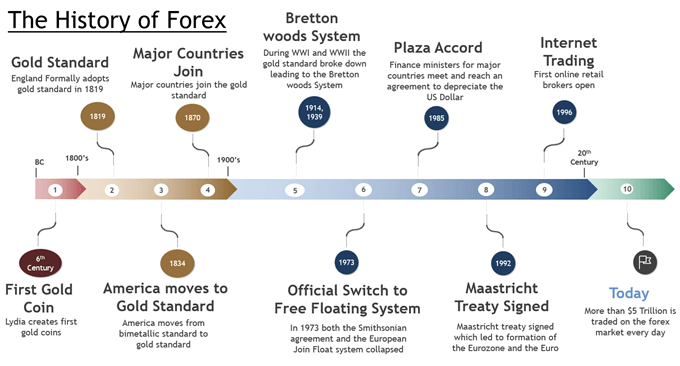
2. Before the modern market: coins to the gold standard
Coinage and the money changers
Standardised coins first appear in Lydia, in western Anatolia, in the sixth century BC. Once coins carried a known weight and purity, exchanging one city’s money for another’s became a trade in its own right, and the money changer became a recognised profession across the ancient and medieval world. The Italian banking houses of the Renaissance turned it into a business with branches, credit and settlement — the word bank comes from the banca, the bench on which a Florentine money changer worked.
A note on the “6000 BC barter” claim you will see repeated on many trading sites: the idea that a pure barter economy preceded money is a textbook simplification that economic historians now treat with scepticism. Early record-keeping societies used units of account and credit long before coinage. It makes a neat story, but it is not the part of forex history that stands up to scrutiny.
The gold standard, 1800s to 1914
The gold standard was the first genuinely global exchange-rate system. Britain formalised it in 1819 and the United States followed in 1834; by the 1870s most major economies had joined. Each currency was redeemable for a fixed weight of gold, which meant every currency was fixed against every other one. Exchange rates moved only within narrow “gold points” — the band inside which shipping physical gold was cheaper than trading the currency.
The system was suspended when the First World War made gold convertibility impossible, restored uneasily in the 1920s, and destroyed by the Depression and the Second World War. Its lesson has repeated in every fixed-rate system since: a peg holds only while the country can defend it, and markets test the ones that cannot.
3. Bretton Woods, 1944–1971
In July 1944, with the war still running, delegates from 44 nations met at the Mount Washington Hotel in Bretton Woods, New Hampshire, to design the post-war monetary order. The result fixed the US dollar to gold at $35 an ounce and pegged every other participating currency to the dollar within a 1% band. The conference also created the International Monetary Fund and the institution that became the World Bank.
The design had one consequence that still shapes every currency pair you trade: it made the US dollar the world’s reserve currency. Eight decades later the dollar is still on one side of 89.2% of all forex trades.
It also had a flaw. The United States had to supply the world with dollars while holding enough gold to redeem them. By the late 1960s it could not do both. Foreign governments, increasingly doubtful, began converting dollars into gold — and the arithmetic ran out.

4. The Nixon Shock and the birth of the free float
Nixon’s announcement on 15 August 1971 had three parts: closing the gold window, a 90-day freeze on wages and prices, and a 10% surcharge on imports. Only the first mattered for currencies, and it mattered completely. The international monetary system became a fiat one overnight.
After the Smithsonian patch failed, the major currencies floated from March 1973. Three things followed immediately, and all three still define how forex works:
- Exchange rates became prices. They now move continuously, and they can be traded.
- Interest-rate differentials became the main driver. With no gold anchor, capital flows to the better yield — the modern equivalent of the old gold points.
- Central banks became the most important market participants. Not because they trade the most, but because they set the rates everything else prices off.
5. The Plaza Accord, 1985
By 1985 the dollar had risen so far that American exporters were in trouble. On 22 September 1985, finance ministers of the G5 — the United States, the United Kingdom, France, West Germany and Japan — met at the Plaza Hotel in New York and agreed to act together to push it down. The dollar fell sharply over the next two years, so sharply that the Louvre Accord of February 1987 was convened to stop the slide.
Why it still matters: Plaza is the cleanest proof in market history that coordinated intervention by major central banks can set the direction of a multi-year currency trend. Positioning does not beat a policy consensus. Traders who were short the yen into September 1985 learned this the expensive way.
6. Black Wednesday, 1992
On 16 September 1992 the United Kingdom was forced out of the European Exchange Rate Mechanism. The Bank of England raised interest rates twice in a single day and spent heavily defending sterling’s peg, and by the evening had abandoned both the rate rises and the peg.
Why it still matters: Black Wednesday is the same lesson as the gold standard, delivered in a single session. A peg that is economically unsustainable will be tested, and the defence — higher rates, reserve spending — is itself the signal that it is in trouble. The pattern repeated with the Swiss National Bank’s abandoned euro floor in January 2015, which moved EUR/CHF by roughly 30% in minutes.
7. The euro, 1992–2002
The Maastricht Treaty of 1992 set the path to a single European currency. The euro launched on 1 January 1999 as an accounting currency for eleven countries, with notes and coins following on 1 January 2002. It instantly became the second reserve currency and the other half of the most traded pair in the world.
The euro’s share has been slipping, though: it appeared on 28.9% of trades in April 2025, down from 30.6% three years earlier.
8. When did online forex trading start?
Online forex trading started in 1996. That was the year the first internet-based retail platforms appeared and OANDA, founded the same year, began publishing exchange rates free on the web — information that had previously been the property of banks.
The electronic market itself was older, but it was closed. Dealers moved from telephone and telex to the Reuters Monitor Dealing Service in 1981, and EBS, launched in 1993, gave the interbank market a proper electronic broker. Neither was open to anyone outside a bank.
The retail era then arrived in three steps:
| Year | What changed | Why it mattered |
|---|---|---|
| 1996 | First internet retail platforms; free online exchange rates | Pricing left the banks — anyone could see the market |
| 2001 | Fully automated online execution (OANDA fxTrade) | Orders could be filled without a dealer on the phone |
| 2005 | MetaTrader 4 released | Charting, automation and a standard platform brought forex to the mass market |
| 2010–2018 | Leverage caps in the US (2010) and EU (2018) | Retail conditions tightened sharply; the 2005-era market no longer exists |
This is the single biggest structural change since 1973: the free float created the market, and the internet opened it.
9. Forex history timeline
| Date | Event | Effect on currency markets | Key figures |
|---|---|---|---|
| 6th c. BC | First standardised coins, Lydia | Currency exchange becomes a trade | — |
| 1819 / 1834 | UK and US formalise the gold standard | Fixed rates within narrow gold points | — |
| 1914 | Gold standard suspended for the war | First global break in fixed rates | — |
| July 1944 | Bretton Woods conference, 44 nations | Dollar fixed to gold at $35/oz; USD becomes the reserve currency | J. M. Keynes, H. D. White |
| 15 Aug 1971 | Nixon Shock | Gold window closed; the system becomes fiat | Richard Nixon, John Connally |
| Dec 1971 | Smithsonian Agreement | Dollar devalued to $38/oz; bands widened to ±2.25% | G10 finance ministers |
| March 1973 | Major currencies float | The modern forex market begins | — |
| 1981 / 1993 | Reuters dealing service; EBS | Interbank trading goes electronic | — |
| 22 Sep 1985 | Plaza Accord | Coordinated dollar depreciation | G5 finance ministers |
| 16 Sep 1992 | Black Wednesday | Sterling forced out of the ERM | Bank of England |
| 1 Jan 1999 | Euro launched | Second reserve currency created | — |
| 1996 / 2005 | Online platforms; MetaTrader 4 | Retail access to the market | — |
| 15 Jan 2015 | Swiss National Bank drops the euro floor | EUR/CHF moves about 30% in minutes | Swiss National Bank |
| Aug 2024 | Yen carry trade unwinds | USD/JPY falls from a 38-year high | Bank of Japan |
| Apr 2025 | BIS survey: $9.6trn a day | Largest turnover ever recorded | — |
| Sep 2026 | Fed, ECB and BoJ all raise rates in nine days | Synchronised tightening after a decade of divergence | Fed, ECB, BoJ, BoE |
10. The market today, in numbers
Every figure in this section comes from the BIS Triennial Central Bank Survey, the three-yearly census of the market that central banks have run each April since 1989. The 2025 results were published on 30 September 2025.
Who is on the other side of the trade
Because every trade involves two currencies, the shares below add up to 200%, not 100%. The dollar’s dominance is the direct inheritance of Bretton Woods; the renminbi’s climb is the fastest structural shift since the euro was created.
Most of the market is not what retail traders do
This is the number that surprises people. The headline $9.6 trillion is not $9.6 trillion of directional speculation — spot trading is only 31% of it. The largest instrument is the FX swap, at about $4 trillion a day, which banks and corporates use to fund and hedge positions rather than to bet on direction.
Where it happens: four locations handle about 75% of global forex. The United Kingdom accounts for roughly 38%, the United States 19%, Singapore 11.8% and Hong Kong 7.0%. London has been the centre of the market since long before it had a screen.
11. Which forex market opens first?
This question comes up constantly alongside the history ones, and it is about the daily cycle rather than the past. Because forex has no central exchange, it runs continuously from Monday morning in Asia to Friday evening in New York. The session order is:
- Sydney — opens the week first
- Tokyo — the main Asian session
- London — the largest single centre, roughly 38% of global turnover
- New York — closes the week
The busiest hours are the London–New York overlap, when the two largest centres are open at once. This 24-hour structure is itself a consequence of the free float: under Bretton Woods there was no reason to trade a rate that was not allowed to move.
12. Who created forex?
There is no founder. Searching for one is the wrong shape of question, because the market is a by-product of policy rather than a product someone launched. The people who mattered most:
| Name | Role | Contribution |
|---|---|---|
| John Maynard Keynes | UK delegation, 1944 | Co-architect of the Bretton Woods system |
| Harry Dexter White | US Treasury, 1944 | Co-architect; his dollar-centred plan prevailed over Keynes’s |
| Richard Nixon | US President, 1971 | Ended dollar-gold convertibility, triggering the float |
| John Connally | US Treasury Secretary, 1971 | Drove the Camp David decision |
| G5 finance ministers | Plaza Hotel, 1985 | Demonstrated coordinated intervention |
The retail market has no founder either. It came from software: the first web platforms of 1996 and the trading terminals that followed.
13. Currency systems compared
| Era | System | How rates were set | Why it ended | Lesson |
|---|---|---|---|---|
| 1800s–1914 | Gold standard | Fixed to gold, so fixed to each other | War finance made convertibility impossible | A peg lasts only as long as the reserves behind it |
| 1944–1971 | Bretton Woods | Dollar to gold, others to the dollar ±1% | Not enough US gold for the dollars issued | Reserve status is an advantage and an obligation |
| 1971–1973 | Smithsonian | Wider bands, dollar at $38/oz | Collapsed within 15 months | Half-measures invite the market to test them |
| 1973–now | Free float | Supply, demand and rate differentials | Still in force | Trade the policy divergence |
| Emerging | Digital settlement, CBDCs | Unchanged drivers, new plumbing | — | Settlement changes; macro does not |
14. What history teaches, 2024–2026
History is only useful if it improves decisions. The last three years have replayed several of the patterns above, with the four major central banks all tightening at once by September 2026.
Case 1 — The carry trade unwinds, August 2024
The Bank of Japan raised rates to 0.25% on 31 July 2024, after years of ultra-loose policy. USD/JPY had reached a 38-year high near 162 on the back of a huge yen-funded carry trade. As the rate gap began to close, that trade unwound violently: the yen surged and 5 August 2024 became one of the most disorderly sessions in modern FX history.
The pattern: policy divergence builds carry trades; policy convergence detonates them. Check positioning extremes before holding an obvious carry position.
Case 2 — A full policy reversal, 2025 to 2026
The Federal Reserve cut three times in late 2025, reaching 3.50–3.75%, and held there into 2026 — then reversed. On 16 September 2026 it raised the target range to 3.75–4.00% on a unanimous 12–0 vote, its first increase since 2023, citing inflation that “remains elevated”. The ECB did the same in reverse order, cutting to 2.00% by June 2025 and then hiking twice in 2026, to 2.50% on 10 September.
The pattern: the first move of a new cycle re-prices the whole expected path, exactly as 1971 and 1985 did on a larger scale. Regime changes deserve trend treatment, not a single trade.
Case 3 — A hike that weakened the currency, September 2026
On 18 September 2026 the Bank of Japan raised its policy rate to around 1.25%, the highest since 1995, on a 7–2 vote. The yen weakened anyway. The move had been almost fully priced beforehand, so the decision carried no new information and traders focused on the dissents and the guidance instead.
The pattern: since 1973, currencies have priced the expected path of policy, not today’s rate. What moves a pair is the gap between the outcome and what was already assumed.
Risk warning: historical patterns describe tendencies, not certainties. The majority of retail accounts trading leveraged products lose money. Everything on this page is educational and is not investment advice.
15. Central bank decision checklist
Before the decision
- Identify the phase of the cycle. A first hike, a mid-cycle move, a pause and a reversal are priced very differently.
- Establish what is already priced in using rate futures or overnight index swaps. The surprise creates the move, not the decision.
- Check positioning. Crowded carry trades unwind violently — August 2024 is the reference case.
- Read the previous statement. The trade is in the difference between the two texts.
- Write both scenarios with entry, stop and target before the release, not after it.
After the decision
- Trade the shift in the rate differential, not the headline number.
- Watch for intervention risk when a move becomes one-sided. The precedents run from Plaza in 1985 to Japanese intervention in 1998, 2022 and 2024.
- Treat a genuine regime change as a trend, not a single candle.
- Record the reaction. Your own log becomes the history that matters most to your trading.
16. Frequently asked questions
When did forex trading start?
The modern forex market started between August 1971 and March 1973. President Nixon suspended dollar convertibility into gold on 15 August 1971, the Smithsonian Agreement failed to rescue fixed rates, and by March 1973 the major currencies were floating freely against each other. Currency exchange itself is far older, going back to coinage in the sixth century BC, but a market where exchange rates are set by supply and demand only exists because of the 1971–1973 break.
When did online forex trading start?
Online forex trading started in 1996, when the first internet-based retail platforms appeared and OANDA began publishing exchange rates free on the web. Fully automated online trading followed with OANDA fxTrade in 2001, and MetaTrader 4 in 2005 made retail forex mainstream. Before that, electronic dealing existed but only between banks, through the Reuters Monitor Dealing Service from 1981 and EBS from 1993.
Who created forex? Is there a founder?
No single person created forex. The modern market is the result of decisions by institutions rather than an invention. The names that matter most are John Maynard Keynes and Harry Dexter White, who designed the Bretton Woods system in 1944, and Richard Nixon, whose 1971 decision to close the gold window ended it. Retail access came later from software companies rather than any one founder.
How old is forex?
As a free-floating market, forex is about 53 years old, dating from the 1973 collapse of fixed exchange rates. As an organised activity, currency exchange is roughly 2,600 years old, dating from the first standardised coins minted in Lydia in the sixth century BC. Both answers are correct; they simply refer to different things.
What was the Bretton Woods Agreement?
Bretton Woods was the monetary order agreed by 44 nations in New Hampshire in July 1944. The US dollar was fixed to gold at 35 dollars an ounce and every other currency was pegged to the dollar within a one percent band. The conference also created the International Monetary Fund and the World Bank. It made the dollar the world’s reserve currency, a position it still holds, and it collapsed in 1971.
What is the gold standard?
The gold standard was a monetary system, adopted by major economies during the nineteenth century, in which paper money could be redeemed for a fixed weight of gold. Because each currency was fixed to gold, exchange rates between them were effectively fixed too. It was suspended during the First World War, partially restored in the 1920s, and abandoned completely by 1971.
What was the Plaza Accord?
The Plaza Accord was an agreement reached by the G5 nations, the United States, the United Kingdom, France, West Germany and Japan, at the Plaza Hotel in New York on 22 September 1985. They agreed to act together to push the US dollar down against the yen and the mark in order to reduce the American trade deficit. The dollar fell sharply over the following two years, and the Louvre Accord of February 1987 was an attempt to stop the decline.
Which forex market opens first each day?
Sydney opens the trading week first, followed by Tokyo, then London and finally New York. This question is about the daily session cycle rather than about history: the forex market has no single exchange, so it runs 24 hours a day from the Sydney open on Monday morning to the New York close on Friday evening. The busiest period is the London and New York overlap.
How big is the forex market today?
Global foreign exchange turnover averaged 9.6 trillion US dollars per day in April 2025, up 28 percent from 7.5 trillion in April 2022, according to the BIS Triennial Central Bank Survey published on 30 September 2025. That makes forex by far the largest financial market in the world. Four locations, the United Kingdom, the United States, Singapore and Hong Kong, account for about 75 percent of it.
Is most forex trading actually spot trading?
No. Spot trading, the kind retail traders do, was 31 percent of turnover in April 2025. FX swaps were the largest instrument at 42 percent, or about 4 trillion dollars a day, and outright forwards were 19 percent. Most of the market is banks and corporates funding and hedging positions rather than speculating on direction, which is why the headline size of the market overstates how much of it is directional trading.
Why did forex turnover fall in 2016?
April 2016 is the only decline in the BIS series, from 5.4 trillion dollars a day in 2013 to 5.1 trillion. Spot turnover fell while hedging instruments held up, reflecting subdued volatility in the preceding period and a retreat from emerging-market currency trading. Turnover resumed growing at every survey since.
When did retail forex trading start?
Retail forex trading started in 1996 with the first internet platforms, expanded sharply after MetaTrader 4 arrived in 2005, and was then reshaped by regulation. Leverage limits introduced in the United States in 2010 and across the European Union in 2018 cut the leverage available to retail clients dramatically, which is why the retail market of today looks very different from the one of 2005.
Why does forex history matter for trading now?
Because the free-floating system created in 1973 is still the system in force, and it made interest-rate differentials the main driver of currency pairs. Every episode since, from the Plaza Accord in 1985 to the September 2026 round of central bank decisions, is the same mechanism repeating: policy diverges, capital chases yield, the pair trends, and coordinated action or a policy turn reverses it.
What is the future of the forex market?
The visible directions are further automation and algorithmic execution, continued growth in the renminbi’s share, which rose from 7.0 percent of trades in 2022 to 8.5 percent in 2025, and central bank digital currency projects that could add new settlement layers. None of these change the underlying driver: as long as currencies float, relative monetary policy sets the direction.
17. Sources
Every date and figure on this page is taken from a primary source:
- Bank for International Settlements — OTC foreign exchange turnover in April 2025: bis.org/statistics/rpfx25_fx.htm
- Bank for International Settlements — media release, 30 September 2025, global FX trading reaches $9.6 trillion a day: bis.org media release
- Federal Reserve History — Creation of the Bretton Woods System, July 1944: federalreservehistory.org
- Federal Reserve History — Nixon Ends Convertibility of US Dollars to Gold, August 1971: federalreservehistory.org
- Federal Reserve — FOMC statement of 16 September 2026: federalreserve.gov
- European Central Bank — key ECB interest rates, historical series: ecb.europa.eu/stats
- Bank of England — Monetary Policy Summary and minutes, September 2026: bankofengland.co.uk
- Bank of Japan — monetary policy decisions: boj.or.jp/en/mopo
Charts are drawn by the Signal2Forex research desk directly from the BIS survey data cited above. Figures current as of 21 September 2026.
Read the policy language: the terms central banks have used at every turning point on this page are explained in our guide to hawkish vs dovish monetary policy and how it affects FX trading.
The next shift in the currency mix: the renminbi reached 8.5% of global turnover in the 2025 BIS survey. See how to trade the top 5 emerging market currencies.


 Signal2forex.com - Best Forex robots and signals


