
By Uladzimir Leuchankou, founder of Signal2Forex · 6 November 2026
What does it mean to short a currency? Just to press Sell and hope that the price falls? I suppose that is an answer too. But for me a short is a trade with two legs. When you sell GBP/USD, you sell pounds and buy dollars at the same moment — and you earn if the pound falls against the dollar.
Can you short forex without owning the currency? Yes. There is nothing to borrow, the way a stock trader borrows shares. The broker books both legs and counts the price difference when you close. So the answer to how to short forex takes one line — open a Sell order, hold it, then buy back the same volume.
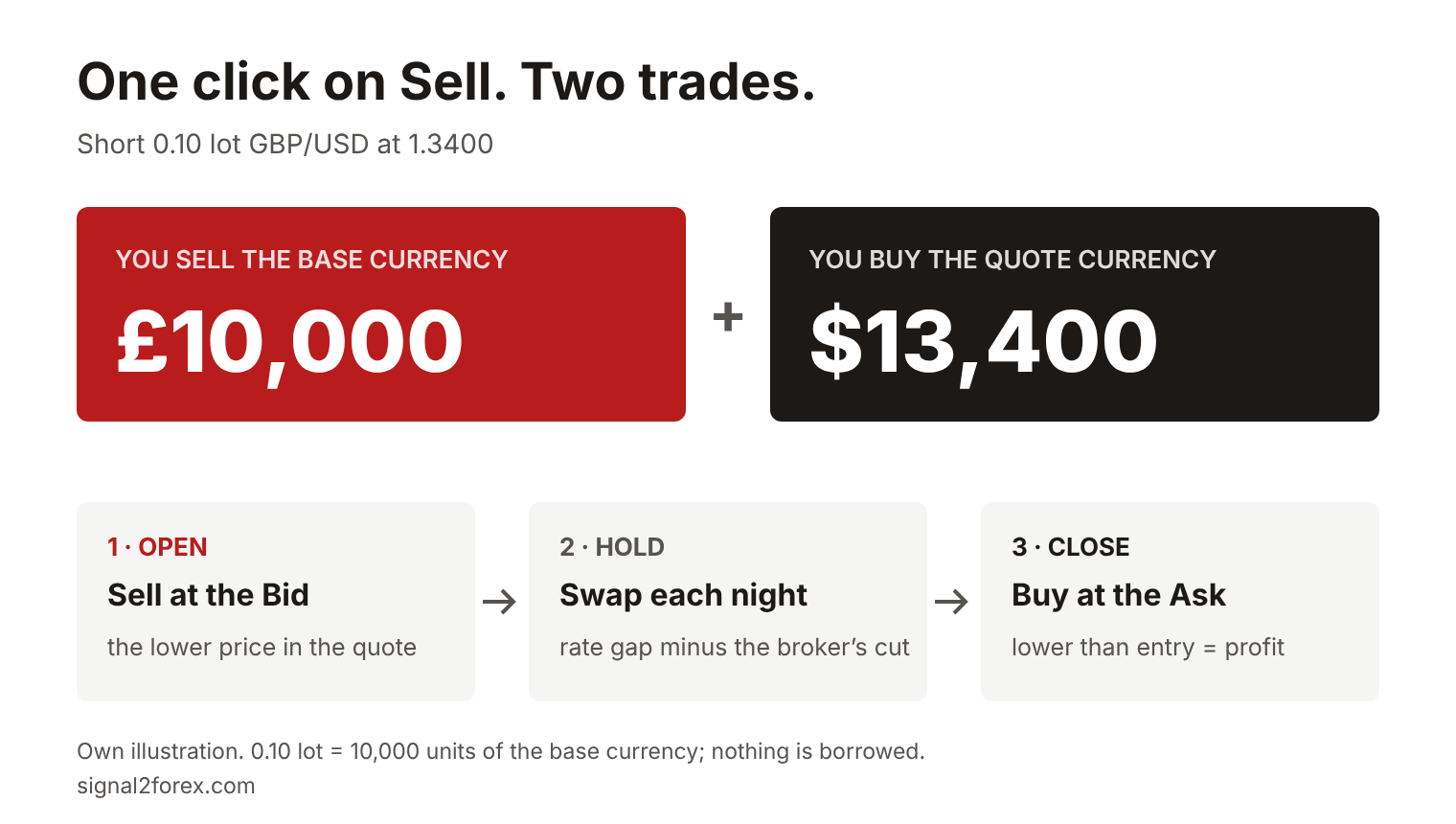
| Step | In the terminal | What it means |
|---|---|---|
| Open | Sell, filled at the Bid price | You sold the first currency of the pair and bought the second |
| Hold | Swap is added or taken each night | You pay one interest rate and earn the other, minus the broker’s cut |
| Close | Buy the same volume at the Ask price | A lower price than the entry is a profit, a higher price is a loss |
Two legs of one trade
Every currency pair is the price of one currency in units of another. In GBP/USD the pound is the base currency and the dollar is the quote currency. A price of 1.3400 means that one pound costs 1.34 dollars. This is the difference between a forex short and a short in stocks — there is always a second currency on the other side.
I like to keep one number in mind here. The Bank for International Settlements counted $9.6 trillion of currency trades per day in April 2025, and the dollar was on one side of 89.2% of them. Every one of these trades sells one currency to get another. A person who buys dollars for a holiday sells his own money, and nobody calls him a short seller.
So shorting a currency is the normal state of this market. Banks, exporters, funds, tourists — all of them do currency shorting every day, they only use other words for it. If you see it this way, the Sell button stops looking special. It is the same trade as Buy, only turned around.
How to short forex in MetaTrader
People often ask me how to short a currency in the terminal, step by step. How do you short a currency if you have never done it? There are three steps, and I will name them in order.
The first step — choose the pair and the volume. On GBP/USD one standard lot is 100,000 pounds, and one pip is worth $10. On 0.01 lot one pip is worth $0.10, and this is the size a small account should start with.
The second step — set the stop loss before the click. A sell order has its stop above the entry price and its take profit below it. This looks obvious, but people who are used to buy orders often put them the wrong way round. The terminal will refuse such an order, and it is better to know why.
The third step — press Sell. Your order is filled at the Bid, the lower of the two prices in the quote. When you close, the terminal buys the same volume at the Ask, the higher one. The gap between them is the spread. On a short you meet it at the exit.
One more thing about the Ask. The MetaTrader chart draws the Bid price, and a short closes at the Ask. So the stop of a sell order can trigger while the candle on the chart never touched that level. It looks like a trick of the broker. It is only the spread, and it gets wider at night and around news — this is why my robots have a spread filter.
You also do not have to close the whole position at once. In the close window you can type a smaller volume — for example 0.05 out of 0.10 lot — and leave the rest in the market with the stop moved to the entry price. I do not know whether this suits everyone, but in a long fall it helps to stay in the trade calmly.
A pound short on real prices
Now an example with dates that are easy to check. On 21 August 2026 the daily reference rates of the European Central Bank put the pound at 1.3656 dollars. On 16 September the Federal Reserve raised its rate to a range of 3.75–4.00%, and the dollar went up. By 2 October the same rates showed 1.3201.
A short opened on the first date and closed on the second caught 455 pips. On one standard lot this is $4,550, on 0.01 lot it is $45.50. Nobody sells the exact top and buys back at the exact bottom, and I am not saying that I did. But this is what short selling currency looks like when the trend is on your side. How a pip turns into money I explained in the article about what a pip is.
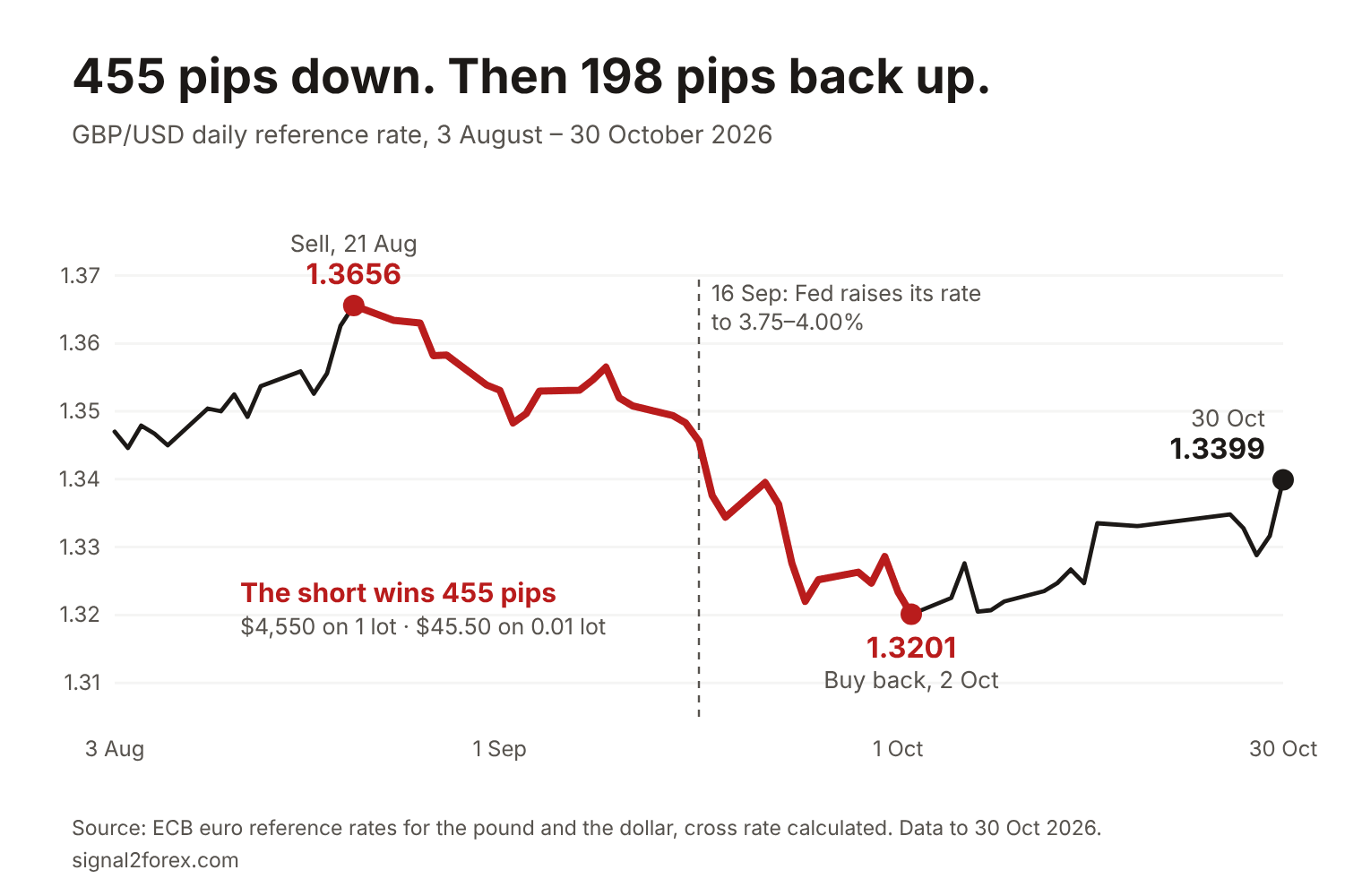
The same chart has the other half of the story. From 2 October the pound turned up. By 30 October the reference rate was 1.3399, and on 5 November the Bank of England raised Bank Rate to 4% by eight votes to one. A short opened at 1.3201 and held to the end of October lost 198 pips — $1,980 on a standard lot, $19.80 on 0.01 lot.
Was the second seller wrong about the pound? Maybe he was right about the year — the pound is still below its August price. He was wrong about the month, and for an account with leverage this is enough. So I look at every short as a trade with a date on it. An opinion about a currency can wait for years, and a sell order cannot.
The cost of holding
There is another cost besides the spread — the swap. When you hold a short overnight, you pay the interest rate of the currency you sold and earn the rate of the currency you bought. The broker takes the difference, adds his own cut and writes the result to your account once a day.
For the pound and the dollar this difference is now close to zero. Bank Rate has been 4% since 5 November, and the Fed range is 3.75–4.00%. With rates this close the broker’s cut decides the sign, and on many accounts both the long swap and the short swap come out negative. Why the central banks moved these rates I described in the article about hawkish and dovish policy.
You do not need to guess the number. In MetaTrader open Market Watch, right-click the symbol, choose Specification and find the line Swap short. This is what one night costs or pays on one lot. The same window shows the day of the triple swap — usually Wednesday — when three nights are counted at once. If you plan to hold a short for weeks, you need to read this line before the entry.
The unlimited loss myth
Most articles about forex short selling repeat one sentence. A buyer can lose only what he paid, and a seller can lose without limit, because a price can rise forever. For stocks I agree. For shorting currency pairs I do not, and here is my reason.
A short in GBP/USD is the same trade as a long in USD/GBP. If the pound doubles against the dollar, the dollar halves against the pound. Neither of them is a company that can rise a hundred times in a year. On a major pair a sell and a buy carry about the same risk. It is the leverage that makes this risk large.
And the broker will not wait for forever. Take a $1,000 account under the European rules that ESMA set in 2018 — leverage of 30:1 on major pairs and a forced close when equity falls to 50% of the required margin. A short of 0.10 lot at 1.3400 needs $447 of margin. The broker starts to close it at $223 of equity, after about 777 pips against you, near 1.4177.
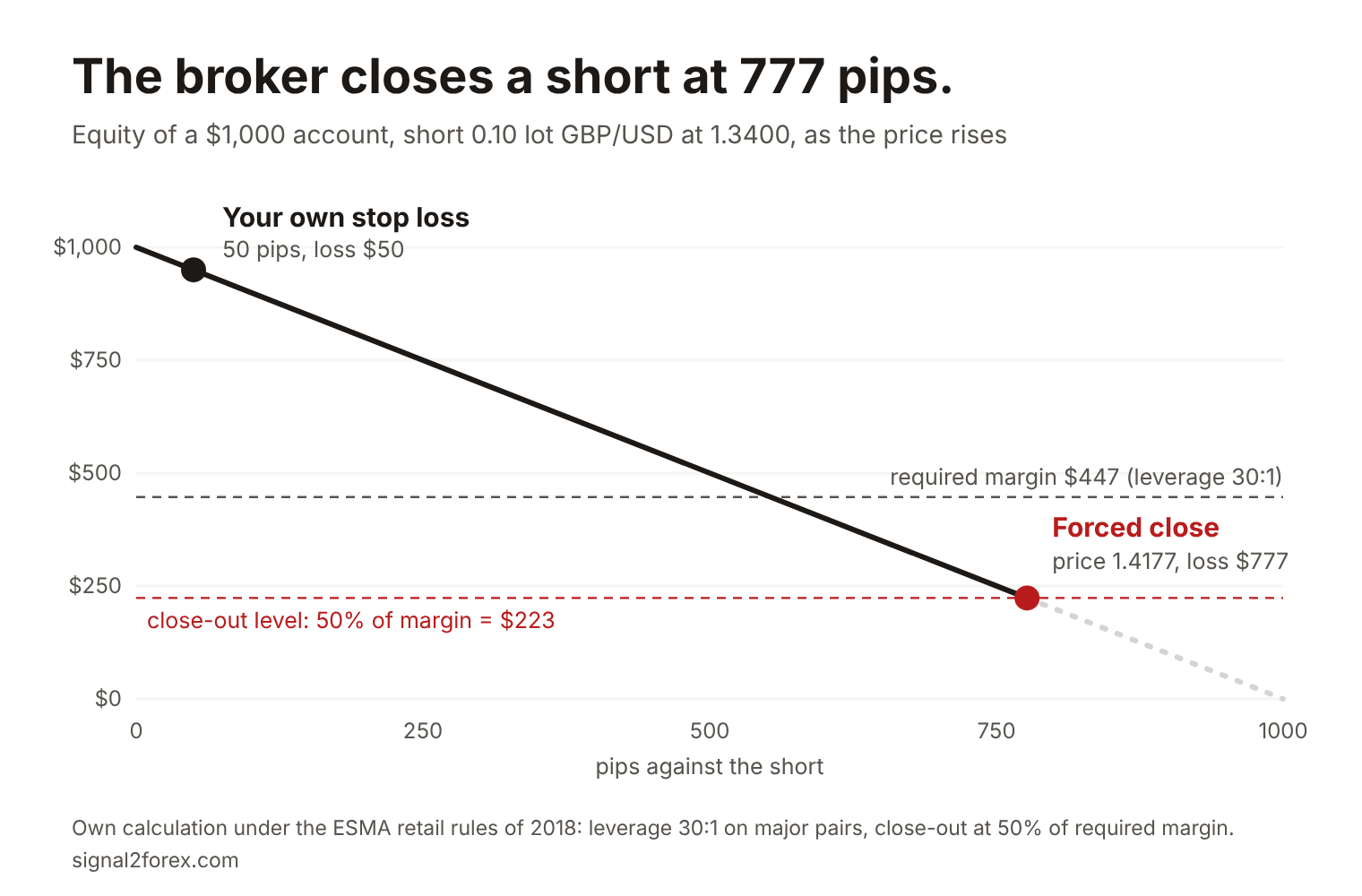
So the loss in this example ends near $777. The same rules, and the matching FCA rules in the UK, add negative balance protection — the account cannot go below zero. On a $100 account with 0.01 lot all these numbers are ten times smaller, about $78. Outside these rules the leverage can be 500:1, and the stop-out level is whatever the contract of the broker says. It is worth reading that line before the first sell.
Still, I would not plan around a forced close — it is the place where the broker protects himself. Your own stop has to stand much closer. In my robots the lot size comes from a Risk setting — a percent of the balance for one trade — and I think a manual short should be sized the same way.
Twenty-eight robots, fourteen sellers
Here is how I use the short side myself. The Forex V Portfolio is 28 expert advisors on 14 currency pairs, and the robots come in pairs too. On every symbol one robot only buys and the other only sells. GBP/USD is one of the fourteen. Each robot has its own magic number, so the terminal never mixes a sell order with the buy order of its neighbour.
I split them because for me the two sides are two separate jobs. A sell robot is its own file with its own settings, and I can switch it off without touching the buy side. Sometimes both robots of one pair are in the market together, and then the two positions partly cover each other. You can watch the sell orders open and close on the live stream of my account.
There is one place where this does not work. In the United States the NFA rule 2-43b does not let a broker keep a long and a short in the same pair on one account. Can you short currency there at all? Yes, freely. But a sell will close an open buy first, and the two sides cannot live together.
Four checks before the click
Before a short I go through four checks. The first check — the trend on the daily chart. To sell a rising pair only because the price looks high is the most costly habit I know. The second check — the calendar. A rate decision or an inflation number can move a pair very fast. On 14 October the pound lost about 140 pips within one day after the US inflation release.
The third check — the size. You need to count the lot from the stop, so that the loss at the stop is a small percent of the balance. With a 50-pip stop and a risk of $10 on a $1,000 account the volume is 0.02 lot.
On a $100 account the same one percent is $1, less than the smallest lot allows, and this is what cent accounts are for. The fourth check — the swap line and the triple swap day, if the trade will live longer than one night.
And what about the pound now? I do not know whether it will hold above 1.34 after the November rise. The next decision of the Bank of England is on 17 December 2026, and until then I would not argue with either side. If you want to learn how to short currency pairs, a quiet week is a better teacher than a decision day.
Two legs, the Bid and the Ask, the swap line, the stop above the entry, the lot counted from the stop — this is all a short is made of. To sell a currency is half of every trade in this market, not only the trades of people with a terminal, but also the trades of banks and tourists. The more of these small things you check before the click, the steadier a short sits in your account.
About the author. Uladzimir Leuchankou is a software engineer with a BSc in Finance and the founder of Signal2Forex. He writes the Forex V Portfolio robots — half of them only sell — and runs them on a real account that is streamed on YouTube. His developer profile is on MQL5. The pound prices and the two rates in this article were checked on 6 November 2026. Corrections are welcome at forexfactory1shop@gmail.com.
Trading currencies with leverage can lose your whole deposit. The examples here are calculations on public prices. They are not trades from the author’s account and not advice to sell the pound.
Figures: BIS Triennial Central Bank Survey, OTC foreign exchange turnover in April 2025, published 30 September 2025; ESMA product intervention measures on CFDs, 1 June 2018; ECB euro reference rates, 3 August to 30 October 2026; Federal Reserve statement of 28 October 2026 and Bank of England decision of 5 November 2026.


 Signal2forex.com - Best Forex robots and signals


