
📑 Table of Contents
- 1. What Is Foreign Exchange Intervention?
- 2. Why Do Central Banks Intervene in the Forex Market?
- 3. Types of Central Bank Interventions
- 4. How to Identify a Central Bank Intervention
- 5. Central Bank Intervention Trading Strategy — Step by Step
- 6. Central Bank Reference Table
- 7. Real-World Examples of Currency Interventions
- 8. Central Bank Intervention Trading Checklist
- 9. Common Mistakes When Trading Central Bank Interventions
- 10. Frequently Asked Questions
1. What Is Foreign Exchange Intervention?
Central bank intervention in the foreign exchange market is the process whereby a central bank buys or sells foreign currency in an attempt to stabilize the exchange rate or correct misalignments. This can be done directly through operational intervention or indirectly through jawboning.
Interventions can be unilateral (one central bank acting alone) or concerted (multiple central banks acting together). The effectiveness of an intervention depends on various factors including the size of the intervention, market conditions, and whether it is coordinated with other central banks.
2. Why Do Central Banks Intervene in the Forex Market?
Central banks intervene in the forex market for several reasons:
- Stimulate the economy: By weakening the domestic currency, central banks can boost exports and make domestic goods more competitive internationally.
- Maintain a desired exchange rate: To prevent excessive appreciation or depreciation that could harm the economy.
- Protect exports: A weaker currency makes exports cheaper and more attractive to foreign buyers.
- Control inflation: A stronger currency can help reduce import costs and lower inflationary pressures.
- Prevent excessive volatility: To maintain financial stability and prevent market disruptions.

3. Types of Central Bank Interventions
Understanding the different types of central bank interventions is essential for developing effective trading strategies. The table below provides a clear comparison.
| Intervention Type | Description | Market Impact | Example |
|---|---|---|---|
| Direct (Operational) | Central bank buys or sells currency directly in the market | Immediate, strong | BoJ buying USD/JPY to weaken JPY |
| Indirect (Jawboning) | Verbal intervention through statements and speeches | Gradual, psychological | ECB “concerned about euro strength” |
| Concerted | Multiple central banks coordinate their actions | Very strong | G7 intervention (1985 Plaza Accord) |
| Sterilized | Intervention offset with open market operations | Moderate | Buying USD while selling bonds |
📌 Market Impact indicates the strength and speed of the effect on currency prices. Sterilized interventions have a more moderate impact as they neutralize the effect on the domestic money supply.
4. How to Identify a Central Bank Intervention
Identifying a central bank intervention before it happens can give traders a significant advantage. Here are the key signs to watch for.
Signs of Impending Intervention
- Verbal warnings: Central bank officials expressing concern about currency strength or weakness.
- Key price levels: Interventions often occur when a currency reaches extreme levels (e.g., 20% below or above a key reference level).
- Economic pressures: When inflation or trade imbalances become problematic, intervention becomes more likely.
Market Signals to Watch
- Unusual price movements: Sharp moves in a short period without clear economic news.
- Increased volatility: Spikes in volatility before intervention often signal that the market is nervous.
- Order flow changes: Large, concentrated orders that suggest official intervention.
Confirmation Indicators
- Official statements: Confirmation from the central bank or government officials.
- Market reaction: Immediate and sustained price movement in the intervention direction.
- Volume analysis: Unusually high trading volume during the price move.
5. Central Bank Intervention Trading Strategy — Step by Step
Trading central bank interventions requires a disciplined approach. Follow these six steps to maximise your chances of success.
Step 1 — Monitor Central Bank Communications
Follow central bank speeches, statements, and press releases. Look for verbal warnings about currency strength or weakness. These are often precursors to actual intervention.
Step 2 — Identify Key Price Levels
Identify key price levels where intervention is likely. These often coincide with multi-year highs or lows, psychological levels, or central bank reference rates.
Step 3 — Wait for Confirmation
Wait for official confirmation or clear market action indicating intervention has occurred. Trading on speculation alone is risky and often leads to losses.
Step 4 — Entry Rules
- Direct Intervention: Enter in the direction of the intervention (e.g., long if the central bank is buying).
- Indirect Intervention: Watch for price action confirmation after verbal warnings.
- Retest Entry: Some traders wait for a retest of the intervention level before entering.
Step 5 — Stop-Loss Placement
- Direct Intervention: Place stop-loss beyond the intervention level (e.g., below the low of the intervention move).
- Buffer: Add a small buffer beyond the extreme to account for market noise.
- Risk Management: Never risk more than 1–2% of your trading account on a single trade.
Step 6 — Take-Profit Targets
- Logical Targets: Set take-profit at previous swing highs/lows, Fibonacci levels, or key resistance/support.
- Trailing Stop: Consider using a trailing stop to capture additional profits if the move continues.
- Risk-Reward: Aim for a minimum risk-reward ratio of 1:2.
6. Central Bank Reference Table
This static reference table provides a quick overview of major central banks and their typical approaches to currency intervention.
| Central Bank | Intervention History | Typical Approach | Key Currency |
|---|---|---|---|
| Federal Reserve (US) | Rare, mostly coordinated | Verbal, concerted | USD |
| European Central Bank | Occasional | Jawboning, direct | EUR |
| Bank of Japan | Frequent | Direct, aggressive | JPY |
| Bank of England | Rare | Verbal | GBP |
| Swiss National Bank | Active | Direct, aggressive | CHF |
| People’s Bank of China | Regular | Managed float | CNY |
📌 Typical Approach indicates the primary method each central bank uses to influence its currency. Intervention History reflects how frequently each bank intervenes in the forex market.
7. Real-World Examples of Currency Interventions
Bank of Japan (USD/JPY) — Successful Intervention
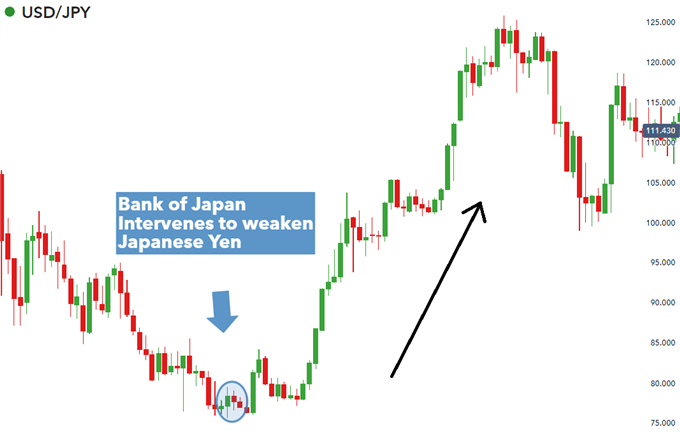
In 2024-2026, the Bank of Japan conducted several successful interventions to weaken the yen. In April 2026, BoJ spent a record 11.7 trillion yen in three interventions, with a single-day operation on April 30 reaching 7.8 trillion yen. The interventions successfully pushed USD/JPY from around 160 to 145-148 levels, demonstrating that coordinated and determined action can influence currency markets.
✅ Success factors: Large-scale operations, clear communication, and favorable market conditions contributed to the intervention’s effectiveness.
Central Bank of Brazil (USD/BRL) — Failed Intervention
In the USD/BRL example from 2018, a failed attempt by the Central Bank of Brazil to keep the currency in line with its expectations. The central bank sold USD and bought BRL but failed to stem the trend. The failure led to the Brazilian Real becoming the worst-performing currency in 2018, falling more than 5% in the week of the intervention.
❌ Failure factors: Persistent outflows, weak domestic fundamentals, and a broader USD strength trend overwhelmed the intervention.
8. Central Bank Intervention Trading Checklist
Before entering a trade based on a central bank intervention, run through this static checklist to ensure you have covered all the key criteria.
| Step | Check | Status |
|---|---|---|
| 1 | Have you identified the central bank’s desired direction? | ☑ Check |
| 2 | Is there a verbal warning or signal from officials? | ☑ Check |
| 3 | Has the currency reached a key intervention level? | ☑ Check |
| 4 | Is there confirmation of intervention (official statement or price action)? | ☑ Check |
| 5 | Is the risk-reward ratio at least 1:2? | ☑ Check |
| 6 | Have you set a stop-loss beyond the intervention level? | ☑ Check |
| 7 | Are you prepared for extreme volatility? | ☑ Check |
📌 Status indicates that each step should be verified before entering a trade. Missing any of these steps increases the risk of a losing trade.
9. Common Mistakes When Trading Central Bank Interventions
Avoid these common pitfalls to improve your success rate when trading central bank interventions.
- ❌ Trading on speculation: Entering a trade before official confirmation of intervention is risky and often leads to losses.
- ❌ Ignoring the overall trend: Interventions are more likely to succeed when they align with the broader market trend.
- ❌ Overlooking verbal warnings: Central banks often signal their intentions through speeches and statements. Ignoring these warnings can lead to missed opportunities.
- ❌ Placing stop-loss too tight: Interventions can cause extreme volatility, so a wider stop-loss may be necessary.
- ❌ Trading against intervention: Trading against the direction of a confirmed intervention is risky and often leads to losses.
- ❌ Forgetting about sterilized interventions: Sterilized interventions have a more moderate impact and may not produce sustained moves.
10. Frequently Asked Questions
What is central bank intervention in the foreign exchange market?
Central bank intervention is the process whereby a central bank buys or sells foreign currency in an attempt to stabilize the exchange rate or correct misalignments in the forex market.
Why do central banks intervene in the forex market?
Central banks intervene to stimulate the economy, maintain a desired exchange rate, protect exports, control inflation, or prevent excessive currency volatility.
What are the types of central bank interventions?
The main types are: Direct (operational) intervention — buying/selling currency; Indirect (jawboning) — verbal statements; Concerted intervention — multiple central banks acting together; and Sterilized intervention — offsetting money supply effects.
What is sterilized intervention?
Sterilized intervention is when a central bank buys or sells foreign currency and simultaneously offsets the effect on the domestic money supply through open market operations, such as buying or selling government securities.
What is jawboning in forex?
Jawboning is an indirect form of intervention where central bank officials make public statements about a currency being overvalued or undervalued, influencing market participants to adjust their positions without actual trading.
How do you trade central bank interventions?
Monitor central bank communications for warnings, identify key price levels where intervention is likely, wait for confirmation of intervention, enter in the direction of the intervention, place stop-loss beyond the intervention level, and set take-profit at logical levels.
Are central bank interventions always successful?
No, interventions can fail. The effectiveness depends on market conditions, the size of the intervention, and whether it is coordinated with other central banks. The USD/BRL example shows that interventions don’t always work.
Which central banks intervene most frequently?
The Bank of Japan (BoJ) is known for frequent and aggressive interventions. The Swiss National Bank (SNB) also intervenes actively. The Federal Reserve and ECB intervene less frequently, preferring verbal intervention.
What is concerted intervention?
Concerted intervention occurs when multiple central banks coordinate their actions to intervene in the forex market together. This sends a stronger signal to the market and is often more effective than unilateral intervention.
📊 Expand your pattern recognition skills: Discover the top 10 candlestick patterns every trader must know. Combining candlestick analysis with central bank intervention knowledge gives you a complete technical and fundamental toolkit for forex trading success.
📈 Enhance your trading with the right tools: Explore our collection of forex indicators for download — powerful tools that can help you identify intervention levels, confirm signals, and manage your trades with confidence.
📞 Need help with your central bank intervention trading strategy? Our team is here to assist you. Visit our Contact Page or use the online chat available on every page of our website for immediate support.


 Signal2forex.com - Best Forex robots and signals