
📑 Table of Contents
- 1. What Is a Dark Cloud Cover Pattern?
- 2. How to Identify a Dark Cloud Cover on Forex Charts
- 3. Dark Cloud Cover vs Bearish Engulfing — Key Differences
- 4. How to Trade the Dark Cloud Cover Pattern — Step by Step
- 5. Dark Cloud Cover Trading Checklist
- 6. How Reliable Is the Dark Cloud Cover Pattern?
- 7. Common Mistakes When Trading Dark Cloud Cover
- 8. Frequently Asked Questions
1. What Is a Dark Cloud Cover Pattern?
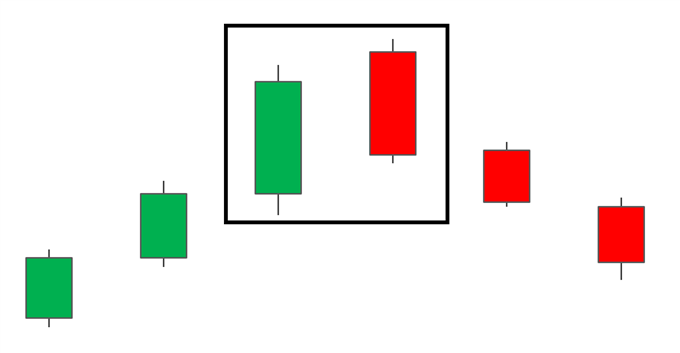
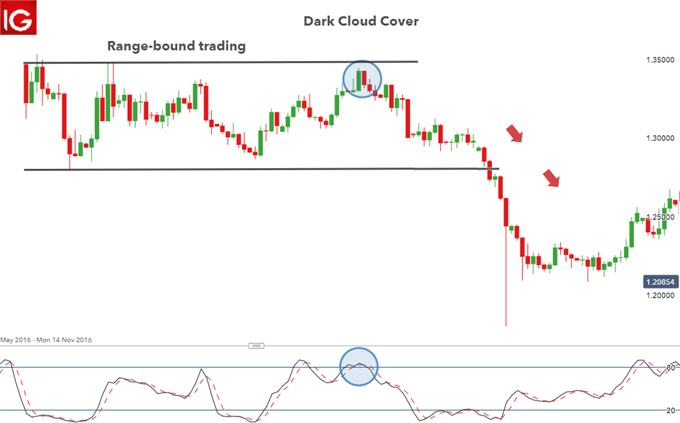
The dark cloud cover candlestick pattern is a bearish reversal pattern that forms at the top of an uptrend. It consists of a large bullish candle followed by a bearish candle that opens above the first candle’s close but closes below the midway point of the first candle’s body.
The dark cloud cover pattern signals that buying pressure is fading and selling pressure is taking control. It is widely regarded as one of the most reliable bearish reversal signals in technical analysis, particularly when confirmed by volume and other indicators.
The pattern gets its name from its visual appearance — the bearish candle “darkens” the bullish candle, covering it like a dark cloud covering the sun.

2. How to Identify a Dark Cloud Cover on Forex Charts
Identifying a dark cloud cover pattern requires a systematic approach. Use the following characteristics and checklist to confirm the pattern.
Key Characteristics of a Dark Cloud Cover
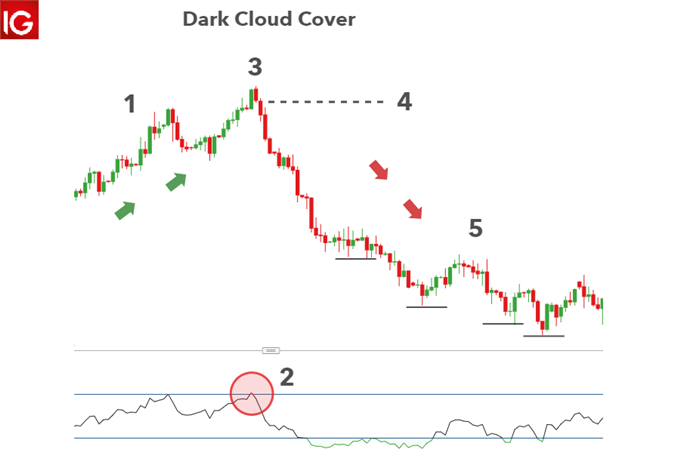
- Market Context: The pattern must form after a clear uptrend.
- First Candle: A large bullish candle (green) with a long body.
- Second Candle: A bearish candle (red) that opens above the close of the first candle (gap up).
- Second Candle Close: The bearish candle must close below the 50% level of the first candle’s body.
- Volume: Increasing volume on the second candle strengthens the signal.
- Confirmation: The next candle should close lower or in the direction of the reversal.
Dark Cloud Cover Checklist
- ✅ Identify existing uptrend
- ✅ Look for a large bullish first candle
- ✅ Confirm the second candle opens above the first close (gap up)
- ✅ Verify the second candle closes below the 50% level of the first body
- ✅ Check for increasing volume on the second candle
- ✅ Wait for confirmation from the next candle
3. Dark Cloud Cover vs Bearish Engulfing — Key Differences
Understanding the differences between the dark cloud cover and bearish engulfing patterns is essential for accurate identification and trading. The table below provides a clear comparison.
| Feature | Dark Cloud Cover | Bearish Engulfing |
|---|---|---|
| Market Context | End of an uptrend | End of an uptrend |
| First Candle | Bullish (large body) | Bullish |
| Second Candle | Bearish (large body) | Bearish (larger body) |
| Second Candle Open | Above first close (gap up) | Below first open |
| Second Candle Close | Below 50% of first body | Below first open (engulfs) |
| Entry Level | More attractive (higher close) | Lower close |
| Risk-Reward | More favourable | Less favourable |
| Signal Strength | Moderate | Stronger |
| Success Rate | ~55-65% | ~60-75% |
📌 Success Rate is based on historical performance when confirmed with additional indicators. Higher timeframes (daily, weekly) tend to be more reliable.
4. How to Trade the Dark Cloud Cover Pattern — Step by Step
Trading the dark cloud cover pattern requires a disciplined approach. Follow these five steps to maximise your chances of success.
Step 1 — Identify a Valid Dark Cloud Cover in an Uptrend
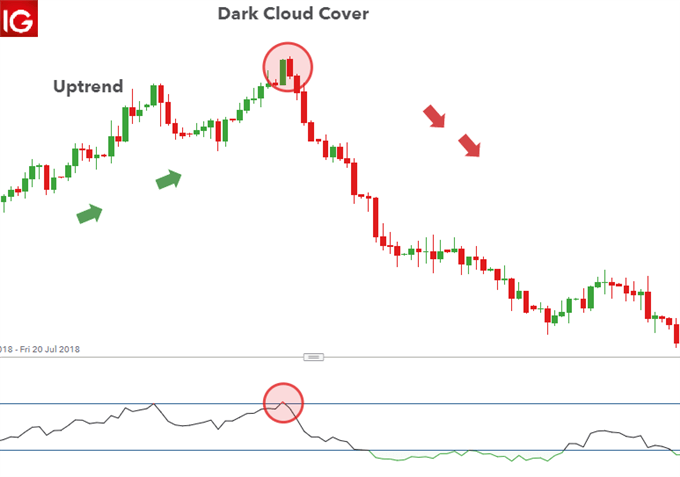
- Ensure the pattern forms at the top of a clear uptrend (higher highs and higher lows).
- Confirm the two-candle structure: a large bullish candle followed by a bearish candle that opens above the first close and closes below the 50% level of the first body.
Step 2 — Wait for Confirmation
- Wait for the next candle to close lower than the dark cloud cover pattern.
- Look for additional confirmation from RSI, MACD, or resistance levels.
- An RSI overbought reading (above 70) or bearish divergence strengthens the signal.
Step 3 — Entry Rules
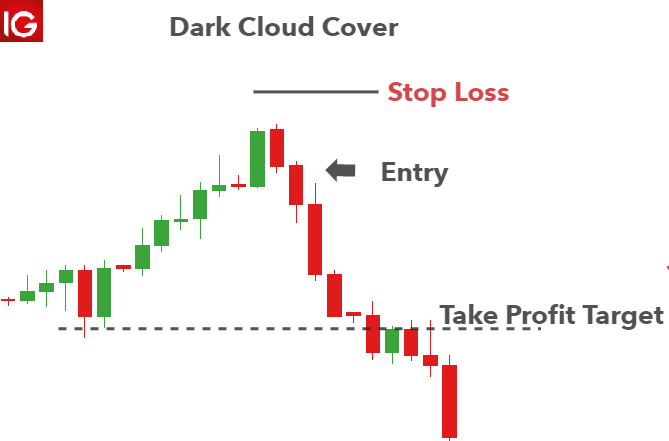
- Entry Signal: Enter a short position on a break below the low of the dark cloud cover pattern.
- Alternative Entry: Some traders enter at the open of the candle following the pattern.
- Confirmation: Wait for the next candle to close below the pattern’s low for additional confirmation.
Step 4 — Stop-Loss Placement
- Stop-Loss Placement: Place your stop-loss above the high of the dark cloud cover pattern (the high of the second candle).
- Buffer: Add a small buffer above the high to account for market noise.
- Risk Management: Never risk more than 1–2% of your trading account on a single trade.
Step 5 — Take-Profit Targets
- Fibonacci Extensions: Use Fibonacci extensions (127.2%, 161.8%) to identify potential profit targets.
- Recent Swing Lows: Target the previous swing low or support level.
- Risk-Reward: Aim for a minimum risk-reward ratio of 1:2.
5. Dark Cloud Cover Trading Checklist
Before entering a trade based on the dark cloud cover pattern, run through this static checklist to ensure you have covered all the key criteria.
| Step | Check | Status |
|---|---|---|
| 1 | Is there a clear uptrend? | ☑ Check |
| 2 | Is the first candle bullish with a large body? | ☑ Check |
| 3 | Does the second candle open above the first close? | ☑ Check |
| 4 | Does the second candle close below the 50% level of the first body? | ☑ Check |
| 5 | Is there confirmation from RSI, MACD, or resistance levels? | ☑ Check |
| 6 | Is the risk-reward ratio at least 1:2? | ☑ Check |
| 7 | Is the stop-loss placed above the second candle’s high? | ☑ Check |
| 8 | Is the take-profit set at a logical level (swing low, Fibonacci)? | ☑ Check |
📌 Status indicates that each step should be verified before entering a trade. Missing any of these steps increases the risk of a losing trade.
6. How Reliable Is the Dark Cloud Cover Pattern?
The reliability of the dark cloud cover pattern depends significantly on the timeframe, market context, and confirmation signals. Here are the key statistics:
- Success Rate: The dark cloud cover pattern has a success rate of approximately 55-65% depending on market conditions, timeframe, and confirmation signals.
- Higher Timeframes: The pattern is more reliable on daily, weekly, or 4-hour charts than on lower timeframes.
- Volume Confirmation: When confirmed by increasing volume on the second candle, reliability increases significantly.
- Confirmation Candle: The pattern is most reliable when the next candle closes lower than the pattern’s low.
- Trend Context: The pattern is most reliable when it forms after a prolonged uptrend with clear higher highs.
💡 Trading tip: Never rely solely on the dark cloud cover pattern. Always use it in combination with other technical tools such as RSI, MACD, and support/resistance levels.
7. Common Mistakes When Trading Dark Cloud Cover
Avoid these common pitfalls to improve your success rate with dark cloud cover patterns.
- ❌ Trading the pattern in isolation: Dark cloud cover patterns require confirmation from other technical indicators and oscillators.
- ❌ Ignoring the overall trend: The pattern is most reliable when it forms after a prolonged uptrend.
- ❌ Entering too early: Entering before the pattern is confirmed (e.g., waiting for the next candle) can lead to losses.
- ❌ Placing stop-loss too tight: Setting the stop-loss too close to the entry can result in being stopped out by normal market noise.
- ❌ Ignoring the 50% rule: The second candle must close below the 50% level of the first candle’s body. Ignoring this rule reduces the pattern’s reliability.
- ❌ Confusing dark cloud cover with bearish engulfing: A dark cloud cover has a gap up and closes below 50%. A bearish engulfing completely engulfs the first candle’s body.
8. Frequently Asked Questions
What is a dark cloud cover candlestick pattern?
The dark cloud cover is a bearish reversal candlestick pattern that forms at the top of an uptrend. It consists of a large bullish candle followed by a bearish candle that opens above the first close but closes below the midway point of the first candle’s body.
How do you identify a dark cloud cover pattern?
Look for an uptrend, a large bullish first candle, and a bearish second candle that opens above the first candle’s close and closes below the 50% level of the first candle’s body. Volume and RSI confirmation strengthen the signal.
What is the difference between a dark cloud cover and a bearish engulfing pattern?
In a dark cloud cover, the second candle closes below the 50% level of the first candle but not below its open. In a bearish engulfing pattern, the second candle completely engulfs the first candle’s body, closing below the first open.
How reliable is the dark cloud cover pattern?
The dark cloud cover pattern has a success rate of approximately 55-65% depending on market conditions, timeframe, and confirmation signals. When confirmed by RSI or volume, reliability increases significantly.
What is the best way to trade a dark cloud cover pattern?
Identify the pattern in an uptrend, wait for confirmation (next candle closes lower), enter on a break below the dark cloud cover’s low or at the open of the next candle, place stop-loss above the pattern’s high, and set take-profit using Fibonacci extensions or recent swing lows.
What confirmation signals work best with the dark cloud cover?
Common confirmation signals include RSI overbought conditions (above 70), bearish divergence, resistance levels, and the next candle closing below the pattern’s low.
Can the dark cloud cover pattern be used in forex trading?
Yes, the dark cloud cover pattern is widely used in forex trading and works on any timeframe, though it is most reliable on daily and 4-hour charts.
What is the 50% rule for dark cloud cover?
The 50% rule states that for a valid dark cloud cover pattern, the bearish second candle must close below the midpoint (50%) of the previous bullish candle’s body. This confirms that sellers have taken control.
What is the success rate of the dark cloud cover pattern?
Research shows the dark cloud cover pattern has a success rate of approximately 55-65% when confirmed by additional indicators. Higher timeframes offer better reliability.
📖 Learn from the world’s greatest investor: Discover Warren Buffett’s favorite steakhouse and how it fits his modest style. While not directly about trading, understanding Buffett’s philosophy of discipline and patience is essential — qualities that also apply to trading dark cloud cover patterns.
⚠️ Protect your trading account: Learn what a margin call is in forex and how to avoid one — essential risk management knowledge that every trader must master, especially when trading reversal patterns like the dark cloud cover.
📞 Need help with your dark cloud cover trading strategy? Our team is here to assist you. Visit our Contact Page or use the online chat available on every page of our website for immediate support.


 Signal2forex.com - Best Forex robots and signals


