
📑 Table of Contents
1. What Is Copper Trading?
Copper trading involves buying and selling financial instruments linked to the price of copper, one of the world’s most important industrial metals. Traders speculate on copper’s price movements to profit from volatility or hedge against price risk. Copper is often called “Dr. Copper” because its price is widely regarded as a reliable leading indicator of global economic health — when copper prices rise, the economy is typically expanding; when they fall, a slowdown may be coming.
Copper is traded on major exchanges including the London Metal Exchange (LME), the COMEX division of the New York Mercantile Exchange, and the Shanghai Futures Exchange (SHFE). It is available in several forms: futures contracts, exchange-traded funds (ETFs), contracts for difference (CFDs), options, and mining company stocks.
2. Why Trade Copper in 2026?
2026 is a landmark year for copper trading, with prices reaching record highs and market conditions creating significant opportunities for traders. Here are the key reasons copper is attracting attention:
Record-High Prices and Supply Deficit
Copper prices have surged to unprecedented levels in 2026. LME copper futures climbed to $13,456 per tonne in early July, while Comex futures reached approximately $6.22 per pound. The market is experiencing its largest supply deficit in 22 years, driven by slower-than-expected mine production growth and surging demand.
Growing Demand from AI, Electrification and Infrastructure
Three powerful forces are driving copper demand higher:
- Artificial Intelligence infrastructure — data centre installations alone will consume approximately 475,000 metric tons of copper in 2026
- Electrification and renewable energy — the global transition to clean energy continues to drive demand for copper, making it a key structural investment
- Power grid and defence infrastructure — strong global demand growth from grid and power infrastructure, backed by investment in strategic sectors
Copper as an Economic Barometer
Copper’s role as a leading economic indicator has never been more relevant. The metal’s price reflects global industrial activity, making it a valuable tool for traders seeking to understand broader market trends. The Economic Survey has warned that the world will soon face a copper shortage due to surging power demand from AI data centres.
3. Key Factors Affecting Copper Prices
Understanding the drivers of copper prices is essential for developing effective trading strategies. Here are the most important factors that influence copper’s value:
US Dollar Correlation
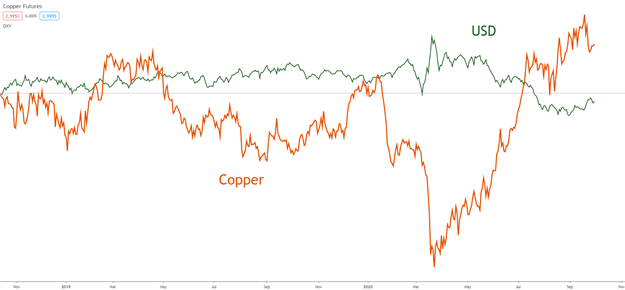
Copper has a strong inverse correlation with the US dollar. Since copper is priced in USD, a weaker dollar makes copper cheaper for foreign buyers, potentially boosting demand and prices. Conversely, a stronger dollar tends to put downward pressure on copper prices.
Chinese Demand and Economic Growth
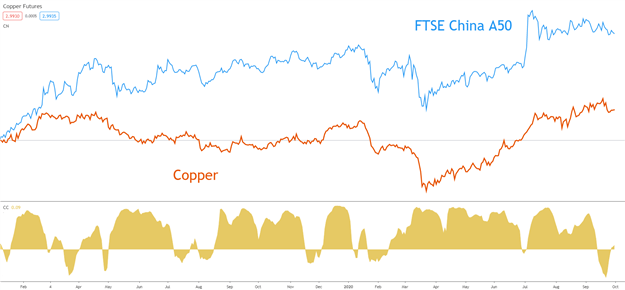
China is the world’s largest copper consumer, accounting for over 50% of global demand. Chinese economic growth, infrastructure spending, industrial production, and import policies significantly impact copper prices. Any slowdown in China’s economy can trigger sharp declines in copper prices.
Supply Constraints and Mining Disruptions
Copper supply is subject to various disruptions:
- Declining ore grades — major mines like Escondida are experiencing declining ore quality
- Production constraints — slower production growth in the DRC, Chile, and constraints at Grasberg and Kamoa mines
- Trade protectionist measures — US tariff uncertainty is influencing global copper flows
Oil Prices and Production Costs
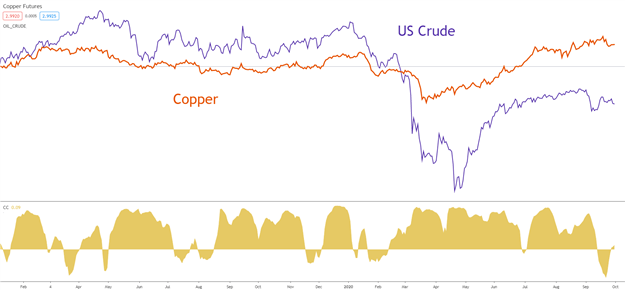
Oil prices affect copper production costs, particularly through energy-intensive mining and refining processes. Higher oil prices can reduce copper supply by making extraction more expensive, potentially pushing copper prices higher.
4. Copper Trading Instruments
Traders have multiple ways to gain exposure to copper. Each instrument has different characteristics, risk profiles, and cost structures. The table below compares the main options.
| Instrument | Description | Leverage | Liquidity | Best For |
|---|---|---|---|---|
| Futures | Standardized contracts on exchanges (LME, COMEX, SHFE) | High | Very High | Professional traders, hedging |
| ETFs | Exchange-traded funds (CPER, JJCB, COPX) | Low | High | Long-term investors, portfolio diversification |
| CFDs | Contracts for difference offered by brokers | High | Medium | Retail traders, speculation |
| Options | Right to buy/sell copper at a specific price | Medium | Medium | Hedging, income generation |
| Mining Stocks | Shares of copper mining companies (FCX, RIO, BHP) | Low | Medium | Equity investors, leveraged to copper price |
📌 Each instrument has unique characteristics. Futures offer the most direct exposure but require margin and understanding of contract specifications. ETFs are simpler for retail investors but may have tracking error. CFDs offer flexibility but carry counterparty risk.

5. Copper Trading Strategies
Successful copper trading requires a well-defined strategy that aligns with current market conditions. Here are the most effective approaches for 2026:
Technical Analysis Strategies
Technical analysis is widely used in copper trading due to the metal’s tendency to trend and react to key price levels. Common approaches include:
- Trend Following: Identify and follow the dominant trend using moving averages (e.g., 50, 100, 200-day) and momentum indicators. With copper in a strong uptrend in 2026, trend-following strategies have been particularly effective.
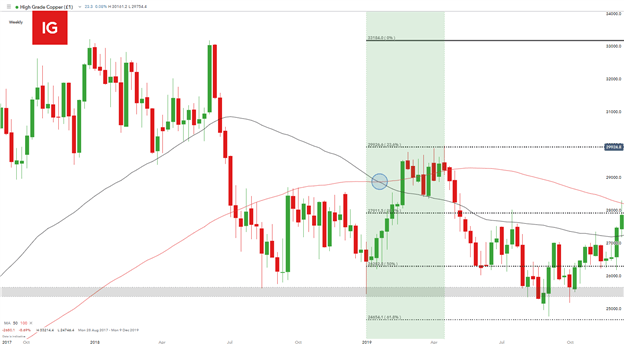
- Support and Resistance: Trade bounces off key support levels or breakouts through resistance. Copper has established clear price zones in 2026, with resistance near $6.60/lb and support around $5.80/lb.
- Chart Patterns: Look for bullish wedge and cup-and-handle patterns that have recently appeared on copper charts.
Fundamental Analysis Strategies
Copper is particularly well-suited to fundamental analysis due to the wealth of data available on supply and demand:
- Supply-Demand Monitoring: Track ICSG reports, mine production data, and inventory levels. The current structural deficit creates a strong bullish case.
- Macroeconomic Analysis: Monitor Chinese economic data, US dollar strength, and global infrastructure spending.
- News Trading: Trade around major announcements, including mining disruptions, tariff decisions, and infrastructure spending bills.
Combining Technical and Fundamental Analysis
The most successful copper traders combine both approaches. Use fundamental analysis to determine the long-term direction and technical analysis to time entries and exits. For example, buy on fundamental bullishness when price pulls back to a key technical support level.

6. Copper Price Forecast 2026
Major financial institutions have released widely varying forecasts for copper prices in 2026, reflecting the uncertainty and volatility of the current market. The table below summarises the key projections:
| Bank / Institution | Price Forecast (USD/ton) | Outlook | Key Driver |
|---|---|---|---|
| Goldman Sachs | $13,735 (year-end 2026) | Bullish | Supply deficit, AI, power grids |
| Citigroup | $14,500 (June 2026) → $15,000 (next 12 months) | Very Bullish | Super-squeeze, tariff uncertainty |
| UBS | $13,200 (average) → $15,000 (March 2027) | Bullish | Supply shortages, electrification |
| J.P. Morgan | $11,200–$12,500 (average ~$11,200) | Cautious | Geopolitical risks, US tariff impact |
| Morgan Stanley | $10,650 (base case) | Moderate | Supply-demand balance |
| HSBC | Varies | Bullish | Geopolitical disruptions, constrained trade flows |
📌 Forecasts vary widely, reflecting the uncertainty in the market. Goldman Sachs’ more recent (June 2026) forecast of $13,735 per ton represents a significant increase from its earlier projection. Copper’s fair price is estimated to be around $11,000 per ton.
7. Risk Management in Copper Trading
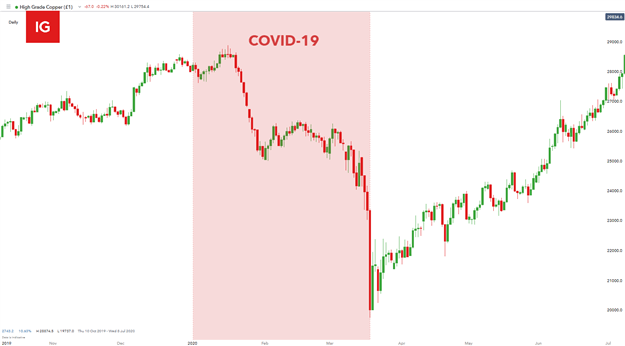
Copper trading can be highly profitable, but it also carries significant risks. Effective risk management is essential for long-term success:
- Position Sizing: Never risk more than 1-2% of your trading capital on a single trade. Copper’s volatility can be extreme, especially during major news events.
- Stop-Loss Placement: Always use stop-loss orders. Place them beyond key technical levels to avoid being stopped out by normal market noise. For copper, consider volatility-based stops using Average True Range (ATR).
- Diversification: Don’t put all your capital into copper. Diversify across different commodities, asset classes, and trading strategies.
- Leverage Awareness: Futures and CFDs offer high leverage, which can amplify both profits and losses. Use leverage cautiously and understand the margin requirements.
- Stay Informed: Copper prices can be affected by unexpected events — mining disruptions, trade policy changes, and geopolitical tensions. Stay updated with news and economic data.
- Monitor the Dollar: Keep a close eye on the US dollar index (DXY). A strong dollar can put downward pressure on copper prices, while a weak dollar can boost them.
8. Frequently Asked Questions
What is copper trading?
Copper trading involves buying and selling financial instruments linked to the price of copper, including futures, ETFs, CFDs, and mining stocks. Traders speculate on price movements to profit from volatility or hedge against price risk.
How do you trade copper?
You can trade copper through futures contracts on exchanges like LME, COMEX, and SHFE, copper ETFs (CPER, JJCB, COPX), CFDs offered by brokers, options, or by investing in copper mining companies.
What affects the price of copper?
Copper prices are influenced by the US dollar (inverse correlation), Chinese demand, global economic growth, supply disruptions, mining costs, oil prices, and industrial production trends.
What is the copper price forecast for 2026?
Goldman Sachs forecasts $13,735 per ton by end of 2026, while J.P. Morgan projects ~$11,200 per ton. Citigroup is the most bullish, forecasting $14,500 in June 2026 and $15,000 within the next year.
Is copper a good investment in 2026?
Many analysts are bullish on copper in 2026 due to supply deficits, record-high prices, and growing demand from AI infrastructure, renewable energy, and electrification. However, prices may be volatile and subject to geopolitical risks.
What is the correlation between copper and the US dollar?
Copper has an inverse correlation with the US dollar. When the dollar weakens, copper prices typically rise, and vice versa, because copper is priced in USD.
How does China affect copper prices?
China is the world’s largest copper consumer, accounting for over 50% of global demand. Chinese economic growth, infrastructure spending, and industrial production significantly impact copper prices.
What are the best copper ETFs?
Popular copper ETFs include CPER (United States Copper Index Fund), JJCB (iPath Series B Bloomberg Copper Subindex Total Return ETN), and COPX (Global X Copper Miners ETF). These provide exposure to copper prices without trading futures directly.
What is the difference between copper futures and CFDs?
Copper futures are standardized contracts traded on exchanges with fixed expiration dates, while CFDs are over-the-counter derivatives with more flexibility but higher counterparty risk.
What are the risks of trading copper?
Risks include price volatility, leverage risk (with futures and CFDs), geopolitical risks affecting supply, currency risk, and the impact of global economic conditions on industrial metal demand.
🤖 Automate Your Commodity Trading: For traders looking to implement systematic strategies across multiple markets, explore our complete collection of forex trading robots and Expert Advisors — fully automated systems designed to execute a variety of strategies, including trend following, scalping, and portfolio trading. With 14 proven EAs available, you can find the perfect automated solution to complement your copper and commodities analysis. Our robots trade 24/7, eliminate emotional decision-making, and have been tested across multiple market conditions.
📈 Master Technical Patterns: Enhance your copper trading with our comprehensive guide to trading the inverted hammer candlestick pattern — learn how to identify this powerful bullish reversal signal that appears at the bottom of downtrends, just as copper’s uptrends often begin with such reversal patterns. Combine candlestick analysis with copper’s fundamental drivers for a complete trading approach.


 Signal2forex.com - Best Forex robots and signals


