
Elliott Wave Zigzag Pattern — Complete Guide to the 5-3-5 Structure (2026)
The zigzag pattern is one of the most common corrective structures in Elliott Wave theory. It is a 3-wave counter-trend formation with a distinctive 5-3-5 sub-structure that appears frequently in wave 2 of an impulse and in complex corrections. This comprehensive guide covers the structure, rules, Fibonacci targets, and how to identify zigzags on price charts — with real examples and a full reference table.
1. What Is a Zigzag in Elliott Wave Theory?
In Elliott Wave theory, a zigzag is a 3-wave corrective pattern labelled A-B-C that moves against the direction of the main trend. It is one of the most common corrective structures and is characterised by a deep retracement that often recovers a significant portion of the prior impulse wave.
📌 Key Definition: A zigzag is a 3-wave (A-B-C) counter-trend formation with a 5-3-5 sub-structure. Wave A and C each consist of 5 sub-waves, while Wave B consists of 3 sub-waves. It typically appears in Wave 2 of a 5-wave impulse or in complex corrections.
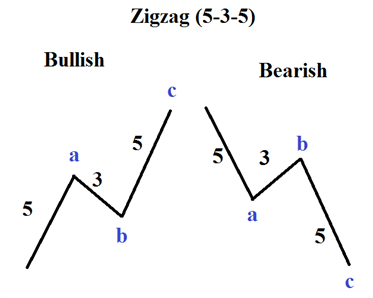
Fig 1: The Elliott Wave zigzag pattern — a 3-wave (A-B-C) counter-trend formation with a 5-3-5 sub-structure.
Key Characteristics of the Zigzag Pattern
- Wave Count: 3 waves (A-B-C)
- Sub-structure: 5-3-5
- Type: Counter-trend / corrective
- Depth: Deep retracement — often 50-78.6% of the prior impulse
- Visual: Resembles a lightning bolt on the chart
- Direction: Can be bullish or bearish, always against the main trend
Where Zigzags Appear in the Elliott Wave Sequence
- Wave 2 — the most common location for a zigzag, as wave 2 often retraces deeply
- Wave 4 — less common but can appear
- Within complex corrections — zigzags can be part of double or triple zigzags
- Within Elliott Wave triangles — zigzags can appear as sub-waves
💡 Pro Tip: Zigzags are deep retracements. If you see a corrective move that retraces more than 61.8% of the prior impulse, it is likely a zigzag (or a more complex corrective structure).
2. The 5-3-5 Structure of a Zigzag
The zigzag pattern has a distinctive 5-3-5 sub-structure. Each of the three waves (A, B, and C) has a specific internal structure that must be respected for the pattern to be valid.
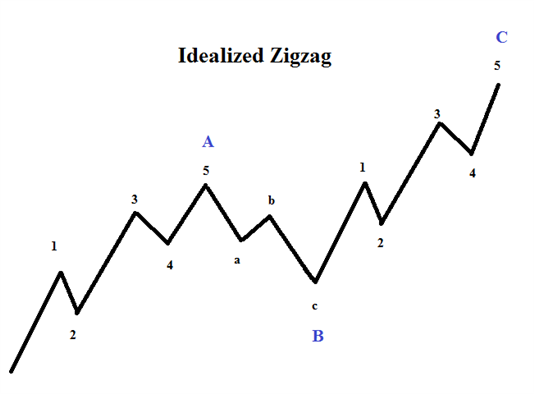
Fig 2: The 5-3-5 structure of a zigzag — Wave A has 5 sub-waves, Wave B has 3 sub-waves, and Wave C has 5 sub-waves.
Wave A — 5 Sub-waves
Wave A is the first wave of the zigzag and moves against the direction of the main trend. It consists of 5 sub-waves (a 5-wave impulse) and represents the initial counter-trend move. This is the first sign that a correction is underway.
- Structure: 5 sub-waves (impulse)
- Direction: Against the main trend
- Length: Often the longest wave in the zigzag
Wave B — 3 Sub-waves
Wave B is the second wave of the zigzag and moves in the direction of the main trend (a retracement of Wave A). It consists of 3 sub-waves (a corrective pattern) and cannot retrace 100% of Wave A.
- Structure: 3 sub-waves (corrective)
- Direction: In the direction of the main trend
- Retracement: Cannot exceed 100% of Wave A
- Common patterns: Zigzag, flat, or triangle
Wave C — 5 Sub-waves
Wave C is the third and final wave of the zigzag. It moves against the direction of the main trend and consists of 5 sub-waves (a 5-wave impulse). It completes the zigzag and often equals or exceeds Wave A in length.
- Structure: 5 sub-waves (impulse)
- Direction: Against the main trend
- Length: Often equal to Wave A (100%) or a Fibonacci multiple (0.618 or 1.618)
📌 Quick Reference: Zigzag = 5-3-5. Wave A (5 waves) → Wave B (3 waves) → Wave C (5 waves). If the structure is 3-3-5, it is a flat pattern, not a zigzag.
3. Rules of the Zigzag Pattern
Elliott Wave theory has strict rules for identifying zigzag patterns. Violating these rules means the pattern is invalid, and an alternative count must be considered.
| Rule | Description |
|---|---|
| Wave A | Must consist of 5 sub-waves (impulse) |
| Wave B | Must consist of 3 sub-waves (corrective) |
| Wave C | Must consist of 5 sub-waves (impulse) |
| Wave B Retracement | Cannot retrace 100% of Wave A (99% is acceptable, but 100% invalidates the zigzag) |
| Wave B Structure | Can be any 3-wave pattern (including another zigzag, flat, or triangle) |
| Direction | Must move against the main trend |
Wave B Cannot Retrace 100% of Wave A
This is the most important rule of the zigzag pattern. If Wave B retraces more than 100% of Wave A, the pattern cannot be a zigzag. It could be a flat pattern (3-3-5) or another corrective structure.
Wave B Can Be Any 3-Wave Pattern
Wave B does not have to be a simple structure. It can be a zigzag, flat, or triangle — as long as it has 3 sub-waves. This flexibility allows zigzags to appear in a variety of market conditions.
Zigzags Are Counter-Trend Formations
Zigzags always move against the direction of the larger trend. In a bull market, a zigzag is a bearish correction (down-up-down). In a bear market, a zigzag is a bullish correction (up-down-up).
⚠️ Important: The 100% retracement rule is non-negotiable. If Wave B exceeds the start of Wave A, you are looking at a flat pattern or a different corrective structure — not a zigzag.
4. How to Identify a Zigzag on Price Charts
Identifying a zigzag pattern requires practice and attention to detail. Here are the key visual and mathematical indicators to look for:
Visual Characteristics — The Lightning Bolt
- Sharp and deep — zigzags are typically sharp, deep retracements that move quickly
- Three distinct waves — A-B-C structure is clearly visible
- Wave C often exceeds Wave A — the final wave often extends beyond the end of Wave A
- Resembles a lightning bolt — the pattern has a distinctive zig-zag shape on the chart
Common Fibonacci Ratios in Zigzags
| Ratio | Description | Frequency |
|---|---|---|
| Wave C = Wave A | Equal waves (1.00) | Common |
| Wave C = 0.618 × Wave A | Fibonacci retracement | Common |
| Wave C = 1.618 × Wave A | Fibonacci extension | Less common but possible |
| Wave B Retracement | 50-78.6% of Wave A | Typical |
💡 Pro Tip: The most reliable zigzag identification comes from combining wave count with Fibonacci ratios. If you see a 5-3-5 structure with Wave C = Wave A (or a Fibonacci multiple), you have a high-probability zigzag.
5. Estimating Zigzag Targets
Estimating the target of a zigzag is essential for setting profit targets and managing risk. Here are the most common methods:
Wave C = Wave A (100%)
The most common target is equality — Wave C equals Wave A in length. This is the default assumption when estimating zigzag targets.
Wave C = 0.618 × Wave A
The Fibonacci 0.618 retracement is a common target for Wave C. This occurs when Wave C is shorter than Wave A, often indicating a weaker counter-trend move.
Wave C = 1.618 × Wave A
The Fibonacci 1.618 extension is a less common but possible target. This occurs when Wave C extends beyond Wave A, indicating a stronger counter-trend move.
Using Price Channels to Estimate Targets
Price channels can be drawn to estimate the termination point of Wave C. By drawing a channel from the start of Wave A to the end of Wave B, traders can project where Wave C is likely to end.
📌 Pro Tip: The 1.00 (equality) target is the most reliable for zigzags. The 0.618 and 1.618 targets are secondary targets that should be used when the price action suggests a weaker or stronger move.
6. Zigzag vs Other Elliott Wave Patterns
The zigzag is just one of several corrective patterns in Elliott Wave theory. Here is how it compares to other common patterns:
| Feature | Zigzag | Flat Pattern | Triangle Pattern |
|---|---|---|---|
| Wave Count | 3 (A-B-C) | 3 (A-B-C) | 5 overlapping waves |
| Sub-structure | 5-3-5 | 3-3-5 | 5-3-5-3-5 |
| Depth | Deep | Shallow | Gradual |
| Wave B Retracement | < 100% of Wave A | > 100% of Wave A | N/A |
| Type | Corrective | Corrective | Corrective |
| Common Location | Wave 2, complex corrections | Wave 4, corrections | Wave 4, corrections |
Zigzag vs Flat Pattern
The key difference is the sub-structure. A zigzag has a 5-3-5 structure, while a flat pattern has a 3-3-5 structure. Additionally, zigzags are deep retracements, while flat patterns are shallow retracements.
Zigzag vs Triangle Pattern
A triangle is a 5-wave pattern (5-3-5-3-5) that moves sideways with converging trendlines. Zigzags are 3-wave patterns that move sharply against the trend. Triangles are typically more gradual and take longer to develop.
7. Zigzag Pattern Reference Table
Use this reference table to quickly understand the zigzag pattern, its rules, and how to trade it.
Part 1: Zigzag at a Glance
Part 2: Rules of the Zigzag Pattern
Part 3: Zigzag vs Other Patterns
| Feature | Zigzag | Flat Pattern | Triangle Pattern |
|---|---|---|---|
| Wave Count | 3 (A-B-C) | 3 (A-B-C) | 5 overlapping waves |
| Sub-structure | 5-3-5 | 3-3-5 | 5-3-5-3-5 |
| Depth | Deep | Shallow | Gradual |
| Wave B Retracement | < 100% of Wave A | > 100% of Wave A | N/A |
Part 4: Fibonacci Ratios for Zigzag Targets
Part 5: Quick Trading Checklist
8. Frequently Asked Questions (FAQ)
What is a zigzag in Elliott Wave theory?
A zigzag is a 3-wave corrective pattern (A-B-C) with a 5-3-5 sub-structure. It is a counter-trend formation that typically appears in wave 2 of an impulse or in complex corrections.
What is the 5-3-5 structure of a zigzag?
Wave A has 5 sub-waves, Wave B has 3 sub-waves, and Wave C has 5 sub-waves. This structure makes the zigzag a deep retracement that recovers a lot of price from the previous trend.
What are the rules of a zigzag pattern?
Wave A and C must have 5 sub-waves each. Wave B must have 3 sub-waves. Wave B cannot retrace 100% of wave A. The pattern moves against the main trend.
Where do zigzags typically appear?
Zigzags typically appear in wave 2 of a 5-wave impulse, in complex corrections, and sometimes within Elliott Wave triangles.
How do you estimate the target of wave C?
Wave C is often equal to wave A (100%), or a Fibonacci multiple of wave A (0.618 or 1.618). Price channels can also be used to estimate the termination point.
What is the difference between a zigzag and a flat pattern?
A zigzag has a 5-3-5 structure and is a deep retracement. A flat pattern has a 3-3-5 structure and is a shallow retracement.
Can a zigzag appear in the direction of the main trend?
Rarely, but yes. In some instances, a zigzag can print in the direction of the larger trend, though it is typically a counter-trend formation.
9. Need Help? Contact Us
Our support team is ready to assist you with any questions about Elliott Wave patterns, zigzags, or our forex products.
📌 Support Hours: Our team is available 24/5 via WhatsApp, Telegram, and Live Chat. We respond to all inquiries within 24 hours on business days.
10. Conclusion
The Elliott Wave zigzag pattern is a powerful corrective structure that appears frequently in forex markets. By understanding the 5-3-5 sub-structure, the strict rules, and the Fibonacci targets, traders can identify high-probability trading opportunities in counter-trend moves.
Key takeaways:
- ✅ The zigzag is a 3-wave corrective pattern (A-B-C) with a 5-3-5 sub-structure
- ✅ It typically appears in Wave 2 of an impulse or in complex corrections
- ✅ Wave B cannot retrace 100% of Wave A — this is the most important rule
- ✅ The most common target for Wave C is equality with Wave A (1.00)
- ✅ Zigzags are deep retracements that often recover 50-78.6% of the prior impulse
- ✅ Use the reference tables above for quick access to rules, Fibonacci ratios, and trading checklists
📌 Final Advice: The zigzag pattern is a valuable tool for traders who understand Elliott Wave theory. To get the best results, practice identifying zigzags on historical charts and combine the pattern with proper risk management. The key to success is patience and discipline — wait for the 5-3-5 structure to complete before entering a trade.
Continue your trading education — explore the guides below to deepen your understanding of forex trading.
Updated: July 2026


 Signal2forex.com - Best Forex robots and signals


