
Margin is one of the most important concepts in forex trading — and one of the most misunderstood. This comprehensive guide explains what margin is, how it works, how to calculate it, and how to use it responsibly to avoid margin calls and protect your trading capital in 2026.
1. What Is Margin in Forex Trading?
Margin is a good faith deposit that a trader puts up as collateral to initiate a leveraged trade. Essentially, it is the minimum amount of money required in your trading account to open and maintain a new position. Margin is usually expressed as a percentage of the notional value (trade size) of the trade.
It is important to understand that margin is not a fee or a transaction cost — it is a portion of your account equity that is set aside and allocated as a margin deposit. Think of it as a security deposit that your broker holds while your trade is open. The difference between the deposit and the full value of the trade is effectively “borrowed” from the broker.
Knowing what margin is — and what it isn’t — can be the difference between profitable trading and catastrophic losses. Traders who fail to understand margin often find themselves facing unexpected margin calls and forced liquidations.
📌 Key Definition: Margin is a good faith deposit required to open and maintain a leveraged forex position. It is not a fee, but rather collateral held by your broker to cover potential losses.
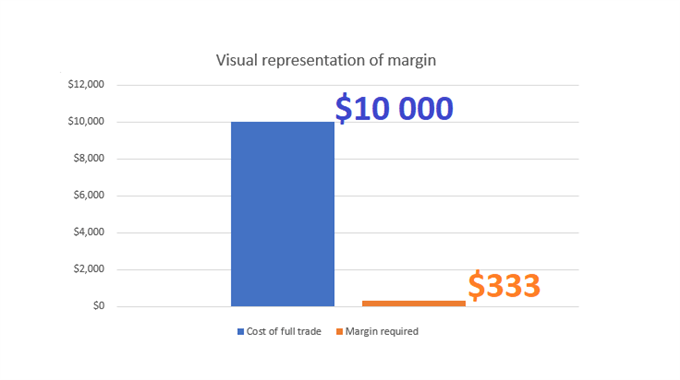
Fig 1: Visual representation of margin requirement relative to the full trade size. A $10,000 trade with a 3.33% margin requirement requires just $333 in margin.
2. How Does Forex Margin Work?
When you trade on margin, you are using borrowed funds from your broker to control a position that is much larger than your account balance. This is known as leveraged trading.
The relationship between margin and leverage is inverse: the more margin that is required, the less leverage traders will be able to use. This is because the trader has to fund more of the trade with their own money and therefore is able to borrow less from the broker. Conversely, when margin requirements are lower, traders can use higher leverage and control larger positions with less capital.
For example, if a broker requires 3.33% margin, this means you need $3.33 in margin for every $100 of trade value — which equates to 30:1 leverage. If the margin requirement is 2%, you get 50:1 leverage. Higher leverage means you can control larger positions, but it also means that even small adverse price movements can have a significant impact on your account.
💡 How It Works: When you open a trade with 30:1 leverage, your broker effectively lends you 96.67% of the trade value. Your margin deposit of 3.33% acts as collateral for that loan. If the trade moves against you, your equity decreases, and your margin level declines — which can eventually trigger a margin call.
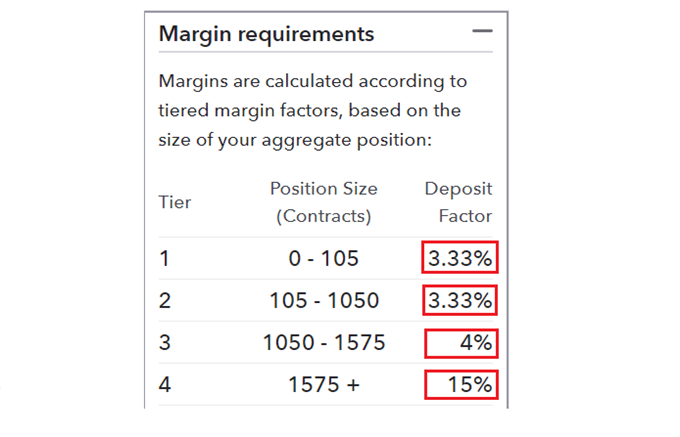
Fig 2: Typical margin requirements and the corresponding maximum leverage available to traders.
3. Forex Margin Requirements Explained
Margin requirements are set by brokers based on the level of risk they are willing to assume (default risk), whilst adhering to regulatory restrictions. These requirements can vary significantly between brokers and across different jurisdictions.
How margin requirements are determined:
- Regulatory limits: Different countries have different maximum leverage limits. In the US, the CFTC/NFA caps leverage at 50:1 (2% margin) for major currency pairs. In the EU and UK, ESMA and FCA cap leverage at 30:1 (3.33% margin) for retail clients. Some offshore brokers offer up to 500:1 (0.2% margin).
- Broker risk appetite: Brokers may set higher margin requirements than the regulatory minimum if they want to reduce their risk exposure.
- Trade size tiers: As trade size increases, margin requirements often increase as well. For example, a broker might require 3.33% margin for trades up to a certain size, but 4% or even 15% for larger positions.
- Volatility: Margin requirements can be temporarily increased during periods of high volatility or in the lead-up to major economic data releases.
It is essential to familiarise yourself with your broker’s margin policy before you start trading. Different brokers have different rules, and failing to understand them can lead to unexpected margin calls.
| Region | Regulatory Body | Max Leverage | Min Margin |
|---|---|---|---|
| United States | CFTC / NFA | 50:1 | 2.00% |
| European Union | ESMA | 30:1 | 3.33% |
| United Kingdom | FCA | 30:1 | 3.33% |
| Australia | ASIC | 30:1 | 3.33% |
| Cyprus | CySEC | 30:1 | 3.33% |
| Offshore | Various | Up to 500:1 | 0.20% |
4. How to Calculate Forex Margin
Calculating the margin required for a trade is straightforward once you understand the formula. The amount of margin needed to hold open a position is determined by the trade size, the market price, and the leverage (or margin requirement percentage).
The basic margin formula is:
Margin = (Trade Size × Market Price) ÷ Leverage
Alternatively, if you know the margin requirement percentage:
Margin = Trade Size × Market Price × Margin Requirement %
Step-by-Step Calculation Examples
| Lot Size | Units | Pair | Price | Leverage | Margin Required |
|---|---|---|---|---|---|
| 0.01 lot | 1,000 | EUR/USD | 1.1050 | 30:1 | $36.83 |
| 0.10 lot | 10,000 | EUR/USD | 1.1050 | 30:1 | $368.33 |
| 1.00 lot | 100,000 | EUR/USD | 1.1050 | 30:1 | $3,683.33 |
| 0.01 lot | 1,000 | GBP/USD | 1.2650 | 30:1 | $42.17 |
| 1.00 lot | 100,000 | USD/JPY | 150.50 | 30:1 | $3,333.33 |
💡 Calculation Example — EUR/USD: To calculate margin for a 0.10 lot of EUR/USD at 1.1050 with 30:1 leverage: Margin = (10,000 × 1.1050) ÷ 30 = $368.33. This means you need $368.33 in your account to open this trade.
5. Understanding Forex Margin Level
Margin level is one of the most important metrics for monitoring your trading account. It provides a measure of how well your trading account is funded and indicates whether you are at risk of a margin call.
The margin level formula is:
Margin Level = (Equity ÷ Used Margin) × 100
Where:
- Equity is the current value of your trading account — your balance plus or minus any unrealised profits or losses from open positions.
- Used Margin is the amount of margin currently being used for your open positions.
What does the margin level tell you?
- Margin Level > 200%: Your account is in a healthy position. You have sufficient free margin to open new trades and withstand normal market fluctuations.
- Margin Level 100–200%: Your account is adequately funded but you should monitor it closely. You cannot open new trades if the level is below 100%.
- Margin Level < 100%: Your account is on margin call. The broker generally prohibits the opening of new trades and may begin liquidating your positions.
Example: Suppose a trader has deposited $10,000 in their account and currently has $8,000 used as margin. The forex margin level will equal 125% — calculated as (10,000 ÷ 8,000) × 100 = 125%. This is above the 100% threshold, but the trader should be cautious as any adverse price movement could push the level below 100%.
⚠️ Important: If the forex margin level dips below 100%, the broker generally prohibits the opening of new trades and may place you on margin call. The lower the margin level, the closer you are to having your positions automatically closed.
6. Margin Call in Forex: What It Is and How to Avoid It
A margin call occurs when your account equity drops below the acceptable level prescribed by the broker, which triggers the immediate liquidation of open positions to bring equity back up to the acceptable level. In simple terms, it is a notification that your open positions are underfunded and at risk of being automatically closed.
What causes a margin call?
- Over-leveraging: Using excessive leverage magnifies both profits and losses. Even a small adverse price movement can wipe out your equity.
- Holding losing trades too long: Without stop-losses, unrealised losses accumulate and reduce your equity.
- Underfunded accounts: Trading with a small account balance makes your margin level more sensitive to price fluctuations.
The margin call procedure:
- When your margin level falls below the broker’s margin call level (typically 100%), the broker issues a warning via email, SMS, or your trading platform.
- The broker requests that you deposit additional funds or close some positions.
- If you do not act, the broker may begin liquidating your positions to bring the account back into compliance.
How to avoid margin calls:
- Use stop-loss orders: Always set stop-losses on every trade to limit potential losses.
- Monitor your margin level regularly: Keep it well above 100% — aim for at least 200%.
- Avoid over-leveraging: Do not use maximum leverage on every trade. Trade with a size that your account can comfortably handle.
- Keep a buffer in your account: Have a large amount of your account equity as free margin.
- Understand your broker’s margin policy: Know the margin requirements, margin call levels, and stop-out rules.
✅ Key Takeaway: Margin calls are almost always the result of poor risk management. By using proper position sizing, setting stop-losses, and avoiding over-leverage, you can dramatically reduce — or eliminate — the risk of a margin call.
7. Risks of Trading on Margin
Trading on margin can be highly profitable, but it also carries significant risks. Understanding these risks is essential for every trader.
- 📉 Leverage Amplifies Both Profits and Losses: While leverage can dramatically increase your profits, it can also magnify your losses. With 50:1 leverage, a 2% move against your position can wipe out your entire account.
- ⚠️ Over-Leveraging: Many traders make the mistake of using maximum leverage on every trade. This leaves them vulnerable to even small adverse price movements and greatly increases the risk of a margin call.
- 📊 Volatility Risk: The forex market can be highly volatile, especially during major news events or economic releases. Sudden price spikes can trigger margin calls even on well-funded accounts.
- 🏦 Liquidity Risk: During periods of low liquidity (such as holidays or after-hours trading), spreads can widen significantly, making it more difficult to exit positions at desired prices.
- 💸 Negative Balance Risk: In extreme market conditions, it is possible to lose more than your initial deposit. Most regulated brokers offer negative balance protection, but it is important to check your broker’s policy.
⚠️ Important: Leverage has the potential to produce large profits and large losses. It is crucial that traders use leverage responsibly. Never trade with money you cannot afford to lose, and always use proper risk management techniques.
8. Margin Trading Tips for Beginners
If you are new to margin trading, here are some essential tips to help you get started safely and avoid common pitfalls:
- ✅ Start with a Demo Account: Practice trading on margin with a demo account before risking real money. This will help you understand how margin works without any financial risk.
- ✅ Use Stop-Loss Orders: Always set stop-loss orders on every trade to limit potential losses. This is your most important risk management tool.
- ✅ Monitor Your Margin Level Regularly: Keep an eye on your margin level throughout the trading day. Aim to keep it above 200% to provide a buffer against adverse price movements.
- ✅ Avoid Over-Leveraging: Just because you can use maximum leverage doesn’t mean you should. Trade with a size that your account can comfortably handle.
- ✅ Keep a Buffer in Your Account: It is considered prudent to have a large amount of your account equity as free margin. This helps you avoid margin calls and ensures your account is sufficiently funded to take advantage of high-probability trades.
- ✅ Understand Your Broker’s Policies: Familiarise yourself with your broker’s margin requirements, margin call levels, and stop-out rules before you start trading.
- ✅ Trade With a Plan: Never enter a trade without a clear plan that includes entry, stop-loss, and take-profit levels. Emotional trading is one of the biggest causes of margin calls.
💡 Pro Tip: Many experienced traders recommend risking no more than 1-2% of your account balance on any single trade. This ensures that even a series of losing trades won’t significantly impact your account equity or trigger a margin call.
9. Forex Margin Reference Table
Use this reference table to quickly understand key terms, compare margin requirements, and review calculation examples.
Part 1: Key Terms & Definitions
Part 2: Margin vs Leverage Comparison
| Margin Required | Leverage | Trade Control per $1 |
|---|---|---|
| 50% | 2:1 | $2 |
| 20% | 5:1 | $5 |
| 10% | 10:1 | $10 |
| 5% | 20:1 | $20 |
| 3.33% | 30:1 | $30 |
| 2.00% | 50:1 | $50 |
| 1% | 100:1 | $100 |
| 0.5% | 200:1 | $200 |
Part 3: Margin Calculation Examples
| Lot Size | Units | Pair | Price | Leverage | Margin Required |
|---|---|---|---|---|---|
| 0.01 lot | 1,000 | EUR/USD | 1.1050 | 30:1 | $36.83 |
| 0.10 lot | 10,000 | EUR/USD | 1.1050 | 30:1 | $368.33 |
| 1.00 lot | 100,000 | EUR/USD | 1.1050 | 30:1 | $3,683.33 |
| 0.01 lot | 1,000 | GBP/USD | 1.2650 | 30:1 | $42.17 |
| 1.00 lot | 100,000 | USD/JPY | 150.50 | 30:1 | $3,333.33 |
Part 4: Quick Reference Checklist
10. Frequently Asked Questions (FAQ)
What is margin in forex trading?
Margin is a good faith deposit required to open and maintain a leveraged position. It is not a fee, but rather collateral held by your broker to cover potential losses.
How is margin different from leverage?
Margin and leverage are inversely related. Higher leverage means lower margin requirements, and vice versa. Margin is the deposit you put up; leverage is the ratio of the trade size to that deposit.
What is a margin requirement?
The percentage of the trade value that must be deposited as margin. For example, a 2% margin requirement means you need $2 for every $100 of trade value.
How do I calculate margin?
Margin = (Trade Size × Market Price) ÷ Leverage. For example, a 0.10 lot of EUR/USD at 1.1050 with 30:1 leverage requires $368.33 in margin.
What is a good margin level?
A margin level above 200% is considered healthy. Below 100% means your account is on margin call. The higher the margin level, the more room your account has to withstand adverse price movements.
What happens during a margin call?
The broker will notify you that your margin level has fallen below the required minimum. You must either deposit more funds or close positions. If you do not act, the broker may liquidate your positions.
How can I avoid margin calls?
Use stop-loss orders, monitor your margin level regularly, avoid over-leveraging, and keep a buffer in your account. Most importantly, never trade with money you cannot afford to lose.
What is free margin?
Free margin is the amount of equity in your account that is not tied up as margin for open positions. It is the money available to open new trades.
Can I lose more than my deposit?
In most cases, regulated brokers offer negative balance protection, meaning you cannot lose more than your deposit. However, this is not guaranteed with all brokers — check your broker’s policy.
What is the stop out level?
The margin level at which the broker will close your positions automatically to prevent further losses. This is typically lower than the margin call level (often 50% or 100%).
11. Conclusion: Using Margin Wisely
Margin is a powerful tool that allows forex traders to control large positions with a relatively small amount of capital. However, with great power comes great responsibility — and trading on margin carries significant risks.
Key takeaways from this guide:
- ✅ Margin is a good faith deposit required to open and maintain a leveraged position
- ✅ Margin is not a fee or transaction cost — it is collateral held by your broker
- ✅ The margin level ((Equity ÷ Used Margin) × 100) tells you how well your account is funded
- ✅ A margin call occurs when your equity drops below the required margin level
- ✅ Risk management is the key to avoiding margin calls — use stop-losses, monitor your margin level, and avoid over-leveraging
- ✅ Free margin is the amount available to open new trades — keep a healthy buffer
📌 Final Advice: Margin trading can be highly rewarding, but it requires discipline, education, and proper risk management. Start with a demo account, learn the basics, and never risk more than you can afford to lose. The most successful traders are those who respect margin and use it as a strategic tool — not as a gamble.
Continue your trading education — explore the guides below to deepen your understanding of risk management and trading strategies.
📞 Need Help? Contact Us
Our support team is ready to assist you with any questions about margin trading, risk management, or our products and services.
📌 Support Hours: Our team is available 24/5 via WhatsApp, Telegram, and Live Chat. We respond to all inquiries within 24 hours on business days.


 Signal2forex.com - Best Forex robots and signals


