
COT Report in Forex: Complete Guide & How to Use It 2026

Trading training
✅ Updated: July 2026

The Commitment of Traders (COT) report is a weekly sentiment report published by the CFTC that provides valuable insight into institutional positioning in futures markets. This comprehensive guide explains what the COT report is, how to read it, and how to use it to improve your forex trading decisions in 2026.


1. What Is the COT Report in Forex?

The Commitment of Traders (COT) report is a weekly publication by the US Commodity Futures Trading Commission (CFTC) that provides a breakdown of the positioning of different trader categories in futures markets. It is one of the most widely followed sentiment indicators for forex traders.

First published in 1962, the COT report offers a window into institutional positioning that is not available from any other source. While the report covers futures markets (including currency futures), it provides valuable insights that can be applied to the spot forex market due to the close relationship between futures and spot prices.

The COT report is released every Friday at 3:30 PM ET and covers data from the previous Tuesday. This means traders have access to positioning data that is only three days old — making it one of the most timely institutional sentiment reports available.

📌 Key Definition: The COT report is a weekly CFTC publication that shows the positioning of different trader categories in futures markets. It provides valuable insight into institutional sentiment that can be applied to forex trading.

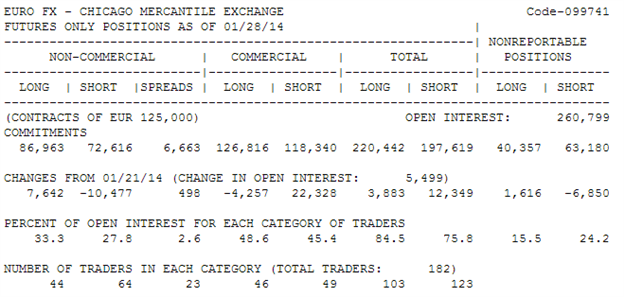
COT report extract showing commercial, non-commercial, and non-reportable positions for EUR/USD futures

Fig 1: A typical COT report extract showing the positioning of commercial, non-commercial, and non-reportable traders for EUR/USD futures.


2. How the COT Report Works

The COT report works by aggregating the positions of all traders in a particular futures market and then categorising them into three main groups based on their primary business activity.

What data is included in the COT report?

  • Long Positions: The total number of long contracts held by each group
  • Short Positions: The total number of short contracts held by each group
  • Open Interest: The total number of outstanding contracts
  • Net Positioning: Long positions minus short positions (can be positive or negative)
  • Week-over-Week Changes: How positioning has changed from the previous week

How the report is compiled:

  • All futures positions are reported to the CFTC by clearing members
  • Positions are aggregated and categorised based on the trader’s primary business activity
  • The data is published every Friday at 3:30 PM ET
  • The report covers data as of the previous Tuesday’s close

💡 How It Works: The COT report provides a weekly snapshot of institutional positioning in futures markets. While it is a lagging indicator (data is three days old), it remains one of the most valuable sentiment tools available to forex traders.

COT report release schedule and data flow diagram — how positions are collected and published

Fig 2: The COT report data flow — positions are collected by the CFTC and published every Friday at 3:30 PM ET.


3. Understanding the Three COT Report Groups

The COT report divides traders into three distinct categories based on their primary business activity. Understanding who these traders are and what motivates them is essential for interpreting the data.

Commercial Traders (Hedgers)

Commercial traders are large corporations that use futures markets to hedge their exposure to price fluctuations. For example, a Japanese manufacturer that exports goods to the US might use USD/JPY futures to protect against adverse currency movements. Commercial traders are often considered the “smart money” because they have intimate knowledge of their underlying markets and trade based on fundamental factors.

Non-Commercial Traders (Large Speculators)

Non-commercial traders are large speculators such as hedge funds, commodity trading advisors (CTAs), and other institutional investors. They trade futures markets for profit rather than for hedging purposes. Non-commercial traders are often considered the “dumb money” at extremes because they tend to pile into trades at the wrong time.

Non-Reportable Traders (Small Speculators)

Non-reportable traders are smaller speculators whose positions fall below the CFTC’s reporting threshold. These are typically retail traders and smaller funds. While this group is the least significant for institutional analysis, it can still provide useful information about retail sentiment.

📌 Key Insight: Commercial traders are often considered the “smart money” because they trade based on fundamental knowledge of their markets. Non-commercial traders at extremes are often considered “dumb money” because they tend to be wrong at major turning points.

COT report groups explained — commercial traders, non-commercial traders, and non-reportable traders

Fig 3: The three COT report groups — commercial traders (hedgers), non-commercial traders (speculators), and non-reportable traders.


4. How to Read the COT Report

Reading the COT report involves more than just looking at the numbers. Here’s a step-by-step guide to extracting actionable insights from the data:

Step 1: Identify Net Positioning

Net positioning is calculated as Long Positions minus Short Positions. A positive net position indicates that a group is net-long (more buyers than sellers), while a negative net position indicates they are net-short.

Step 2: Compare Commercials vs Non-Commercials

When commercials are net-long and non-commercials are net-short, it often signals a bullish sentiment divergence. Conversely, when commercials are net-short and non-commercials are net-long, it often signals a bearish sentiment divergence.

Step 3: Identify Sentiment Extremes

When non-commercial positioning reaches historically high or low levels, it can signal an impending reversal. This is because large speculators tend to be wrong at extremes.

Step 4: Look for Week-over-Week Changes

Large week-over-week changes in positioning can indicate a shift in sentiment that may precede a price move. Watch for aggressive buying or selling by commercials, as this is often a sign of a trend change.

✅ Key Takeaway: The most valuable COT report signals come from divergence between commercials and non-commercials and from sentiment extremes. When commercials are buying while non-commercials are selling (or vice versa), the commercials are often right.


5. COT Report Trading Strategies

There are several proven trading strategies that incorporate the COT report. Here are three of the most effective approaches:

Strategy #1 — COT Divergence Trading

This strategy involves trading when commercials and non-commercials are moving in opposite directions.

  • Setup: Identify a market where commercials are increasing their longs while non-commercials are increasing their shorts
  • Entry: Enter in the direction of the commercials when price confirms the divergence
  • Stop-Loss: Place stop-loss beyond the recent swing high or low
  • Take-Profit: Target the next support or resistance level

Strategy #2 — COT Sentiment Extremes

This strategy involves trading when non-commercial positioning reaches historically high or low levels.

  • Setup: Identify when non-commercial net positioning is at an extreme (90th percentile or higher for longs, 10th percentile or lower for shorts)
  • Entry: Enter in the opposite direction of the extreme when price confirms the reversal
  • Stop-Loss: Place stop-loss beyond the recent extreme
  • Take-Profit: Target the first support or resistance level

Strategy #3 — Commercials vs Speculators

This strategy involves following the commercials, who are often considered the “smart money.”

  • Setup: Identify the net positioning of commercials
  • Entry: Enter in the direction of the commercials’ net position
  • Stop-Loss: Place stop-loss beyond the 200-day moving average or recent support/resistance
  • Take-Profit: Target the next support or resistance level

⚠️ Important: The COT report is a lagging indicator that should be used as part of a broader trading strategy, not as a standalone signal. Always use technical and fundamental analysis to confirm your trades.


6. COT Report vs Other Sentiment Indicators

The COT report is not the only sentiment indicator available to forex traders. Here’s how it compares to other popular sentiment tools:

Feature COT Report IG Client Sentiment DailyFX Sentiment
Data Source Institutional futures positions Retail CFD/forex positions Retail CFD/forex positions
Update Frequency Weekly (Friday 3:30 PM ET) Twice daily Real-time
Market Focus Futures markets (including forex futures) OTC forex (spot) OTC forex (spot)
Participant Types Commercials, non-commercials, non-reportable Retail traders only Retail traders only
Best Used For Institutional flow analysis Retail sentiment extremes Retail sentiment extremes
Reliability High Moderate Moderate

💡 Key Insight: The COT report and retail sentiment indicators like IG Client Sentiment provide complementary information. While the COT report shows institutional positioning, retail sentiment indicators show what the crowd is doing. Using both can provide a more complete picture of market sentiment.


7. COT Report Reference Table

Use this reference table to quickly understand key terms, identify the three COT groups, and follow a trading checklist.

Part 1: Key Terms & Definitions

COT Report Commitment of Traders report — a weekly CFTC publication showing futures market positioning
CFTC Commodity Futures Trading Commission — the US regulator that publishes the COT report
Commercial Traders Large corporations hedging their exposure to price fluctuations
Non-Commercial Traders Large speculators (hedge funds, CTAs) trading for profit
Non-Reportable Traders Small speculators who don’t meet the reporting threshold
Net Positioning Long positions minus short positions — shows overall market bias
Open Interest The total number of outstanding futures contracts
Sentiment Extremes When positioning reaches historically high or low levels

Part 2: COT Report Groups

Group Description Example Trading Significance
Commercial Traders Large corporations with hedging interest Japanese manufacturer hedging USD/JPY exposure Often considered “smart money”
Non-Commercial Traders Large speculators (hedge funds, CTAs) Major commodity fund betting on EUR/USD Often considered “dumb money” at extremes
Non-Reportable Traders Small speculators below reporting threshold Retail traders, small funds Least significant for analysis

Part 3: COT Report vs IG Client Sentiment

Feature COT Report IG Client Sentiment
Data Source Institutional futures positions Retail CFD/forex positions
Update Frequency Weekly (Friday 3:30 PM ET) Twice daily
Market Focus Futures markets (including forex futures) OTC forex (spot)
Participant Types Commercials, non-commercials, non-reportable Retail traders only
Best Used For Institutional flow analysis Retail sentiment extremes
Reliability High Moderate

Part 4: Quick Reference Checklist

Understand what the COT report is and why it matters
Know the release schedule (Friday 3:30 PM ET)
Identify the three trading groups (Commercial, Non-Commercial, Non-Reportable)
Learn to read net positioning data
Look for divergence between commercials and speculators
Watch for sentiment extremes (historical highs/lows)
Combine COT analysis with technical analysis
Cross-reference with other sentiment indicators (IG Client Sentiment)
Practice on a demo account before trading with real money
💡 Tip: Use this checklist before every COT-based trade to ensure you have covered all the key criteria.

8. Frequently Asked Questions (FAQ)

What is the COT report in forex?

The Commitment of Traders (COT) report is a weekly CFTC publication showing the positioning of futures traders, which can be used as a sentiment indicator for forex markets.

When is the COT report released?

The COT report is released every Friday at 3:30 PM ET by the CFTC.

How do I read the COT report?

Focus on net positioning (longs minus shorts), week-over-week changes, and the positioning of the three trading groups (commercials, non-commercials, non-reportable).

What are the three groups in the COT report?

Commercial Traders (hedgers), Non-Commercial Traders (large speculators), and Non-Reportable Traders (small speculators).

How can I use the COT report for trading?

Look for divergence between commercials and speculators, identify sentiment extremes, and confirm with technical analysis.

Is the COT report reliable?

The COT report is a valuable sentiment indicator, but it should be used in conjunction with technical and fundamental analysis. It is not a standalone trading signal.

What is the difference between COT and IG Client Sentiment?

COT shows institutional futures positioning (weekly), while IG Client Sentiment shows retail CFD/forex positioning (twice daily).

Where can I find the COT report?

The CFTC website, DailyFX, and many forex brokers provide COT report analysis and data.

What is net positioning?

Net positioning is the difference between long and short positions for a specific group. It shows the overall bias of that group.

How do commercials differ from speculators?

Commercials are corporations hedging their exposure, while speculators (non-commercials) are trading for profit. Commercials are often considered “smart money.”


9. Conclusion

The Commitment of Traders (COT) report is one of the most valuable sentiment tools available to forex traders. By understanding what it is, how to read it, and how to trade with it, you can gain a significant edge in the markets.

Key takeaways from this guide:

  • ✅ The COT report is a weekly CFTC publication showing institutional positioning in futures markets
  • ✅ The report is released every Friday at 3:30 PM ET
  • ✅ The three groups are Commercial (hedgers), Non-Commercial (speculators), and Non-Reportable (small speculators)
  • ✅ Commercial traders are often considered the “smart money”
  • ✅ Effective strategies include divergence trading, sentiment extremes, and following the commercials
  • ✅ The COT report works best when combined with technical and fundamental analysis

📌 Final Advice: The COT report is a powerful addition to any trader’s toolkit. To get the best results, practice reading the report regularly, combine it with technical analysis, and always use proper risk management. The key to success is patience and discipline — wait for the right setup and follow your trading plan.

Continue your trading education — explore the guides below to deepen your understanding of sentiment analysis and trading strategies.


📞 Need Help? Contact Us

Our support team is ready to assist you with any questions about the COT report, trading strategies, or our products and services.

📱
WhatsApp
✈️
Telegram
💬
Live Chat
Available on our website — click the chat icon in the bottom-right corner

📌 Support Hours: Our team is available 24/5 via WhatsApp, Telegram, and Live Chat. We respond to all inquiries within 24 hours on business days.


Updated: July 2026 — This guide is regularly reviewed and refreshed to ensure accuracy, relevance, and alignment with the latest market conditions and trading practices.