
The inside bar pattern is one of the most versatile and frequently occurring candlestick formations in forex trading. This comprehensive guide explains how to identify inside bars, the difference between continuation and reversal patterns, and proven trading strategies with entry rules, stop-loss placement, and real chart examples.
1. What Is an Inside Bar Pattern?
The inside bar pattern is a popular reversal and continuation candlestick formation that requires just two candles to form. It occurs regularly within the financial markets and, when incorporated into a trading system, can significantly enhance a trader’s market analysis technique.
The pattern consists of a mother bar (the preceding candle) and an inside bar (the current candle) that is fully contained within the high and low of the mother bar. This formation signals a period of market indecision — a reluctance of prices to progress above or below the preceding candle’s range.
The inside bar represents a direct play on short-term market sentiment, with traders looking to enter before the ‘big moves’ that may take place in the market. When traders see an inside bar pattern form, it is interpreted as the market’s unwillingness to push price higher or lower — often due to an upcoming major report, or simply because the market has just made a significant move and traders are cautious about bidding price much further.
📌 Key Definition: An inside bar is a two-candle pattern where the second candle (the inside bar) is completely engulfed by the high and low of the first candle (the mother bar). It signals market indecision and often precedes a significant price move.
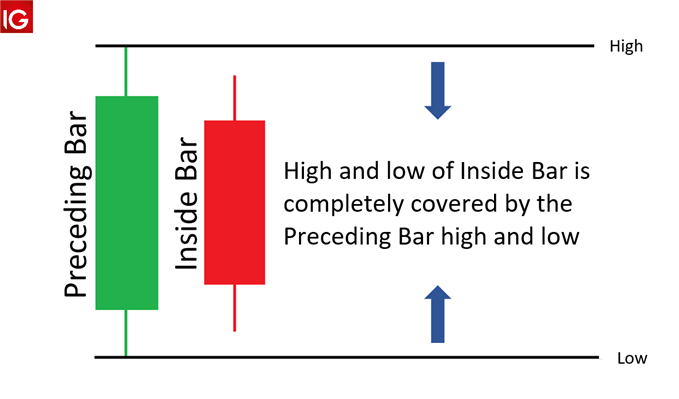
Fig 1: Inside bar pattern — the inside bar is fully contained within the high and low of the preceding mother bar.
2. How to Identify an Inside Bar on Forex Charts
Identifying an inside bar pattern on forex charts is straightforward once you know what to look for. Follow these steps:
- Identify the preceding trend — use price action or technical indicators to determine the current market direction
- Locate the mother bar — this is the candle that will contain the inside bar
- Find the inside bar — look for a candle that is fully engulfed by the mother bar’s high and low
- Verify the pattern — confirm that the inside bar’s high is lower than the mother bar’s high, and the inside bar’s low is higher than the mother bar’s low
- Check for multiple inside bars — sometimes you may see two or more inside bars in a row, which can signal an even stronger consolidation
What to avoid: Be cautious of inside bars that form in choppy, sideways markets with no clear trend. The pattern is most reliable when it appears within a clear trend or at key support/resistance levels.
💡 Pro Tip: The inside bar pattern is easiest to spot on daily and 4-hour charts. Lower timeframes (5-min, 15-min) can produce many false signals due to market noise.

Fig 2: Identifying an inside bar pattern on a forex chart — the inside bar is fully contained within the mother bar.
3. Inside Bar: Continuation vs Reversal Pattern
One of the most important aspects of the inside bar pattern is understanding that it can signal either a continuation or a reversal of the current trend. This duality makes the pattern more complex but also more versatile.
Continuation Pattern
Some traders consider the inside bar a continuation pattern. After a strong trend, the market pauses (represented by the inside bar) before continuing in the same direction. In this scenario, the breakout occurs in the direction of the prevailing trend.
Reversal Pattern
However, a breakout in the opposite direction is also possible. After price has trended up or down for an extended period, the pause in price movement (represented by the inside bar) can precede a reversal of the trend. In this case, traders look to trade the inside bar for a short-term counter-trend trade.
| Aspect | Continuation Pattern | Reversal Pattern |
|---|---|---|
| Trend Context | Strong existing trend | Overextended trend |
| Breakout Direction | Same as the trend | Opposite to the trend |
| Volume | Increasing on breakout | Increasing on breakout |
| Confirmation | Strong candle in trend direction | Reversal candlestick pattern |
| Risk Level | Lower | Higher |
⚠️ Important: Trading against the trend carries more risk which leads to greater caution taken by the trader. Always wait for confirmation before entering a reversal trade.
4. Inside Bar Trading Strategies
Strategy #1 — Breakout Strategy
The inside bar represents a period of short-term consolidation with low volatility within a trending market. Traders look to trade breakouts after a new high or low is formed.
In the example below, the preceding trend is identified by lower lows and lower highs. The breakout occurs below the low of the mother bar, triggering a short entry. Had this breakout occurred above the high of the mother bar, this would signal a long (buy) entry, indicating a potential reversal in trend.
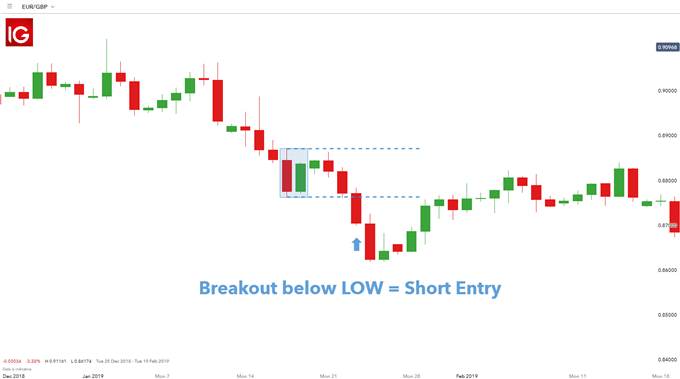
Fig 3: Inside bar breakout strategy — entry below the mother bar low, stop-loss above the mother bar high, and take-profit at 2x stop-loss distance.
Strategy #2 — Reversal Strategy
When an inside bar forms after an extended trend, it can signal a potential reversal. Traders look to enter in the opposite direction of the trend when price breaks the mother bar. This strategy aims to capture the counter-trend move that often follows a period of indecision.
Strategy #3 — Inside Bar with Trend Confirmation
Combine the inside bar pattern with other technical indicators to improve reliability. For example:
- Moving Averages: Only take trades in the direction of the moving average
- Support/Resistance: Look for inside bars forming at key levels
- RSI/MACD: Use momentum indicators to confirm the breakout direction
Strategy #4 — Inside Bar with Support/Resistance
Inside bars that form at major support or resistance levels are particularly powerful. The combination of a key level and a consolidation pattern creates a high-probability setup for a breakout or reversal.
✅ Pro Tip: The most reliable inside bar trades occur when the pattern forms at key support/resistance levels or in the direction of the prevailing trend on higher timeframes.
5. Entry, Stop-Loss and Take-Profit Rules
Proper risk management is essential when trading inside bars. The pattern offers clear entry and exit rules that help traders maintain a positive risk-reward ratio.
| Element | Breakout Strategy | Reversal Strategy |
|---|---|---|
| Entry | Break above mother bar high (long) or below low (short) | Break in opposite direction of the trend |
| Stop-Loss | Beyond the opposite side of mother bar | Beyond the mother bar extreme |
| Take-Profit | 2x stop-loss distance (1:2 R:R) | Next support/resistance level |
| Confirmation | Strong breakout candle | Reversal candlestick pattern |
Stop-Loss Placement: Stop levels can be taken from the previous swing high or low (depending on the trend) as dictated by key price action levels. Alternatively, place the stop beyond the mother bar’s extreme on the opposite side of the breakout.
Take-Profit Targets: Using the stop as a benchmark, traders can use this stop distance to expand by a factor of two to realise the take-profit level. This creates a 1:2 risk-reward ratio in line with responsible risk management. Fibonacci extensions may also be utilised as a limit forecast.
⚠️ Important: Always maintain a minimum 1:2 risk-reward ratio on every trade. This ensures that even with a 50% win rate, your strategy remains profitable in the long run.
6. How Reliable Is the Inside Bar Pattern?
The reliability of the inside bar pattern is moderate — it works best with confirmation and in the context of a trend. However, there are important factors to consider.
False breakouts can occur, which lessens the reliability of the inside bar as an isolated pattern. This is why traders prefer using the inside bar as part of an overall forex trading strategy. The strategy is the foundation, with the inside bar seen as more of a prompt rather than a standalone signal.
How to improve reliability:
- Use confirmation — wait for a strong breakout candle or a candlestick reversal pattern
- Combine with technical analysis — use support/resistance, moving averages, or momentum indicators
- Consider the trend context — inside bars are more reliable in a clear trend
- Look at higher timeframes — daily and 4-hour charts produce more reliable signals
- Avoid low liquidity periods — inside bars during low-volume periods are less reliable
📊 Reliability Statistics: While exact statistics vary, many traders report 60-70% success rates when combining inside bars with proper confirmation and trend analysis. The pattern is particularly reliable when it forms at key support/resistance levels.
7. Inside Bar Pattern Reference Table
Use this reference table to quickly understand key terms, identify pattern types, and follow a trading checklist.
Part 1: Key Terms & Definitions
Part 2: Continuation vs Reversal — Quick Guide
| Aspect | Continuation Pattern | Reversal Pattern |
|---|---|---|
| Trend Context | Strong existing trend | Overextended trend |
| Breakout Direction | Same as the trend | Opposite to the trend |
| Volume | Increasing on breakout | Increasing on breakout |
| Confirmation | Strong candle in trend direction | Reversal candlestick pattern |
| Risk Level | Lower | Higher |
Part 3: Breakout Strategy Quick Reference
Part 4: Reversal Strategy Quick Reference
Part 5: Entry, Stop-Loss & Take-Profit Rules
| Element | Breakout Strategy | Reversal Strategy |
|---|---|---|
| Entry | Break above mother bar high (long) or below low (short) | Break in opposite direction of trend |
| Stop-Loss | Beyond the opposite side of mother bar | Beyond the mother bar extreme |
| Take-Profit | 2x stop-loss distance (1:2 R:R) | Next support/resistance level |
| Confirmation | Strong breakout candle | Reversal candlestick pattern |
Part 6: Pros and Cons
| Pros ✅ | Cons ❌ |
|---|---|
| Occurs frequently within financial markets | Can signify reversal or continuation patterns |
| Easy to identify for novice traders | False breakouts are common |
| Opportunity for favourable risk-reward ratios (1:2+) | Requires confirmation for reliability |
| Works on all timeframes | Less reliable as a standalone pattern |
| Clear entry and exit rules | Can produce whipsaws in choppy markets |
Part 7: Quick Trading Checklist
8. Frequently Asked Questions (FAQ)
What is an inside bar pattern?
A two-candle pattern where the second candle is fully contained within the high and low of the first (mother) candle. It signals market indecision and often precedes a significant price move.
How do you identify an inside bar?
Look for a candle that is completely engulfed by the previous candle’s high and low. The inside bar’s high must be lower than the mother bar’s high, and its low must be higher than the mother bar’s low.
Is the inside bar a continuation or reversal pattern?
It can be both. Some traders consider it a continuation pattern, though a breakout in the opposite direction is possible too. The type depends on the breakout direction and trend context.
How do you trade an inside bar breakout?
Enter when price breaks above the mother bar high (long) or below the low (short). Place your stop-loss beyond the opposite side of the mother bar and set take-profit at 2x stop-loss distance.
How do you trade an inside bar reversal?
Enter in the opposite direction of the trend when price breaks the mother bar. This strategy aims to capture the counter-trend move that often follows a period of indecision.
What is a false breakout and how do you avoid it?
A false breakout occurs when price breaks out but quickly reverses, trapping breakout traders. Avoid by waiting for confirmation — a strong breakout candle or a candlestick reversal pattern.
What is the best timeframe for inside bar trading?
Inside bars work on all timeframes, but 1H, 4H, and Daily are most reliable. Lower timeframes (5-min, 15-min) can produce many false signals due to market noise.
How reliable is the inside bar pattern?
Reliability is moderate — it works best with confirmation and in the context of a trend. False breakouts can occur, which is why traders prefer using it as part of an overall trading strategy.
What indicators work best with inside bars?
Support/resistance levels, moving averages, and momentum indicators (RSI, MACD) can improve reliability. Inside bars are most powerful when they form at key technical levels.
Can beginners trade inside bars?
Yes, the pattern is easy to identify and has clear entry and exit rules. However, beginners should practice on demo accounts first and always use proper risk management.
9. Conclusion
The inside bar pattern is a versatile and frequently occurring candlestick formation that can significantly enhance a trader’s market analysis technique. Whether used as a continuation or reversal signal, the pattern offers clear entry and exit rules with the potential for favourable risk-reward ratios.
Key takeaways:
- ✅ The inside bar consists of two candles — a mother bar and an inside bar fully contained within it
- ✅ It signals market indecision and often precedes a significant price move
- ✅ The pattern can signal continuation or reversal — context is key
- ✅ Use confirmation to avoid false breakouts
- ✅ Always maintain a minimum 1:2 risk-reward ratio
- ✅ The inside bar is best used as part of an overall trading strategy, not as a standalone signal
📌 Final Advice: The inside bar pattern is a powerful addition to any trader’s toolkit. To get the best results, practice on a demo account first, and always combine the pattern with proper confirmation and risk management. The key to success is patience and discipline — wait for the right setup and follow your trading plan.
Continue your trading education — explore the guides below to deepen your understanding of forex trading strategies.
📞 Need Help? Contact Us
Our support team is ready to assist you with any questions about the inside bar pattern, trading strategies, or our products and services.
📌 Support Hours: Our team is available 24/5 via WhatsApp, Telegram, and Live Chat. We respond to all inquiries within 24 hours on business days.


 Signal2forex.com - Best Forex robots and signals


