
📑 Table of Contents
- 1. What Is Copper Trading?
- 2. What Is Copper Used For?
- 3. Why Is Copper Called “Doctor Copper”?
- 4. What Affects Copper Prices?
- 5. How to Trade Copper
- 6. Copper Trading Methods Comparison
- 7. Copper Trading Strategies
- 8. Copper Market Outlook 2026
- 9. Copper Trading Tips for Beginners
- 10. Frequently Asked Questions
1. What Is Copper Trading?
Copper trading involves speculating on the price movements of copper without necessarily owning the physical metal. Retail traders typically use derivatives like CFDs, futures, or exchange-traded products to gain exposure to copper price movements.
Copper is one of the most actively traded base metals in the world. Its price is influenced by global economic growth, industrial demand, supply disruptions, and geopolitical events. In 2026, copper has emerged as a critical barometer for the global energy transition and AI infrastructure build-out.
2. What Is Copper Used For?
Copper is one of the most versatile industrial metals. Its unique combination of electrical conductivity, thermal conductivity, and corrosion resistance makes it essential across multiple industries.
- Construction and Infrastructure: Wiring, plumbing, roofing, and building materials
- Electronics and Technology: Printed circuit boards, semiconductors, data centres
- Transportation: Electric vehicles (EVs), hybrid vehicles, charging infrastructure
- Renewable Energy: Solar panels, wind turbines, grid upgrades
- Industrial Machinery: Motors, transformers, heat exchangers
Key Insight 2026: The copper market is undergoing a fundamental transformation. The industry now widely accepts the concept of “copper-electric integration,” with approximately 60% of copper demand growth in 2026 coming from three key areas: AI data centres, power grid upgrades, and renewable energy.
3. Why Is Copper Called “Doctor Copper”?
Copper has earned the nickname “Doctor Copper” because its price is viewed as a reliable economic indicator. When copper prices rise, it suggests economic growth; when they fall, it signals potential slowdown. In 2026, copper has evolved into an “Electrification and AI Barometer.”
As one analyst noted: “Copper has long been viewed as ‘Dr. Copper’: the only metal with a Ph.D. in economics. As we move into the second half of the decade, the red metal is taking on a new role: the Copper Sentinel.”
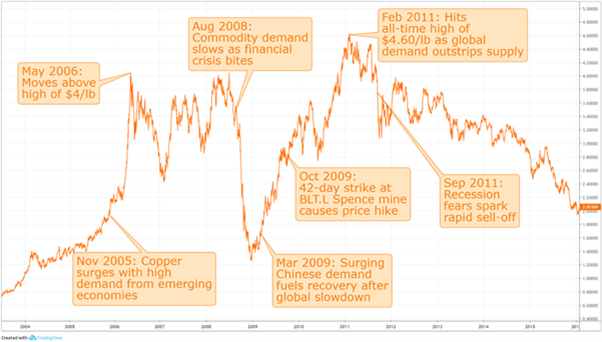
In early 2026, copper prices surged past $13,300 per tonne, setting new historical highs. This price action is serving as an early warning system for a collision between two massive global forces: the physical reality of aging mines and the exponential energy requirements of artificial intelligence.
4. What Affects Copper Prices?
Copper prices are influenced by a complex interplay of supply, demand, and macroeconomic factors. Below are the key drivers in 2026.
| Factor | Category | Impact | Examples |
|---|---|---|---|
| Mine Production | Supply | High | Strikes, operational issues at Grasberg, Kamoa-Kakula |
| AI Data Centre Build‑Out | Demand | Very High | AI‑capable facilities require 3‑4× more copper |
| Global Economic Growth | Demand | Very High | GDP growth, manufacturing PMI |
| Electrification & EVs | Demand | High | EV production, charging infrastructure, renewables |
| Inventory Levels | Supply/Demand | Medium | LME, COMEX, SHFE warehouse stocks |
| Substitute Metals | Demand | Medium | Aluminium substitution in some applications |
| USD Strength | Pricing | Medium | Inverse correlation with dollar index |
| Geopolitical Risks | Supply/Demand | High | Trade tariffs, supply chain disruptions |
📌 2026 Outlook: The market is currently grappling with a supply deficit, driven by AI infrastructure, grid upgrades, and electrification demand, while mine supply growth remains constrained.
5. How to Trade Copper
Copper can be traded through various instruments, each with different leverage, costs, and risk profiles. Below is an overview of the most common methods.
Copper Futures
Futures are standardised contracts traded on exchanges like COMEX (CME Group) and the London Metal Exchange (LME). They have fixed expiration dates and are suitable for professional traders and institutions. In July 2026, LME copper is trading around $13,169–$13,209 per tonne.
Copper CFDs (Contract for Difference)
CFDs are over‑the‑counter derivatives with no expiration, allowing you to trade on margin with flexible position sizes. They are more accessible for retail traders and offer the ability to go long or short.
Copper ETFs and ETCs
Exchange‑traded funds like COPX (Global X Copper Miners ETF) and JJC (iPath Bloomberg Copper Subindex Total Return ETN) provide exposure to copper prices or copper mining stocks without the complexity of futures.
Copper Mining Stocks
Investing in companies like Freeport‑McMoRan, Glencore, or BHP offers indirect exposure to copper prices, with additional company‑specific risks and opportunities.
Copper Options
Options on copper futures provide the right, but not the obligation, to buy or sell copper at a specific price. They are used for hedging or speculative purposes with defined risk.
6. Copper Trading Methods Comparison
Choosing the right trading method depends on your experience, capital, and trading goals. This table compares the key features of each method.
| Feature | Copper Futures | Copper CFDs | Copper ETFs | Copper Mining Stocks | Copper Options |
|---|---|---|---|---|---|
| Leverage | High | High | Low‑Medium | Low | High |
| Cost | Low (margin) | Low (spread) | Medium (management fees) | Low | Premium |
| Complexity | Medium‑High | Medium | Low | Medium | High |
| Liquidity | Very High | High | Medium | Medium‑High | Medium |
| Best For | Professional traders | Active traders | Long‑term investors | Value investors | Hedging |
| Risk Level | High | High | Medium | Medium‑High | Medium‑High |
📌 Pro Tip: For beginners, ETFs or CFDs on a demo account are the best starting points. Futures and options require more experience and capital.
7. Copper Trading Strategies
Here are four proven strategies for trading copper in 2026, based on the current market environment.
Trend‑Following Strategy
With copper in a strong uptrend (up over 40% year‑on‑year), trend‑following strategies can be effective. Use moving averages (e.g., 50‑day and 200‑day) to identify the trend direction and enter on pullbacks to support levels.
Mean Reversion Strategy
Copper is currently trading in historically high ranges, with significant volatility. Mean reversion strategies involve identifying overextended moves using RSI or Bollinger Bands and trading reversals back toward the mean.
Event‑Driven Trading
Copper is sensitive to geopolitical events and economic data releases. Key events to watch include US tariff decisions, China’s manufacturing PMI, and supply disruptions from major mines like Grasberg and Kamoa‑Kakula.
Copper Arbitrage (LME‑SHFE)
With price gaps between domestic and international copper markets widening, arbitrage opportunities exist between LME and SHFE copper futures. This strategy requires sophisticated execution and is best suited for experienced traders.
8. Copper Market Outlook 2026
Major investment banks hold differing views on copper prices in 2026. Below is a summary of the latest forecasts.
| Institution | 2026 Price Forecast | Outlook |
|---|---|---|
| Goldman Sachs | $13,735/t (year‑end) | Bullish — raised forecast citing tighter global market |
| J.P. Morgan | $12,075/t (avg), $12,500/t (Q2 peak) | Bullish — sustained tightness expected |
| UBS | $14,000/t (Sept), $14,500/t (Dec) | Very Bullish — projects steady step‑up as deficit deepens |
| Citi | $14,000‑$15,000/t (upside) | Bullish — contingent on severe supply disruptions |
| Deutsche Bank | $12,125/t (avg), $13,000/t (Q2 peak) | Bullish — driven by supply disruptions and AI demand |
| Morgan Stanley | $10,650/t (base case) | Cautious — bearish outlier |
📌 Key Takeaway: The consensus is bullish, with most banks forecasting prices above $12,000/t in 2026. The primary drivers are supply constraints, electrification demand, AI infrastructure, and geopolitical risks.
Current Market Context (July 2026): LME copper is trading around $13,169‑$13,209 per tonne. The market is walking a “high‑wire act” between bulls and bears, with prices fluctuating in the range of $12,000‑$13,200 per tonne. UBS projects a refined copper market deficit of about 520,000 tonnes in 2026.
9. Copper Trading Tips for Beginners
If you’re new to copper trading, follow these essential tips to build a solid foundation.
- Start with a demo account — practice trading copper without risking real money.
- Understand the drivers — copper is driven by industrial demand, supply disruptions, and geopolitical events, not just technical analysis.
- Use proper risk management — never risk more than 1‑2% of your capital on a single trade.
- Follow the news — monitor US tariff decisions, China’s economic data, and major mine updates.
- Combine with technical analysis — use support/resistance, moving averages, and RSI to time your entries and exits.
- Be patient — copper can be volatile; wait for clear setups and confirmation before entering trades.
- Diversify — don’t put all your capital into copper; consider other commodities or asset classes.
10. Frequently Asked Questions
What is copper trading?
Copper trading involves speculating on the price movements of copper without necessarily owning the physical metal. Retail traders typically use derivatives like CFDs, futures, or exchange‑traded products to gain exposure to copper price movements.
How do you trade copper?
Copper can be traded through various instruments including futures on the COMEX or LME, CFDs, ETFs (like COPX or JJC), and mining company stocks. Each method has different leverage, costs, and risk profiles.
Why is copper called “Doctor Copper”?
Copper has earned the nickname “Doctor Copper” because its price is viewed as a reliable economic indicator. When copper prices rise, it suggests economic growth; when they fall, it signals potential slowdown. In 2026, it has evolved into an “Electrification and AI Barometer.”
What affects copper prices?
Copper prices are influenced by supply (mine production, strikes, operational issues), demand (economic growth, electrification, EV production, data centres), substitute metals, and USD strength. The market is currently driven by green energy transition and AI infrastructure.
What is the copper price forecast for 2026?
Major banks have varying forecasts: Goldman Sachs forecasts $13,735/t (year‑end), UBS projects $14,000‑$14,500/t, J.P. Morgan expects $12,075/t (average), and Deutsche Bank forecasts $12,125/t (average). The consensus is bullish, driven by supply constraints and AI demand.
Is copper a good investment in 2026?
Many analysts are bullish on copper in 2026 due to supply constraints, electrification demand, and AI infrastructure growth. However, prices are volatile and depend on global economic conditions. Copper has reached record highs above $14,000/tonne in early 2026.
What is the difference between copper futures and copper CFDs?
Futures are standardised contracts traded on exchanges with fixed expiration dates, while CFDs are over‑the‑counter derivatives with no expiration, allowing you to trade on margin with flexible position sizes. CFDs are more accessible for retail traders.
How does copper trading compare to forex trading?
Copper trading is influenced by different factors than forex — industrial demand, supply constraints, and global economic growth. Copper is often more volatile than major currency pairs and can provide diversification benefits for forex traders.
What are the risks of trading copper?
Key risks include high volatility, leverage exposure (especially with futures and CFDs), geopolitical risks affecting supply, and correlation with global economic cycles. Always use stop‑losses and proper position sizing.
Where can I trade copper?
Copper can be traded on major exchanges like COMEX (CME Group) and LME (London Metal Exchange). Retail traders can access copper through brokers offering CFDs, spread betting, or ETFs.
📉 Complement Your Reversal Analysis: To strengthen your overall trading toolkit, learn about the Dark Cloud Cover Candlestick Pattern — a powerful bearish reversal signal that can help you identify potential turning points in copper and other commodity markets.
📊 Understand Market Positioning: To gain deeper insight into institutional sentiment in copper futures, explore our complete guide on the Commitment of Traders (COT) Report — essential for tracking how large speculators and commercial hedgers are positioned in the copper market.


 Signal2forex.com - Best Forex robots and signals


