
📑 Table of Contents
- 1. What Is a Moving Average Crossover?
- 2. Types of Moving Average Crossovers
- 3. Moving Average Crossover Strategies — Complete Guide
- 4. Best Moving Average Crossover Settings by Timeframe
- 5. How to Filter False Moving Average Crossover Signals
- 6. Moving Average Crossover Strategy Comparison
- 7. Pros and Cons of Moving Average Crossover Strategies
- 8. Common Mistakes When Using Moving Average Crossovers
- 9. Frequently Asked Questions
1. What Is a Moving Average Crossover?
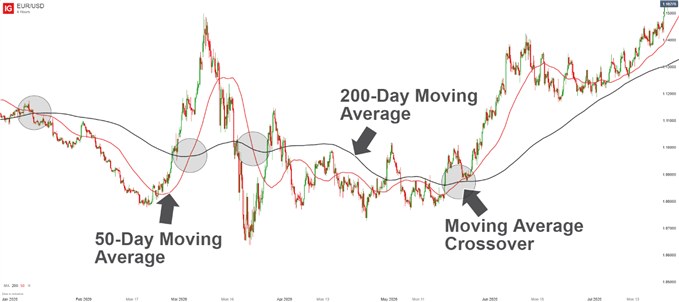
A moving average crossover occurs when a shorter-term moving average crosses above or below a longer-term moving average. This is one of the most widely followed technical signals in trading, used to identify potential trend changes and generate entry and exit points across all financial markets — including forex, stocks, commodities, and indices.
The concept is simple yet powerful: when the faster (shorter-term) moving average crosses above the slower (longer-term) moving average, it signals that momentum is shifting to the upside — a bullish crossover. Conversely, when the faster moving average crosses below the slower moving average, it signals that momentum is shifting to the downside — a bearish crossover.
Moving average crossovers work because they capture shifts in market sentiment and momentum. During strong trends, crossovers can generate substantial profits. However, they are lagging indicators, which means they confirm moves that have already begun. This is why filtering false signals is essential for consistent profitability.
2. Types of Moving Average Crossovers
There are several types of moving average crossovers, each with different characteristics and best-use cases. The choice depends on your trading timeframe and style.
Golden Cross (50/200)
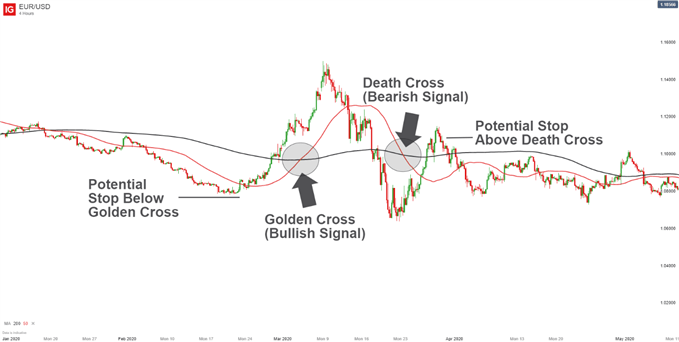
The Golden Cross occurs when the 50-period Simple Moving Average (SMA) crosses above the 200-period SMA. This is widely regarded as a long-term bullish signal, historically indicating the start of a major bull market. It is one of the most followed technical signals by institutional traders and investors.
Death Cross (50/200)
The Death Cross occurs when the 50-period SMA crosses below the 200-period SMA. This is a long-term bearish signal, suggesting that momentum has shifted to the downside and a potential bear market may be developing.
12/26 EMA Crossover
The 12/26 EMA crossover uses a 12-period and 26-period Exponential Moving Average. This is a medium-term momentum strategy often associated with the MACD indicator. When the 12 EMA crosses above the 26 EMA, it generates a buy signal; a cross below generates a sell signal.
9/21 EMA Crossover
The 9/21 EMA crossover is a short-term strategy popular among day traders and scalpers. It is more sensitive and generates more frequent signals, making it suitable for capturing quick momentum shifts in active markets.
Multi-Moving Average Crossover
A multi-MA crossover uses three or more moving averages (e.g., 9, 21, and 50). A bullish signal occurs when all three are aligned (9 > 21 > 50), confirming a strong trend. This reduces false signals by requiring confirmation across multiple timeframes.
| Crossover Type | Fast MA | Slow MA | Best Timeframe | Signal Type | Reliability |
|---|---|---|---|---|---|
| Golden Cross | 50 SMA | 200 SMA | Daily/Weekly | Bullish (Long) | High |
| Death Cross | 50 SMA | 200 SMA | Daily/Weekly | Bearish (Short) | High |
| 12/26 EMA Crossover | 12 EMA | 26 EMA | 1H-4H | Bullish/Bearish | Medium |
| 9/21 EMA Crossover | 9 EMA | 21 EMA | 15M-1H | Bullish/Bearish | Low-Medium |
| Triple MA Crossover | 9/12 EMA | 21/26 EMA | All | Bullish/Bearish | Medium-High |
📌 Reliability varies by market conditions. All crossovers are most effective in trending markets and least effective in ranging or choppy conditions.
3. Moving Average Crossover Strategies — Complete Guide
Here are the four most effective moving average crossover strategies, each suited to different trading styles and timeframes.
Strategy 1 — 50/200 Golden/Death Cross (Long-Term)
This strategy is designed for position traders and long-term investors. The Golden Cross (50 SMA above 200 SMA) signals the start of a bull market, while the Death Cross (50 SMA below 200 SMA) signals a bear market. Entry is on the crossover itself, with exit on the opposite crossover. This strategy has the lowest frequency of signals but the highest reliability.
Strategy 2 — 12/26 EMA Crossover (Medium-Term)
This is a swing trading strategy that captures medium-term momentum. The 12 EMA crossing above the 26 EMA generates a buy signal; crossing below generates a sell signal. This strategy works best on 1-hour and 4-hour charts and can be enhanced with MACD confirmation.
Strategy 3 — 9/21 EMA Crossover (Short-Term)
This is a day trading strategy for capturing short-term momentum. It generates frequent signals and is best used on 15-minute to 1-hour charts. Due to its sensitivity, it requires strict risk management and should be combined with trend filters to avoid whipsaws.
Strategy 4 — Triple Moving Average Crossover
This strategy uses three moving averages (e.g., 9, 21, and 50). A bullish signal occurs when the 9 EMA is above the 21 EMA and the 21 EMA is above the 50 SMA (stacked alignment). A bearish signal occurs when the opposite is true. This strategy provides stronger confirmation and reduces false signals.
4. Best Moving Average Crossover Settings by Timeframe
The optimal moving average crossover settings depend on your trading timeframe. The table below provides recommended settings for different trading styles.
| Timeframe | Fast MA | Slow MA | Additional Filter | Best Use |
|---|---|---|---|---|
| 1-Minute | 9 EMA | 21 EMA | 200 SMA Trend Filter | Scalping |
| 5-Minute | 9 EMA | 21 EMA | 200 SMA Trend Filter | Scalping |
| 15-Minute | 12 EMA | 26 EMA | 50 SMA | Day trading |
| 1-Hour | 20 EMA | 50 SMA | 200 SMA | Swing trading |
| 4-Hour | 20 EMA | 50 SMA | 200 SMA | Swing trading |
| Daily | 20 EMA | 50 SMA | 200 SMA | Position trading |
| Weekly | 20 EMA | 50 SMA | 200 SMA | Long-term analysis |
📌 These are general guidelines. Always test and adjust settings based on the specific market and asset you are trading.
5. How to Filter False Moving Average Crossover Signals
False signals are the biggest challenge when trading moving average crossovers, especially in ranging markets. Here are the most effective filtering techniques.
| Filter Method | How It Works | Best Used With |
|---|---|---|
| RSI Confirmation | Only trade crossovers when RSI confirms momentum (above 50 for bullish, below 50 for bearish) | 12/26 EMA Crossover |
| Price Action Confirmation | Wait for candlestick pattern confirmation (engulfing, pin bar, or inside bar) at crossover point | All crossovers |
| Multiple Timeframe Analysis | Confirm crossover on higher timeframe before trading lower timeframe signal | 9/21 EMA Crossover |
| 200 SMA Trend Filter | Only take bullish crossovers when price is above 200 SMA; only take bearish crossovers when price is below 200 SMA | Golden/Death Cross |
| Volume Confirmation | Ensure volume supports the crossover direction (increasing volume on breakout) | All crossovers |
| ADX Trend Strength | Only trade crossovers when ADX is above 25 (trending market) | All crossovers |
📌 Combining multiple filters significantly improves the reliability of moving average crossover signals. The 200 SMA trend filter is one of the most effective single filters.
6. Moving Average Crossover Strategy Comparison
Each crossover strategy has different characteristics in terms of signal frequency, risk, and best market conditions. Choose the one that matches your trading style.
| Strategy | Entry Signal | Exit Signal | Best Market | Risk Level | Signal Frequency |
|---|---|---|---|---|---|
| 50/200 Golden/Death Cross | 50 MA crosses 200 MA | Opposite crossover | Strong trends | Low-Medium | Very Low |
| 12/26 EMA Crossover | 12 EMA crosses 26 EMA | Opposite crossover | Medium-term trends | Medium | Low-Medium |
| 9/21 EMA Crossover | 9 EMA crosses 21 EMA | Opposite crossover | Short-term trends | Medium-High | High |
| Triple MA Crossover | Fastest crosses above/below all | All aligned | Strong trends | Low | Low-Medium |
📌 The Triple MA Crossover has the lowest risk due to its built-in confirmation mechanism, while the 9/21 EMA Crossover has the highest signal frequency but requires more active management.
7. Pros and Cons of Moving Average Crossover Strategies
Like any trading tool, moving average crossovers have strengths and weaknesses. Understanding both is essential for using them effectively.
| Pros | Cons |
|---|---|
| Simple and objective — easy to understand and implement | Lagging indicator — signals come after price moves have started |
| Works well in strong trends — captures major market moves | Ineffective in ranging markets — generates frequent false signals |
| Provides clear entry/exit rules — removes emotional decisions | Delayed entry — price may have already moved significantly |
| Can be used across all markets — forex, stocks, commodities, indices | Whiplash in volatile markets — frequent crossover signals |
| Various combinations available — can adapt to different trading styles | No predictive power — only confirms what already happened |
📌 The key to success with moving average crossovers is not the indicator itself — it is how you use it in conjunction with proper filters, risk management, and market context.
8. Common Mistakes When Using Moving Average Crossovers
Even experienced traders make mistakes with moving average crossovers. Avoid these common pitfalls to improve your results.
| Mistake | Why It’s Harmful | How to Fix |
|---|---|---|
| Using crossovers in sideways markets | Generates frequent false signals and whipsaws | Only use in trending markets; use ADX to confirm trend strength (>25) |
| Trading every crossover | Whipsaws and excessive transaction costs | Filter with trend confirmation (200 SMA) and price action |
| Using wrong period for timeframe | Too short = whipsaw; too long = too laggy | Match MA period to your trading timeframe |
| Ignoring higher timeframe context | Can trade against the bigger trend | Always check higher timeframe MA alignment |
| Not using confirmation filters | Many false signals in choppy conditions | Use RSI, volume, candlestick patterns for confirmation |
| Over-relying on Golden/Death Cross | These are lagging signals that can be late | Combine with other indicators for confirmation |
| No risk management | Large losses on false signals | Always use stop-losses and proper position sizing |
📌 The most successful traders use moving average crossovers as part of a broader system that includes trend filters, confirmation indicators, and strict risk management.
9. Frequently Asked Questions
What is a moving average crossover?
A moving average crossover occurs when a shorter-term moving average crosses above or below a longer-term moving average. It is a popular technical signal used to identify trend changes and generate entry and exit points in trading.
What is the Golden Cross in moving average trading?
The Golden Cross occurs when the 50-period moving average crosses above the 200-period moving average. It is a widely followed bullish signal that historically indicates the start of a long-term bull market.
What is the Death Cross in moving average trading?
The Death Cross occurs when the 50-period moving average crosses below the 200-period moving average. It is a widely followed bearish signal suggesting that momentum has shifted to the downside.
What is the best moving average crossover strategy for beginners?
The 50/200 Golden Cross/Death Cross is often recommended for beginners because it provides clear, long-term signals and works well on daily charts. However, beginners should practise on demo accounts first and use trend filters to avoid false signals.
What are the best settings for moving average crossover?
Common settings include: 50/200 for long-term trends, 12/26 for medium-term swing trading, and 9/21 for short-term day trading. The optimal settings depend on your trading timeframe and style.
How can I filter false moving average crossover signals?
Use RSI confirmation (momentum above 50 for bullish), candlestick pattern confirmation (engulfing, pin bars), multiple timeframe analysis, or the 200 SMA as a trend filter. Combining multiple filters significantly improves reliability.
What is the 12/26 EMA crossover strategy?
The 12/26 EMA crossover uses a 12-period and 26-period EMA. When the 12 EMA crosses above the 26 EMA, it generates a buy signal. When it crosses below, it generates a sell signal. This is one of the most widely used EMA crossover strategies.
Can moving average crossovers be used in forex trading?
Yes, moving average crossovers are widely used in forex trading. They work particularly well on higher timeframes (4H, Daily) and in trending markets. Many forex traders use them in combination with other indicators like RSI or MACD.
What is a triple moving average crossover strategy?
A triple moving average crossover uses three moving averages (e.g., 9, 21, and 50). A bullish signal occurs when all three are aligned (9 > 21 > 50), and a bearish signal occurs when the opposite is true. This strategy helps filter out false signals by requiring confirmation across multiple timeframes.
What is the most reliable moving average crossover?
The 50/200 Golden Cross is widely regarded as the most reliable for long-term trend identification due to its large data set and ability to filter out market noise. However, reliability depends on market conditions and proper confirmation.
📈 Combine Crossovers with Candlestick Confirmation: Moving average crossovers are powerful trend signals, but they work even better when combined with price action confirmation. Master the Morning Star Candlestick — A Forex Trader’s Guide — a powerful three-candle reversal pattern that frequently appears at crossover points, helping you confirm entries with greater precision.
🕯️ Strengthen Your Crossover Signals with Doji Patterns: Doji candlesticks signal indecision and potential reversals — making them the perfect complement to moving average crossover signals. Learn the Top 5 Types of Doji Candlesticks and how to use them to filter false signals and time your entries around crossovers for higher probability trades.


 Signal2forex.com - Best Forex robots and signals


