
By Uladzimir Leuchankou, founder of Signal2Forex and developer of the Forex V robots
What is rollover in forex? The interest your broker adds to a position, or takes from it, when the position stays open past 5 p.m. New York time. I suppose that is an answer too. But for me forex rollover is first of all a line in my trade history — a small number in the Swap column that I did not choose and cannot switch off.
That number has a plain source. Every currency has an interest rate, and its central bank sets it. When you buy AUD/CHF, you hold Australian dollars at 4.85% and you owe Swiss francs at 0%. The gap between the two rates is settled for every night you keep the trade. Buy the higher rate — and the night pays you. Sell it — and you pay.
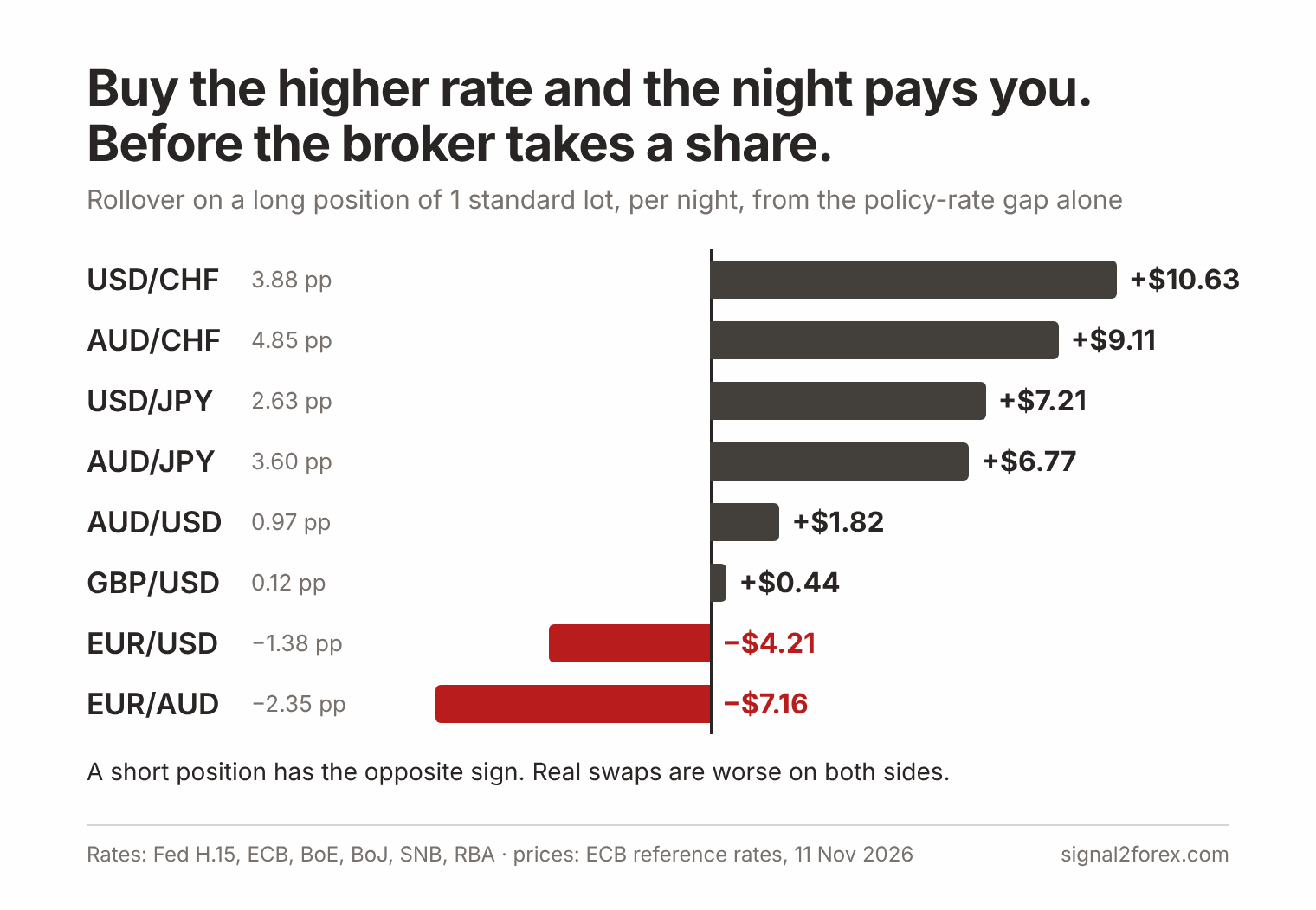
The rollover rate meaning is no wider than this. It is one night of interest on the full size of the position — not on your margin. On one standard lot of AUD/CHF — 100,000 Australian dollars — the gap is worth about $9.11 a night today. On a 0.01 lot it is 9 cents.
On this page: the numbers · the hour · the triple night · your broker’s rates · my robots · what can change them
Forex rollover in numbers
How do I get $9.11? I take the size of the position, multiply it by the rate gap and divide by 365 days. Then I turn the result into US dollars.
100,000 AUD × 4.85% ÷ 365 = 13.29 AUD per night
13.29 AUD × 0.6859 = $9.11
1.00 lot — $9.11 · 0.10 lot — $0.91 · 0.01 lot — $0.09
The rates are the ones in force on 12 November 2026. The Reserve Bank of Australia raised its cash rate to 4.85% on 3 November — its November Statement on Monetary Policy notes that most other large central banks raised rates this autumn too.
The Swiss National Bank holds 0%. For the US dollar I use the effective federal funds rate — 3.88% in the Federal Reserve’s H.15 table. Prices come from the ECB reference rates of 11 November, with AUD/USD at 0.6859.
| Pair | Rate gap | Buy 1 lot, per night |
|---|---|---|
| USD/CHF | 3.88% − 0% | +$10.63 |
| AUD/CHF | 4.85% − 0% | +$9.11 |
| USD/JPY | 3.88% − 1.25% | +$7.21 |
| AUD/USD | 4.85% − 3.88% | +$1.82 |
| EUR/USD | 2.50% − 3.88% | −$4.21 |
| EUR/AUD | 2.50% − 4.85% | −$7.16 |
My calculation from central bank rates, checked on 12 November 2026. This is the clean rate gap, before any broker takes a share.
Why does USD/CHF pay more than AUD/CHF when its gap is smaller? One lot of USD/CHF is $100,000, and one lot of AUD/CHF is only $68,590. The gap is a percentage — the money depends on what it is a percentage of.
On a $10,000 account with one 0.10 lot of AUD/CHF this is 91 cents a night, about $27 a month. On a $100 cent account with a 0.01 lot it is 9 cents a night. In pips it is 0.76 of a pip, and I explain the unit in the article on what a pip is. Small. But the charge comes every night, and it does not ask whether the trade is in profit.
Forex rollover time
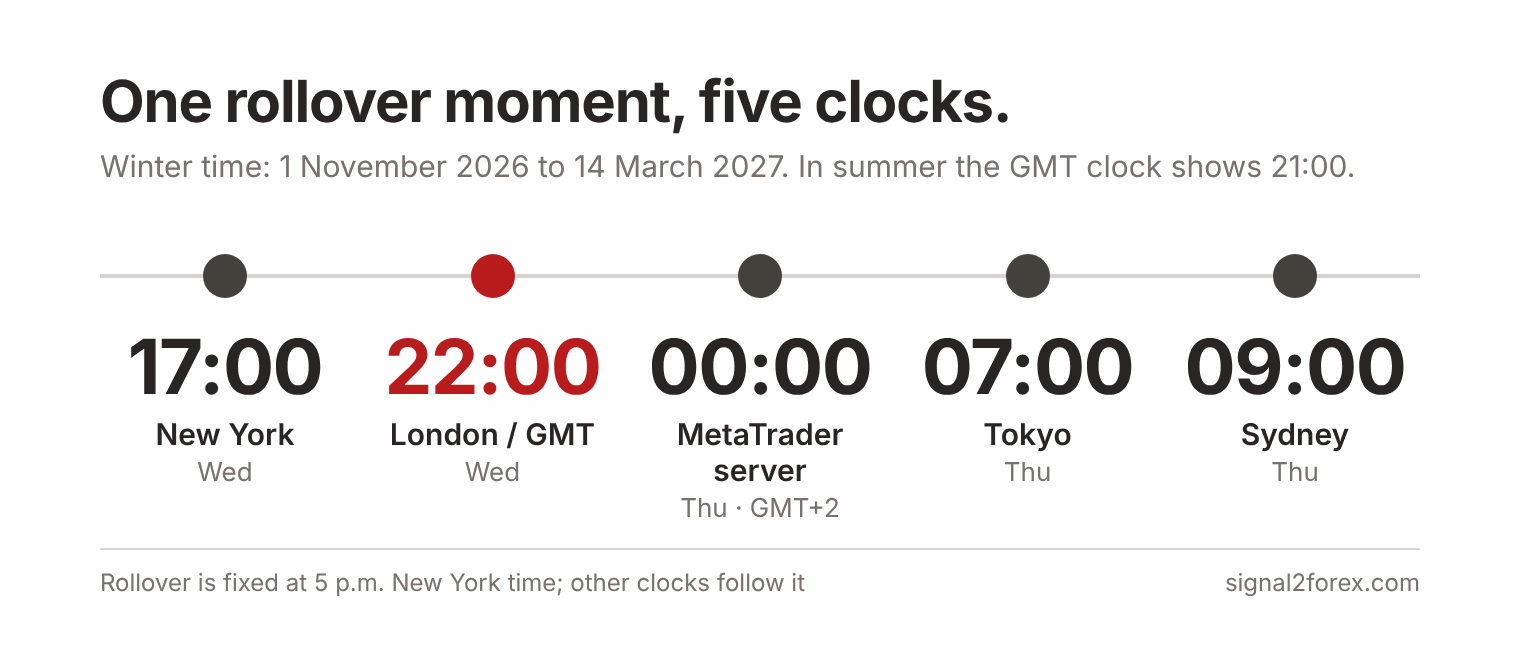
There is one more thing to know — the hour. Forex rollover time is 5 p.m. in New York, the moment when the trading day changes its date. Since 1 November 2026 that is 22:00 GMT. From 14 March 2027, when the United States moves its clocks forward, it will be 21:00 GMT again.
A position that is open at 21:59 GMT and still open at 22:00 gets the full night. A position opened at 22:01 and closed the next evening at 21:59 gets nothing, even after almost 24 hours in the market. The charge does not count hours. It counts who is there at one moment.
On most MetaTrader servers that moment is midnight on the server clock. Many brokers keep the server at GMT+2 in winter for this reason — the new day in the terminal then starts with the rollover. I do not know which clock your broker uses, but you can check it in a minute. Compare the time in Market Watch with GMT.
For a robot the hour matters more than the money. Around the rollover the banks that supply prices close their books, there are fewer quotes, and the spread opens up for some minutes. A stop that sits close to the price can be hit by the spread alone, with no real move behind it.
I wrote about this in the article on what a forex spread tells you. If you run a robot through the night, you need to know what its spread filter does at that hour.
The triple swap night
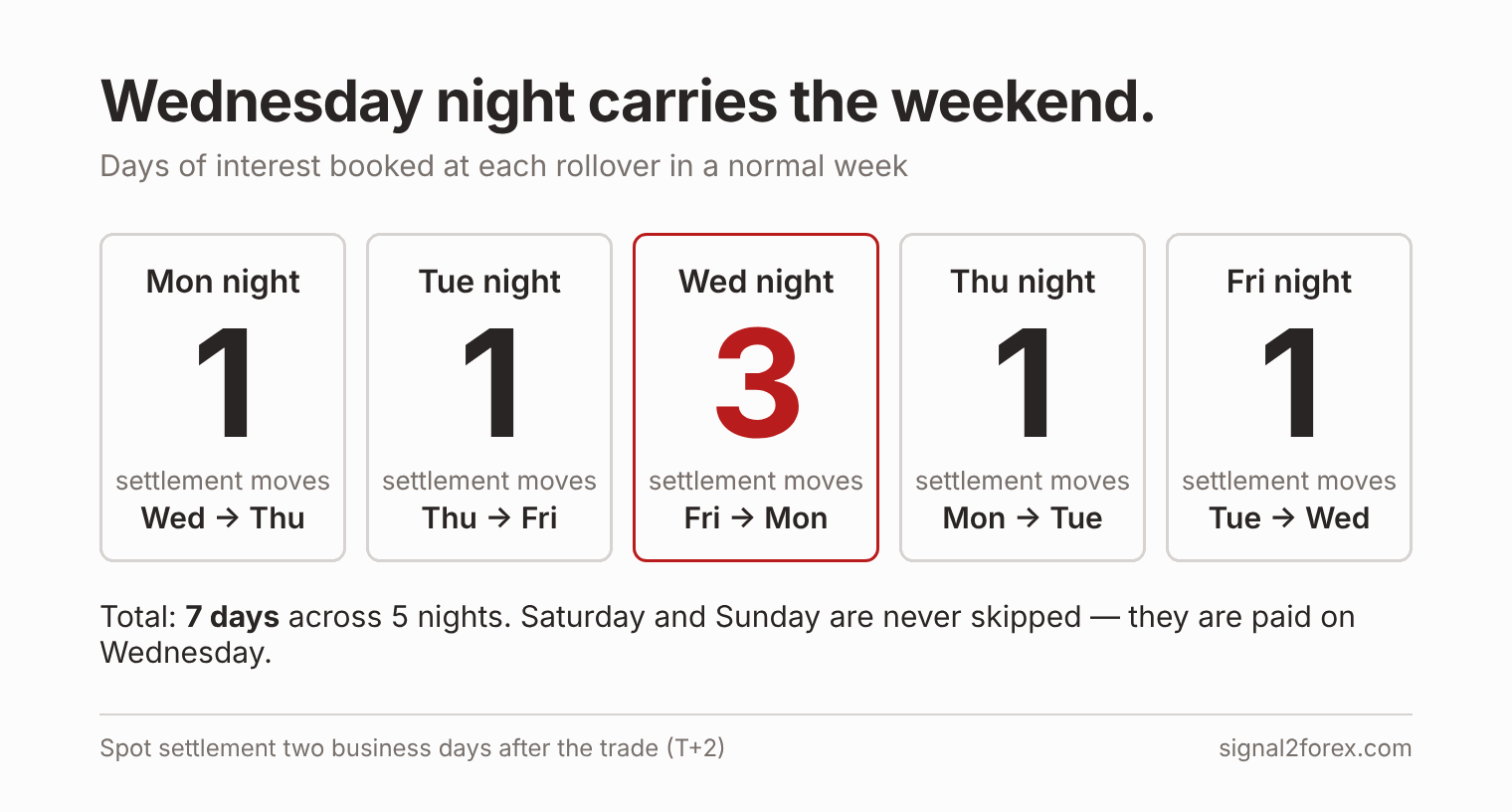
Why does one night cost three times more than the others? A spot trade in most pairs is settled two business days after the deal. Roll a position on Wednesday night, and its settlement day moves from Friday to Monday. Three calendar days pass — and interest is owed for all three.
So a normal week has five rollovers and seven days of interest. Monday, Tuesday, Thursday and Friday carry one day each. Wednesday carries three. On AUD/CHF that is $27.34 on one lot instead of $9.11, or 27 cents on a 0.01 lot.
Most guides tell you to close before Wednesday night when the swap is against you. I do not agree, at least not as a rule. The triple night is not a penalty. It is three ordinary nights booked at once, and you would pay the same three if banks worked on Saturday and Sunday. Closing at 21:55 and opening again at 22:05 costs you the spread twice — at the hour when the spread is at its widest.
Not every instrument follows Wednesday. USD/CAD is settled in one business day, so some brokers book its three days on Thursday. Indices and metals often use Friday. Bank holidays move the count as well, and I cannot give you one calendar that fits every broker. The terminal can — every symbol has a field called 3-days swap.
Current FX rollover rates
Where do you find current fx rollover rates for your own account? Not in an article. People search for forex.com rollover rates, or for one table of forex rollover rates by pair, and every broker does publish such a table. But each table is true only for that broker and only for that week.
My numbers above are the clean rate gap, and no broker pays it in full. The broker starts from the price that banks charge each other to roll a position by one day. That price follows the same rate gap.
Then the broker adds its own share on both sides. The side that should receive gets less. The side that should pay pays more. On a pair with a small gap — GBP/USD today, with 0.12 of a percentage point — both sides usually end up negative.
The place to look is the terminal. Right-click the pair in Market Watch and open Specification. You need three fields there — Swap long, Swap short and 3-days swap. They are listed in MetaTrader’s own help. When the swap type is in points, one line gives you the money. Say Swap long on AUD/CHF shows 5.0 — this is an example, not a quote from any broker.
lots × contract size × point × swap value
1.00 × 100,000 × 0.00001 × 5.0 = 5.00 CHF per night
clean rate gap: 7.56 CHF · difference: 2.56 CHF
In this example 2.56 francs a night stay with the broker — about $3.08 on one lot, 3 cents on a 0.01 lot. Is that a lot? Compare Swap long with Swap short on your own pair. Without a broker’s share the two numbers would be equal in size and opposite in sign. They never are.
One note on names. A web platform calls the charge rollover, and MetaTrader calls it swap. This is why people type rollover forex swap into a search box as if it were two things. For the retail trader it is one thing.
Some brokers offer swap-free accounts. The interest does not vanish there — it usually comes back as a wider spread or a fixed fee after several nights. I have not compared them all, so I will not say which is cheaper.
Swap in my robots
I see all of this from the robot side. Our Forex V Portfolio runs 28 robots on 14 pairs — a Buy robot and a Sell robot for each pair, on the H1 chart. A typical trade stays open for about four working days. So almost every trade meets the rollover several times, and most of them meet a Wednesday.
Take AUD/CHF again. The Buy robot holds the 4.85% side and collects. The Sell robot holds the 0% side and pays — more than the Buy robot collects, because the broker’s share sits on both. A trade open from Monday to Friday crosses four rollovers and six days of interest. On the clean gap that is $54.68 on one lot, 55 cents on a 0.01 lot, or about 4.5 pips.
Is 4.5 pips a lot? Not against the move the robot is built to catch. But it is not zero either, and it always falls on the same side. For me swap is not income when it is positive and not noise when it is negative. It is the cost of holding, as the spread is the cost of entering.
One small detail from my own code. When I wrote a utility that closes positions at a set profit, I had to decide which profit it reads. I left it on the Profit column, the same number you see in the terminal. That column does not include swap. Swap sits in its own column next to it. If you judge an open trade by the Profit column alone, you need to add the Swap column yourself.
Historical rate rollover
There is another phrase that looks related and is not. Historical rate rollover comes from the world of banks and company treasurers. A company has a forward contract — a deal to exchange currency on a future date at a fixed price — and the date arrives. The company does not settle. It extends the contract at the old price, and the gain or loss moves into the new contract.
In a retail terminal you will not meet this. Your position is rolled at the market price every night, and the interest is settled the same night.
The next rate decisions
Every number on this page lives until a central bank moves. The Reserve Bank of Australia decides on 8 December 2026, the Federal Reserve on 9 December, the Swiss National Bank on 10 December and the Bank of Japan on 18 December.
A change of a quarter of a point moves the nightly figure by 47 cents on one lot of an AUD pair and by 68 cents on one lot of a USD pair. How a bank’s tone turns into a rate, I describe in the article on interest rates and the forex market.
Will the Fed move? I do not know. We will see on 9 December at 19:00 GMT.
The rate gap, the size of the position, the hour, the Wednesday, the broker’s share — forex rollover is made of these five things. If you hold trades for days, you need to read the swap fields before you open, not after you close. The more of the cost you count before the trade, the steadier the result after it.


 Signal2forex.com - Best Forex robots and signals


