
By Uladzimir Leuchankou, founder of Signal2Forex
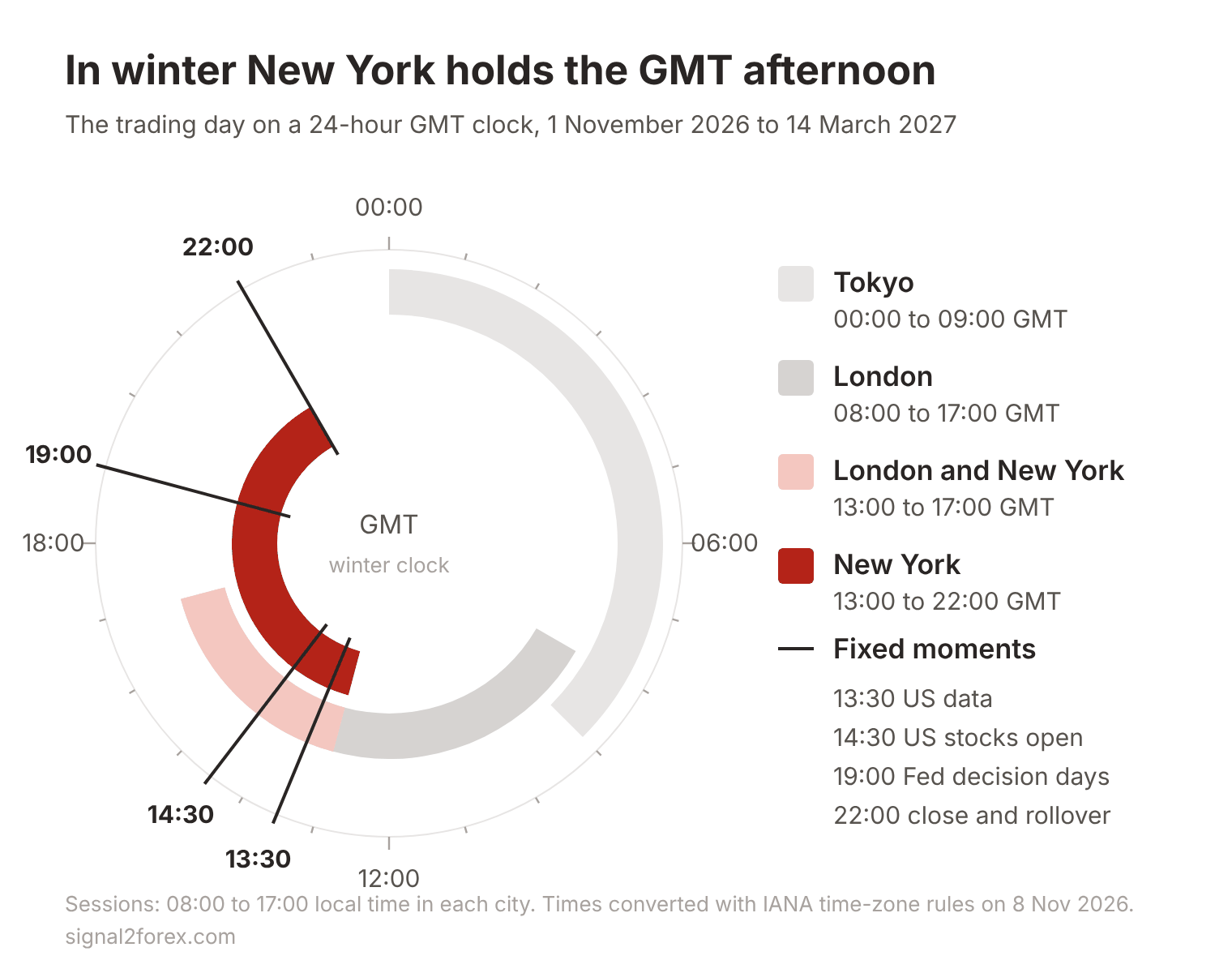
What is the New York session? Most guides answer with a clock — the hours from 08:00 to 17:00 in New York. I suppose that is an answer too. But for me the New York session is the part of the day when US data, the Federal Reserve and the New York close set the price of the dollar. After the US clock change on 1 November 2026 it runs from 13:00 to 22:00 GMT.
| What happens | New York | GMT |
|---|---|---|
| Session opens | 08:00 | 13:00 |
| US data: jobs, inflation | 08:30 | 13:30 |
| London closes | 12:00 | 17:00 |
| Fed decision days | 14:00 | 19:00 |
| Close and rollover | 17:00 | 22:00 |
For a small account I watch two lines in this table — 13:30 and 22:00. The first brings the biggest moves of the day. The second brings the widest spreads. Between them sits the forex trading New York session most people mean: four hours together with London, then a quieter afternoon.
Friday, 6 November
There is no better way to see the session than one real day. On Friday, 6 November 2026, the US Bureau of Labor Statistics published the October jobs report at 08:30 New York time — 13:30 GMT. Payrolls rose by 165,000. Economists polled by Reuters expected 65,000. The unemployment rate fell to 4.1%.
The dollar did not wait. By mid-morning in New York the dollar index was up 0.63% at 102.12 and EUR/USD was down 0.55% at 1.1157, Reuters reported. That is about 60 pips — roughly $600 on one standard lot of 100,000 units and $6 on a 0.01 lot. USD/JPY rose to 158.20.
There is another detail from that day which most session guides miss. At the same minute, Statistics Canada released its own October job numbers, as its 2026 release schedule shows. USD/CAD got two job reports at 13:30 GMT — one for each currency in the pair. If you trade USD/CAD in New York hours, you need the Canadian calendar as well as the American one.
Is that a normal Friday? Not quite. The first Friday of the month is the loudest day of the session. Still, the shape repeats on quieter days — a calm European morning, a jump at 13:30, a second wave when US stocks open at 14:30 GMT, then a slow afternoon after London goes home.
Two clock changes
Why does one guide say the New York session opens at 13:00 GMT and another says 12:00? Both are right, at different times of the year. The United States and Britain both move their clocks — but not on the same Sundays.
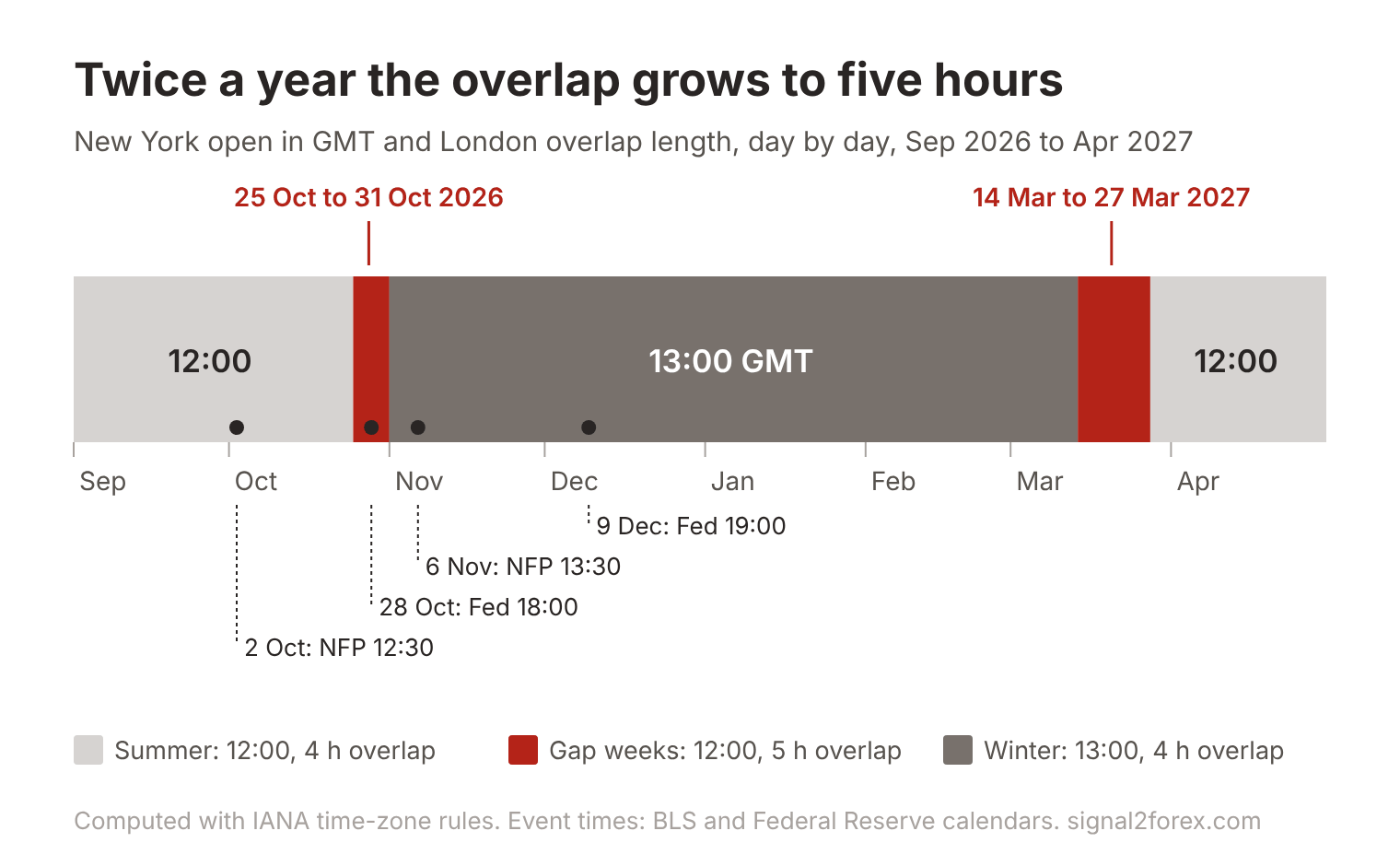
This autumn Britain went back to winter time on 25 October 2026. The United States followed a week later, on 1 November. For that one week New York opened at 12:00 GMT while London still closed at 17:00, so the two cities shared five hours instead of four. The Fed decision of 28 October came at 18:00 GMT. The next one, on 9 December, comes at 19:00 GMT.
Spring brings the same gap. The US moves to summer time on 14 March 2027 and Britain on 28 March. In those two weeks every New York time you keep in GMT is one hour early. This is not only theory — the jobs report of 2 October came out at 12:30 GMT, and the one of 6 November at 13:30 GMT.
| City | Until 14 Mar 2027 | After 28 Mar 2027 |
|---|---|---|
| Lagos | 14:00 | 13:00 |
| Johannesburg | 15:00 | 14:00 |
| Berlin, Madrid | 14:00 | 14:00 |
| Dubai | 17:00 | 16:00 |
| New Delhi | 18:30 | 17:30 |
| Jakarta | 20:00 | 19:00 |
Berlin and Madrid are the odd ones. They change clocks together with London, so their New York open stays at 14:00 all year — except the two gap weeks, when it is 13:00. If you trade from a city without summer time, you need to move your alarm twice a year: in late October and in mid-March.
Server time in an expert
Is there a clock that does not move? As someone who writes MetaTrader experts, I would say yes — the trading server. Many brokers run their servers at GMT+2 in winter and GMT+3 in summer, and they switch on the US dates. This is done on purpose: 17:00 in New York becomes 00:00 on the server, so every daily candle starts at the New York close.
On such a server the New York session never moves. It opens at 15:00 and closes at midnight all year. US jobs data always comes at 15:30, the Fed always at 21:00. It is London that jumps — its 08:00 open sits at 10:00 server time for most of the year and at 11:00 in the two gap weeks.
For me, the first question about any time filter is simple — whose clock is it? A filter written as 13:00 to 17:00 means one thing in GMT and another on the server.
Our Forex V Portfolio trades 14 pairs on the H1 chart, and the real account on our YouTube stream runs through all three sessions on the server’s clock. If you set session hours in a robot or an indicator, you need to write them in server time and check the broker’s offset before the first live trade.
The overlap with London
Why do so many traders work only from 13:00 to 17:00 GMT? Because two big centres trade at once. In the latest BIS survey, from April 2025, sales desks in the United Kingdom handled 38% of world currency trading and those in the United States about 19%. World turnover was $9.6 trillion a day. When both are open, the order books are deepest. The London half of this window is covered in our London session guide.
The usual New York session trading strategy for these hours is the breakout. Start by marking the high and the low of the London morning, from 08:00 to 13:00 GMT. Then wait for the 13:30 data or the 14:30 stock open.
After that, act only on a candle that closes outside the range on M15 or H1. The stop goes behind the breakout candle, and the trade size comes from that stop, not from the target.
Most guides call the overlap the best time for everyone. I do not fully agree. It is the best time for liquidity, but not always for entries on a small account.
In the first minute after a big release the spread widens, and a tight stop can fill several pips worse than you set it. On a $100 cent account that is cents in money but a large share of the trade. If you trade the breakout, you need to let the first spike pass and enter on a closed candle.
New York session forex pairs
Which are the best pairs to trade during New York session hours? The dollar pairs, because the news of these hours is American. The BIS survey ranks them by share of world turnover: EUR/USD 21.2%, USD/JPY 14.3%, GBP/USD 7.6%, USD/CAD 5.3% and USD/CHF 4.9%.
If I had to name one best pair to trade during New York session hours for a new trader, it would be EUR/USD. Its spread is the lowest of all pairs at most brokers, its moves after US data are large but readable, and almost every analysis of the dollar starts with it. The 60 pips of 6 November were a typical answer of this pair to a strong US surprise.
USD/CAD is the one pair where both sides often publish data at the same minute. Canada releases its jobs data on the same Friday as the US several times a year, and its inflation data also comes at 13:30 GMT. On such days the pair can move twice as far — or stand still when the two reports cancel out.
USD/JPY follows US bond yields, and at 158 it is close to the 160 area where Japan’s Ministry of Finance bought yen in 2024. I do not know whether that line holds this time, but I watch it. GBP/USD is busiest before 17:00 GMT and often goes quiet after London closes.
AUD/USD and NZD/USD belong more to the Tokyo session.
The afternoon and the close
What happens after 17:00 GMT? London goes home, and most pairs slow down. This is where the second New York session strategy lives — trading a range. You need a range that price has touched at least twice from each side, and you buy near the floor and sell near the ceiling with stops just outside. It works on quiet days. It fails on Fed days, when the statement comes at 19:00 GMT and the press conference at 19:30.
At 22:00 GMT New York closes and the trading day rolls over. For several minutes liquidity is thin, spreads widen, and the broker charges or pays swap on open trades. On Wednesday the swap is usually triple — with two-day settlement, that night’s rollover covers the weekend. I suppose this is the one hour of the day when a robot should simply not open new trades.
Short answers
| What time does the New York forex session open in GMT? | At 13:00 GMT from 1 November 2026 to 14 March 2027, and at 12:00 GMT in summer. It closes at 22:00 or 21:00 GMT. |
| Is the NYC session the same as the US session? | Yes. NYC session, US session and New York session are three names for the same hours. |
| Which are the best forex pairs to trade during New York session hours? | EUR/USD, USD/JPY, GBP/USD and USD/CAD. USD/CAD is strongest on days when Canada publishes data too. |
| Are New York sessions on Friday different? | The first Friday of the month brings the US jobs report at 13:30 GMT. Friday evening is thin before the weekend close. |
| What comes next? | US inflation for October on Tuesday, 10 November 2026, at 13:30 GMT. The Fed decides on 9 December at 19:00 GMT. |
Another view
Not everyone thinks forex trading New York hours is worth it at all. Their argument is simple. One number at 13:30 can erase a careful analysis in a second, and the spread at that moment costs more than any edge. People who think this way trade the London morning or the Tokyo hours and close before New York opens. There is truth in it for scalpers on wide-spread accounts.
But for me the answer is not to avoid the session — it is to avoid two short windows inside it, the first minutes after a release and the rollover hour. The rest of the New York day is ordinary, deep and well priced. I do not know whether Tuesday’s inflation report will move the dollar as much as Friday’s payrolls did. We will see at 13:30 GMT.
Session hours, the two clock changes, the server offset, the 13:30 data, the 22:00 rollover — all of this is one calendar. The more of it you keep in server time, the steadier your trading in New York hours becomes.
Sources: US jobs report — BLS, 6 November 2026; Canadian release dates — Statistics Canada, 2026 schedule; Fed meeting times — Federal Reserve, December 2026 calendar; turnover by country and pair — BIS Triennial Survey, April 2025; market moves — Reuters via CNBC, 6 November 2026. Time-zone conversions are our own, computed from the IANA time-zone rules.
Uladzimir Leuchankou is a software engineer with a BSc in Finance and the founder of Signal2Forex. He develops the site’s trading robots, including the Forex V Portfolio, and runs a real account on the Signal2Forex YouTube stream. Questions about session hours in an expert can go to forexfactory1shop@gmail.com or to his MQL5 profile.


 Signal2forex.com - Best Forex robots and signals


