
Gap Trading: What Are Gaps & How to Trade Them
📑 Table of Contents
1. What Is a Gap in Trading?
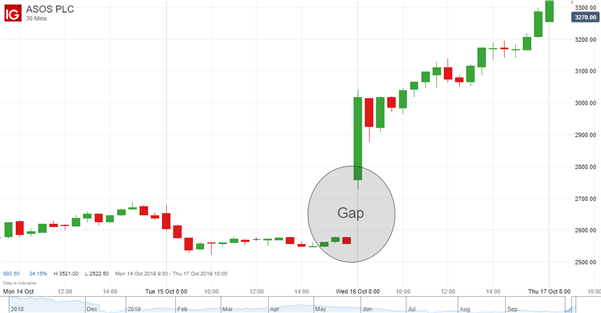
A gap is an area on a price chart where no trading activity has taken place. It occurs when an asset’s price opens significantly higher or lower than its previous close, creating a visible empty space on the chart.
Gaps are most commonly observed in stock markets between daily trading sessions, but they also appear in the forex market — typically over weekends or during major holidays when trading is closed. In forex, gaps can also occur between the Friday close and Sunday open, or during unexpected news events that trigger sharp price movements.
A gap up happens when the opening price is higher than the previous day’s high. A gap down occurs when the opening price is lower than the previous day’s low. These visible discontinuities provide traders with potential trading opportunities based on expectations of continuation or reversal.
2. Why Do Gaps Occur?
Gaps typically occur due to new information released when markets are closed or during periods of low liquidity. Common catalysts include:
- Earnings reports — released after market close or before market open
- Economic data releases — such as Nonfarm Payrolls, CPI, or central bank decisions
- Geopolitical events — elections, wars, natural disasters, or policy changes
- Overnight news — developments in other time zones that affect global markets
- Weekend gaps in forex — when the market reopens on Sunday after Friday’s close
3. The 4 Types of Gaps in Trading
Understanding the four types of gaps is essential for developing a successful gap trading strategy. Each type has distinct characteristics, signals, and trading approaches.
| Gap Type | Description | Signal | Volume | Trading Action | Risk Level |
|---|---|---|---|---|---|
| Common Gap | Small gap, no major news, often fills quickly | Neutral | Low | Avoid or fade | Low |
| Breakaway Gap | New trend begins, breaks from a consolidation pattern | Strong | High | Trade in gap direction | Medium |
| Continuation Gap | Trend accelerates, confirms existing trend | Confirmation | Moderate | Follow the trend | Medium |
| Exhaustion Gap | Trend ends, reversal signal near trend exhaustion | Reversal | High | Trade against the trend | High |
📌 Signal indicates the trading implication of each gap type. Volume refers to typical trading volume during and after the gap formation. Risk Level reflects the relative difficulty and uncertainty of trading each gap type.
Additionally, gaps are classified based on their fill probability and typical timeframe for filling:
| Gap Type | Fill Probability | Typical Timeframe |
|---|---|---|
| Common Gap | ~90% | 1–5 days |
| Breakaway Gap | ~30–40% | Weeks to months |
| Continuation Gap | ~50–60% | 1–2 weeks |
| Exhaustion Gap | ~80–90% | 1–5 days |
📌 Fill Probability indicates the likelihood that the price will return to fill the gap area. Typical Timeframe refers to the average time it takes for the gap to be filled.
4. What Does It Mean When a Gap Has Been Filled?
A gap is considered “filled” when the price returns to the original level before the gap occurred — specifically, when the price moves back to the last day’s close before the gap. This typically happens in the following days or weeks as the price retraces to fill the empty space on the chart.
Gap filling is a well-documented market phenomenon. Common gaps are filled approximately 90% of the time, often within 1 to 5 days. Exhaustion gaps also have a high fill probability (~80–90%). In contrast, breakaway gaps are filled only about 30–40% of the time, as they signal the start of a new trend that often continues without retracing.
The speed and likelihood of gap filling depend on several factors: the gap type, the volume at the gap breakout, and the overall market context. High-volume gaps with strong momentum are less likely to be filled quickly.
5. Gap Trading Strategies — How to Trade Each Type
Each gap type requires a specific trading approach. Here are proven strategies for trading each type of gap.
How to Trade Breakaway Gaps
- Entry: Enter in the direction of the gap (long on gap up, short on gap down) on the breakout candle or after a retest of the gap level.
- Confirmation: Ensure high volume accompanies the gap. This confirms genuine institutional interest and reduces the chance of a false breakout.
- Stop-Loss: Place stop-loss below the gap level (for long positions) or above the gap level (for short positions).
- Take-Profit: Target the measured move based on the preceding consolidation pattern’s height.
How to Trade Continuation Gaps
- Entry: Enter in the direction of the existing trend after the gap confirms the trend is accelerating.
- Confirmation: Look for moderate volume and clear trend indicators (e.g., moving averages aligned in the trend direction).
- Stop-Loss: Place stop-loss below the gap (for uptrends) or above the gap (for downtrends).
- Take-Profit: Use trailing stops to capture the continuation move, or target the previous swing high/low.
How to Trade Exhaustion Gaps
- Entry: Enter against the gap direction — short on gap up, long on gap down — after a reversal signal (e.g., bearish engulfing, shooting star).
- Confirmation: Look for high volume on the gap candle followed by a reversal candle in the opposite direction.
- Stop-Loss: Place stop-loss beyond the gap high (for short positions) or below the gap low (for long positions).
- Take-Profit: Target the gap fill — the price level before the gap occurred.
How to Trade Common Gaps
- Entry: Generally avoid trading common gaps as they are unpredictable and often fill quickly.
- Alternative: If you choose to trade, consider a fade strategy — trade against the gap direction with a tight stop-loss, targeting a quick fill.
- Confirmation: Look for low volume and absence of significant news to confirm it’s a common gap.
- Stop-Loss: Place stop-loss just beyond the gap to minimise risk.
6. Gap Trading Example (with Real Numbers)
Let’s walk through a realistic breakaway gap trading example using recent market data.
Scenario: Gold (XAUUSD) has been consolidating between $4,100 and $4,160 for several weeks. On Friday evening, weak US Nonfarm Payrolls data is released, showing only 57,000 jobs added vs. 110,000 expected.
Monday open: Gold gaps up to $4,250 (previous close was $4,150). Volume is significantly above average, confirming strong buying interest.
Trade Setup (Breakaway Gap):
- Entry: Buy at $4,255 on the breakout candle.
- Stop-Loss: Place stop-loss below the gap at $4,145 (risk = $110).
- Take-Profit: Measured move = consolidation range height ($4,160 – $4,100 = $60) projected from the gap top. Target = $4,260 + $60 = $4,320.
- Risk-Reward Ratio: $110 risk vs. $65 reward = approximately 1:0.6 — not ideal.
- Improved Entry: Wait for a retest of the gap level at $4,250. If price holds, enter at $4,255 with a tighter stop-loss at $4,200 (risk = $55). Target remains $4,320. New risk-reward = 1:1.18.
In this example, patience and waiting for a retest significantly improved the risk-reward ratio. The trade ultimately reached $4,320, delivering a ~$65 profit on the improved entry.
7. Gap Trading Risk Management
Gap trading can be profitable, but it carries significant risks. Follow these risk management principles to protect your capital.
- Position Size: Never risk more than 1–2% of your trading account on a single gap trade.
- Stop-Loss Discipline: Always use a stop-loss order. Gaps can continue or reverse sharply without warning.
- Volume Confirmation: Only trade gaps with volume confirmation. Low-volume gaps are unreliable.
- Avoid Trading Exhaustion Gaps: These are the most dangerous. Only trade them with strong reversal signals and tight stops.
- News Awareness: Be aware of upcoming news events that could cause further gaps or volatility.
- Partial Profits: Consider taking partial profits at key levels to lock in gains while letting the rest run.
💡 Trading tip: The gap fill strategy — trading in the direction of the gap fill — is one of the highest probability trades when applied correctly. However, it requires patience and careful selection of gap types.
8. Frequently Asked Questions
What is a gap in trading?
A gap is an area on a price chart where no trading activity has taken place. It occurs when an asset’s price opens significantly higher or lower than its previous close, creating a visible empty space on the chart.
What are the 4 types of gaps in trading?
The four types are: Common gaps (small, no major news), Breakaway gaps (signal new trend), Continuation/Runaway gaps (trend acceleration), and Exhaustion gaps (trend reversal).
What is a breakaway gap?
A breakaway gap signals the start of a new trend. It occurs when price gaps away from a consolidation pattern, often accompanied by higher trading volume. Traders typically trade in the direction of the gap.
What is a continuation gap?
A continuation gap, also called a runaway gap, shows an acceleration of an existing trend in the same direction. It confirms the current trend and traders often follow the trend.
What is an exhaustion gap?
An exhaustion gap occurs near the end of a trend when price makes a final gap in the trend direction, then reverses. It’s often caused by herd mentality and traders watch for reversal signals.
What does it mean when a gap is filled?
A gap is “filled” when the price returns to the original level before the gap occurred. This usually happens in the following days or weeks as the price retraces to the last day before the gap.
What is the best gap trading strategy?
The best strategy depends on the gap type. Breakaway gaps are traded in the gap direction with volume confirmation. Exhaustion gaps are traded against the trend. Common gaps are typically avoided. The gap fill strategy is also popular among traders.
Do all gaps get filled?
No, not all gaps get filled. Common gaps have ~90% fill probability, while breakaway gaps have only ~30–40%. The likelihood depends on the gap type and market context.
📊 Master price action trading: Learn how to use price action to trade new trends — a powerful skill that complements gap trading by helping you confirm breakouts and identify trend reversals.
⏰ Understand market timing: Discover the major forex trading sessions from around the world — gaps often occur between sessions, and knowing session overlaps can help you anticipate and trade gaps more effectively.
📞 Need help with your gap trading strategy? Our team is here to assist you. Visit our Contact Page or use the online chat available on every page of our website for immediate support.


 Signal2forex.com - Best Forex robots and signals


