
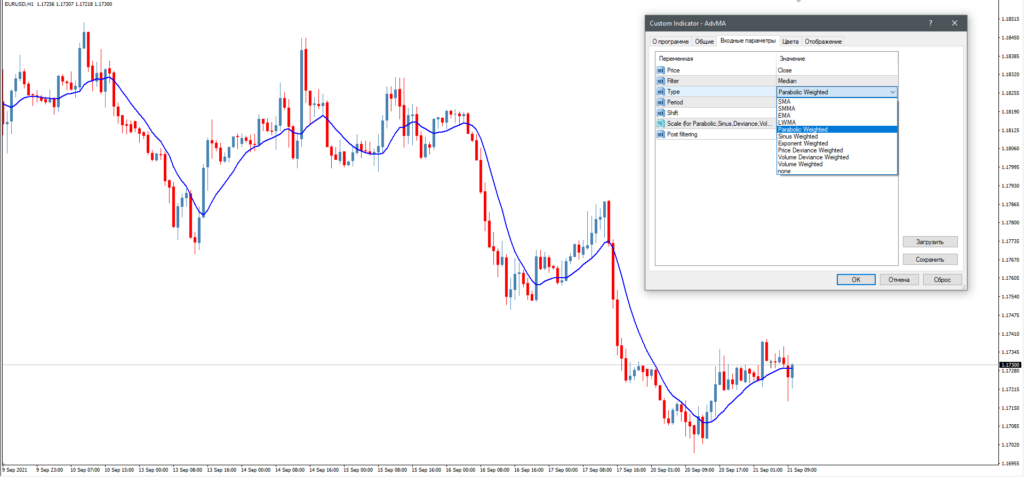
AdvMA Indicator – Free Download for MT4/MT5
$0.00
System: Metatrader 4/5
Timeframe: any
Chart: any
How to download: Click Free download and checkout. Then enter your details and place order. You’ll receive download link automatically thereafter.
Description
📑 Table of Contents
- 1. What Is the AdvMA Trading Indicator?
- 2. Key Features of AdvMA Indicator
- 3. AdvMA Indicator for MetaTrader 4 (MT4)
- 4. AdvMA Indicator for MetaTrader 5 (MT5)
- 5. Technical Specifications
- 6. Types of Averaging in AdvMA
- 7. AdvMA Indicator Settings and Configuration
- 8. How to Use AdvMA Indicator
- 9. How to Install AdvMA Indicator in MT4 & MT5
- 10. AdvMA Indicator Review: Pros and Cons
- 11. Comparison Table: AdvMA vs Standard Moving Averages
- 12. Frequently Asked Questions
1. What Is the AdvMA Trading Indicator?
The AdvMA (Advanced Moving Average) indicator is a powerful free trend-following tool designed for MetaTrader 4 and MetaTrader 5 that combines multiple averaging methods into a single, unified indicator. Unlike standard moving averages that offer only one type of averaging, AdvMA allows traders to choose from nine different averaging methods including SMA, SMMA, LWMA, EMA, Parabolic, Sinus, Volume Weighted, Price Deviance, and Volume Deviance.
This versatile indicator gives traders unprecedented flexibility in analyzing price trends. Whether you prefer the simplicity of a Simple Moving Average (SMA), the responsiveness of an Exponential Moving Average (EMA), or the advanced weighting of Parabolic or Sinus methods, AdvMA has you covered. Additionally, the indicator includes custom filters like median and post-filtering to further refine signals and reduce market noise.
The AdvMA indicator is ideal for traders who want to experiment with different averaging techniques without having to install multiple indicators. By replacing the classic Moving Average indicator, AdvMA can increase the accuracy and efficiency of trading signals, helping you make better-informed trading decisions.
2. Key Features of AdvMA Indicator
The AdvMA indicator offers a comprehensive set of features that make it one of the most versatile moving average tools available:
- 9 Averaging Methods in One — Choose from SMA, SMMA, LWMA, EMA, Parabolic, Sinus, Volume Weighted, Price Deviance, and Volume Deviance
- Custom Filters — Apply median or average-between-median-and-last-value filters to reduce noise
- Flexible Parameters — Adjust Price, Filter, Type, Period, Shift, Scale, and PostFilter to match your trading style
- Parabolic Weighting — K(n)=n^Scale for fast-moving markets
- Sinus Weighting — K(n)=sin(n)^Scale for cyclical markets
- Volume Weighted — K(n)=Volume(n)^Scale for volume-confirmed trends
- Price Deviance — Weighted by deviation from the mean
- Volume Deviance — Weighted by deviation from average volume
- Works on Any Timeframe — From M1 to Monthly charts
- Works on Any Symbol — Forex, commodities, indices, and more
- Compatible with MT4 and MT5 — Available for both platforms
- Completely Free — No hidden fees, no limitations
3. AdvMA Indicator for MetaTrader 4 (MT4)
The MT4 version of the AdvMA indicator is fully compatible with MetaTrader 4, the world’s most popular trading platform. It integrates seamlessly into the MT4 environment and can be used alongside any other indicators or expert advisors.
Key benefits of the MT4 version:
- Runs on all MT4 builds (including the latest versions)
- Supports all MT4 timeframes (M1 to MN1)
- Can be combined with other MT4 indicators for confirmation
- Lightweight and fast — does not slow down your platform
- Easy to install — copy to the MQL4/Indicators folder
4. AdvMA Indicator for MetaTrader 5 (MT5)
The MT5 version of the AdvMA indicator is optimised for MetaTrader 5, the next-generation trading platform. It takes full advantage of MT5’s advanced features while maintaining the same core functionality and accuracy as the MT4 version.
Key benefits of the MT5 version:
- Optimised for MT5’s multi-threaded architecture
- Supports all MT5 timeframes and symbols
- Works with MT5’s advanced charting and analysis tools
- Compatible with MT5’s automated trading features
- Installation is simple — copy to the MQL5/Indicators folder
5. Technical Specifications
Below is a complete breakdown of the AdvMA indicator’s technical specifications.
| Specification | Details |
|---|---|
| Indicator Name | AdvMA (Advanced Moving Average) |
| Type | Trend Following / Custom Moving Average |
| Platform | MetaTrader 4 (MT4) & MetaTrader 5 (MT5) |
| Averaging Types | SMA, SMMA, LWMA, EMA, Parabolic, Sinus, Volume Weighted, Price Deviance, Volume Deviance |
| Key Parameters | Price, Filter, Type, Period, Shift, Scale, PostFilter |
| Filters | Median of last three, Average between median and last value |
| Timeframe | Any (M1 to MN1) |
| Currency Pairs | Any |
| Chart Type | Any |
| License | Free |
| Price | $0.00 |
📌 AdvMA combines 9 different averaging methods in one indicator, giving traders more flexibility than standard moving averages.
6. Types of Averaging in AdvMA
The AdvMA indicator supports nine different averaging methods, each with unique characteristics and best-use cases.
Standard Types – SMA, EMA, LWMA, SMMA
- SMA (Simple Moving Average): Equal weight to all prices. Best for long-term trend identification.
- EMA (Exponential Moving Average): More weight to recent prices. Best for short-term momentum trading.
- LWMA (Linear Weighted Moving Average): Linearly decreasing weight. Good for trend following with less lag.
- SMMA (Smoothed Moving Average): Smoothed averaging. Good for smoothing without excessive lag.
Advanced Types – Parabolic, Sinus
- Parabolic: Uses parabolic weights K(n)=n^Scale. Ideal for fast-moving markets.
- Sinus: Uses sine-weighted coefficients K(n)=sin(n)^Scale. Ideal for cyclical markets.
Volume-Based Types – Volume Weighted, Volume Deviance
- Volume Weighted: Weighted by tick volume K(n)=Volume(n)^Scale. Best for volume-confirmed trends.
- Volume Deviance: Weighted by deviation from average volume K(n)=(Volume(n)-AverageVolume)^Scale. Adaptive to volume volatility.
Deviation-Based Types – Price Deviance
- Price Deviance: Weighted by deviation from the mean K(n)=(Price(n)-AveragePrice)^Scale. Adaptive to price volatility.
7. AdvMA Indicator Settings and Configuration
The AdvMA indicator offers seven key parameters that you can adjust to suit your trading style:
- Price: The initial price data used for the calculation
- Filter: Price filtering method (Median of last three, or Average between median and last value)
- Type: The averaging method (SMA, SMMA, LWMA, EMA, Parabolic, Sinus, Volume Weighted, Price Deviance, Volume Deviance)
- Period: The averaging period (number of bars used in the calculation)
- Shift: Horizontal shift of the indicator line
- Scale: Scale factor for the averaging method
- PostFilter: Result filter (Median of last three, or Average between median and last value)
Below are recommended settings for different trading styles:
| Trading Style | Type | Period | Scale | Filter |
|---|---|---|---|---|
| Short-term (Scalping) | EMA or Parabolic | 5-13 | 1-2 | Median |
| Medium-term (Swing) | SMA or LWMA | 30-62 | 1 | Median/Average |
| Long-term (Position) | SMA | 100-200 | 1 | Average |
| Volume-based | Volume Weighted | 20-50 | 1-2 | Median |
📌 These settings are a starting point. Experiment with different values to find what works best for your trading style and the instruments you trade.
8. How to Use AdvMA Indicator
The AdvMA indicator can be used in several ways to improve your trading decisions. Here are the most common applications.
Trend Identification
When price is above a rising AdvMA line, the trend is considered bullish. When price is below a falling AdvMA line, the trend is considered bearish. The direction and slope of the AdvMA line provide a clear visual representation of the underlying trend.
Support and Resistance
In strong trends, the AdvMA line often acts as dynamic support (in an uptrend) or dynamic resistance (in a downtrend). Price frequently pulls back to the AdvMA before resuming the trend, providing traders with high-probability entry opportunities.
Entry and Exit Rules
- Entry: Enter a buy trade when price bounces off the AdvMA line in an uptrend. Enter a sell trade when price rejects the AdvMA line in a downtrend.
- Stop Loss: Place your stop loss just below the AdvMA line for buy trades, or just above it for sell trades.
- Take Profit: Set your take profit at a key support or resistance level, or exit when the AdvMA line changes direction.
- Exit: Close your position when price breaks through the AdvMA line in the opposite direction.
Trading Strategies with AdvMA
- Trend Following: Use a longer-period AdvMA (e.g., 100-200 periods) to identify the trend direction and enter trades in the direction of the trend.
- Crossover Strategy: Use two AdvMA lines with different periods — when the shorter-period AdvMA crosses above the longer-period AdvMA, it signals a buy; when it crosses below, it signals a sell.
- Volume-Confirmed Trends: Use the Volume Weighted averaging type to confirm that trend moves are supported by strong volume.
9. How to Install AdvMA Indicator in MT4 & MT5
Installing the AdvMA indicator is quick and straightforward. Follow the steps below for your specific platform.
Installation for MetaTrader 4 (MT4)
- Download the indicator file from this page for free.
- Open your MetaTrader 4 platform.
- Go to
File → Open Data Folder. - Navigate to
MQL4 → Indicators. - Copy the indicator file into the Indicators folder.
- Restart MetaTrader 4.
- Drag the indicator from the Navigator panel onto your chart.
Installation for MetaTrader 5 (MT5)
- Download the indicator file from this page for free.
- Open your MetaTrader 5 platform.
- Go to
File → Open Data Folder. - Navigate to
MQL5 → Indicators. - Copy the indicator file into the Indicators folder.
- Restart MetaTrader 5.
- Drag the indicator from the Navigator panel onto your chart.
10. AdvMA Indicator Review: Pros and Cons
Here is an honest assessment of the AdvMA indicator based on user feedback and real-world performance.
✅ Pros:
- 9 averaging methods in one — unmatched flexibility
- Custom filters — median and post-filtering reduce false signals
- Adaptive to market conditions — choose the right averaging method for any market
- Volume-weighted options — unique among moving average indicators
- Works on MT4 and MT5 — compatible with both platforms
- Completely free — no hidden fees or limitations
- Versatile — works on any timeframe and any instrument
❌ Cons:
- Complexity — may be overwhelming for beginners
- Not a standalone system — works best with price action confirmation
- Requires practice — like any tool, it takes time to master
- Best on higher timeframes — H1 and above recommended for optimal results
11. Comparison Table: AdvMA vs Standard Moving Averages
How does the AdvMA indicator compare to standard moving averages? This table highlights the key differences.
| Feature | AdvMA | Standard SMA | Standard EMA |
|---|---|---|---|
| Platform | MT4 & MT5 | MT4 & MT5 | MT4 & MT5 |
| Averaging Methods | 9 types (SMA, EMA, LWMA, SMMA, Parabolic, Sinus, Volume Weighted, Price Deviance, Volume Deviance) | 1 type | 1 type |
| Custom Filters | ✅ Yes (Median, Average) | ❌ No | ❌ No |
| Volume Weighted | ✅ Yes | ❌ No | ❌ No |
| Deviation Weighted | ✅ Yes | ❌ No | ❌ No |
| Flexibility | High | Low | Low |
| Price | Free | Free | Free |
📌 The AdvMA indicator’s unique combination of 9 averaging methods and custom filters makes it a powerful alternative to standard moving averages.
12. Frequently Asked Questions
What is the AdvMA indicator?
AdvMA (Advanced Moving Average) is a free trend indicator for MT4 and MT5 that combines multiple averaging methods including SMA, EMA, LWMA, SMMA, Parabolic, Sinus, Volume Weighted, Price Deviance, and Volume Deviance into one powerful tool.
Is AdvMA indicator available for MT5?
Yes, the AdvMA indicator is available for both MetaTrader 4 (MT4) and MetaTrader 5 (MT5). You can download the appropriate version from this page for free.
What types of moving averages does AdvMA support?
AdvMA supports standard types: SMA, SMMA, LWMA, EMA; and advanced types: Parabolic (parabolic weights), Sinus (sine-weighted coefficients), Volume Weighted (tick volume weighted), Price Deviance (weighted by deviation from the mean), and Volume Deviance (weighted by deviation from average volume).
What is the difference between AdvMA and a standard Moving Average?
A standard Moving Average offers only one averaging method (SMA, EMA, etc.). AdvMA combines 9 different averaging methods in one indicator with additional filters like median and post-filtering, giving traders more flexibility and customization options.
What are the key parameters of AdvMA?
The key parameters are: Price (initial price), Filter (price filtering method), Type (averaging method), Period (averaging period), Shift (line shift), Scale (scale factor), and PostFilter (result filter).
What are the available filter options in AdvMA?
The Filter and PostFilter options include: Median of the last three values, and Average between the median and the last value. These filters help smooth the indicator and reduce false signals.
What are the best settings for AdvMA?
Recommended settings depend on your trading style: short-term trading uses EMA or Parabolic with periods 5-13; medium-term uses SMA or LWMA with periods 30-62; long-term uses SMA with periods 100-200. Volume Weighted is recommended for volume-confirmed trends.
How do I install the AdvMA indicator?
Download the indicator file, copy it to the Indicators folder in your MetaTrader directory (MQL4/Indicators for MT4 or MQL5/Indicators for MT5), restart the platform, and drag the indicator onto your chart.
What currency pairs work with AdvMA?
The AdvMA indicator works with any currency pair, commodity, or index. It is particularly effective on major forex pairs like EURUSD, GBPUSD, and USDJPY.
Is AdvMA free to use?
Yes, the AdvMA indicator is completely free to download and use. There are no hidden fees or limitations.
📈 Build your foundation: The AdvMA indicator builds upon the classic Moving Average concept. If you’re new to moving averages or want to deepen your understanding, start with our comprehensive guide on getting started with moving averages — covering everything from the basic Simple Moving Average formula to how moving averages can be used as trend filters and dynamic support/resistance levels.
📊 Choose the right tool for your strategy: Understanding the differences between Simple and Exponential Moving Averages is essential for using the AdvMA indicator effectively. Read our detailed guide on SMA vs EMA — which moving average is right for you, covering calculation methods, pros and cons, and how each type fits different trading styles. This knowledge will help you select the best averaging type within AdvMA for your specific strategy.

 Signal2forex.com - Best Forex robots and signals


Reviews
There are no reviews yet.